In the 1960s, the Forest Department planted a thorned, fast-growing legume across the arid expanses of Kutch to hold the soil and green a district that looked, to outside eyes, like it was losing the fight against the desert. The tree was Prosopis juliflora, imported from the Americas, and it worked, in the narrowest possible sense of the word. It held the soil. It also held everything else out.
A Tree That Rewrites the Ground Beneath It
Prosopis juliflora fixes atmospheric nitrogen through root nodules, which sounds beneficial until you understand what it means in a grassland context. Native grasses in the Banni grasslands of Kutch evolved on nutrient-poor, saline soils. That poverty was the condition they required. When juliflora floods the soil with nitrogen, it tilts the competitive balance decisively in favour of the tree itself and a narrow set of opportunistic weeds. The native grasses, sewan, dhaman, and the low-growing species that made Banni one of the largest tropical grasslands in Asia, cannot compete on enriched ground. They retreat, then disappear from the patch entirely.
The tree also draws water from deep in the soil profile through a taproot that can reach six to nine metres down, well below the reach of grasses. In a landscape where groundwater is already under pressure from erratic monsoons and extraction, this gives juliflora an advantage no native plant can match. The result is visible from the air: dense, dark thickets replacing the open, pale sweep of grass that once defined the Rann's edge.
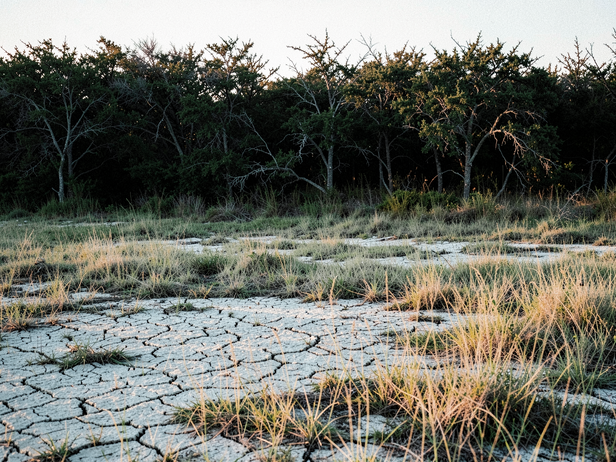
![Saline Dawn, Mesquite Wall]()
Saline Dawn, Mesquite Wall
Image credit : AI
Dawn light breaks over cracked saline soil, a stark contrast to the dense mesquite treeline, a common sight in Banni grasslands.
What the Maldharis Lost
The Maldhari pastoralists of Kutch have grazed cattle, buffalo, and sheep across Banni for centuries. The grassland was not wilderness in the Western sense, it was a working landscape, shaped by grazing and fire into something that sustained both the animals and the people who kept them. Banni's Kankrej cattle and Banni buffalo, both recognised breeds, are specifically adapted to the region's grasses, heat, and mineral-lean water. Their bodies are calibrated to that particular feed.
Prosopis juliflora produces pods that cattle and buffalo will eat when nothing else is available. This is sometimes cited as a benefit. The pods contain a neurotoxin, mimosine and related compounds, that causes a condition called equine and bovine neurological disease when consumed in quantity over time. Affected animals develop jaw paralysis, a progressive inability to chew, and eventually starve. Veterinary researchers documenting livestock in Banni have recorded the condition in animals whose diets shifted heavily toward juliflora pods as the grassland cover declined. The tree offered food and then disabled the mechanism for eating it.
For Maldhari families, the loss of grazing land has meant smaller herds, reduced milk yields, and in many cases the abandonment of pastoral livelihoods that had no urban equivalent waiting for them.
The Wildlife Calculus
Banni and the adjacent grasslands of the Rann of Kutch form critical habitat for the Indian wolf, the chinkara, the Indian fox, and, at the grassland's edge, the caracal and the striped hyena. The grassland bird community is exceptional: the great Indian bustard once moved through this landscape, and florican populations have been recorded in the region. All of these species depend, directly or through their prey base, on open ground.
Juliflora thickets do support some wildlife. Nilgai move through them. Certain raptors perch in them. But the specialist grassland species, the ones that cannot substitute a shrub thicket for open sightlines and low vegetation, have no alternative. The great Indian bustard requires unobstructed visibility to detect predators and to conduct its display flights. Dense Prosopis cover makes the landscape functionally invisible to the bird. Grassland-dependent invertebrates, which underpin the food web for small mammals and ground-nesting birds, decline sharply under closed canopy.
The transformation is not metaphorical. Ecological surveys in Banni have documented the shift in vegetation cover in measurable terms: juliflora now occupies a substantial fraction of what was open grassland within living memory, with estimates from different studies ranging from thirty to over fifty percent of the grassland area affected.
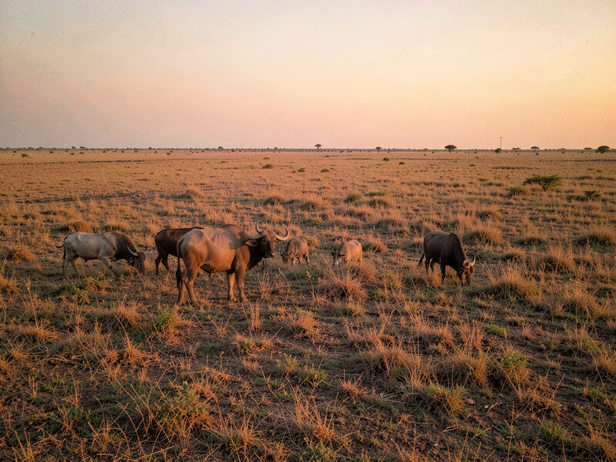
![Kutch Buffalo Dusk Grazing]()
Kutch Buffalo Dusk Grazing
Image credit : AI
I watch Indian buffalo graze on sparse grass in Kutch's Banni grasslands at dusk, bathed in warm amber light.
Why Removal Is Harder Than It Sounds
Prosopis juliflora coppices aggressively. Cut it at the stem and it sends up multiple shoots from the rootstock within weeks. Burn it and the heat-stimulated seeds in the soil germinate in the next rain. The tree produces tens of thousands of seeds per year, dispersed efficiently by cattle and wildlife that eat the pods and deposit them across the landscape. Its root system survives most mechanical removal attempts unless the entire rootstock is extracted, which at scale requires equipment and sustained effort that neither the Forest Department nor local communities have consistently been able to deploy.
Several removal programmes have been attempted in Banni. Some have cleared patches that then re-established within a few seasons. The most durable results have come from combining mechanical clearance with active re-seeding of native grasses and coordinated grazing management, giving the grassland something to come back to rather than leaving cleared ground open for re-invasion. These programmes are slow, expensive, and require the kind of institutional continuity that conservation projects in India rarely sustain across government cycles.
The charcoal and timber trade in juliflora wood has been proposed as an incentive for local removal. It creates a partial economic case for clearing the tree, though critics note it also creates an incentive to harvest without replanting natives, and the trade has at times moved faster than the restoration work that was supposed to follow it.
What the Banni Case Tells Us About Introduced Species
Prosopis juliflora is not unique in its trajectory. Lantana camara in Indian forests, water hyacinth in peninsular wetlands, and parthenium across roadsides follow the same pattern: introduced to solve one problem, ecologically unchecked because the predators and pathogens that regulate them in their native range are absent, and eventually more expensive to manage than the original problem they were planted to address. The difference in Banni is that the cost has been paid not just by wildlife but by a specific human community whose pastoral economy was directly tied to the land the tree displaced.
The Banni grasslands are not a pristine ecosystem waiting to be restored to a pre-human baseline. They were made by people and animals together over centuries. What Prosopis juliflora disrupted was not wilderness, it was a working relationship between a landscape, its livestock, and the families who understood both. That relationship is harder to replant than native grass.