By the time the baraat has left and the caterers are stacking trays, the real meal is just beginning for the animals outside. Street dogs press through the gate gaps. Cattle drift in from the roadside. What they find is not a windfall, it is a concentrated dose of everything their digestive systems were never built to handle.
The Gut Biology That Makes Rich Food Dangerous
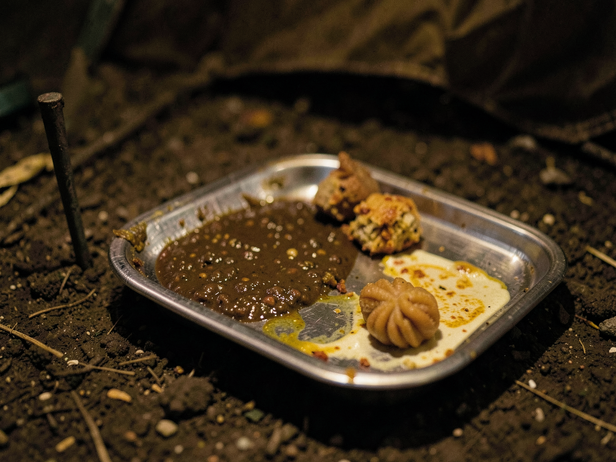
![Wedding Food Remnants on Ground]()
Wedding Food Remnants on Ground
Image credit : AI
Discarded Indian wedding food, including dal and curry, near a tent peg. Concerns arise regarding wedding food waste and its impact on street dogs.
Street dogs are facultative scavengers, meaning their digestive tracts can process a wide range of foods, but not without limits. Paneer, ghee-heavy dal makhani, cream-based curries, and deep-fried snacks spike fat intake far beyond what a street dog's liver can clear in a single sitting. Acute pancreatitis, a painful and sometimes fatal inflammation of the pancreas, is a documented consequence of sudden high-fat feeding in dogs. Veterinary studies in small-animal medicine consistently identify fatty meal ingestion as the leading dietary trigger. A dog that eats scraps from one wedding night may not show symptoms until 12 to 24 hours later, long after the shamiana has been dismantled.
Cattle face a different but equally serious risk. Ruminants, cows and buffaloes, ferment their food in a four-chambered stomach. When they consume large quantities of starchy wedding food, particularly rice, bread, and sweets, the fermentation process accelerates and produces gas faster than the animal can expel it. The result is bloat, technically called ruminal tympany, which can become life-threatening within hours if the rumen distends enough to compress the diaphragm. A cow grazing on shamiana leftovers is not eating a treat. She is loading her fermentation chamber with the wrong substrate.
What the Spices Actually Do
Indian wedding food is heavily spiced by design, cumin, chilli, garam masala, and asafoetida are used in quantities that make the food palatable and aromatic for humans. For street dogs, the same spice load irritates the gastric lining and can trigger vomiting, diarrhoea, and in repeated exposures, chronic gastritis. Onion and garlic, present in nearly every savoury wedding dish, contain thiosulphate compounds that damage red blood cells in dogs, causing haemolytic anaemia. A single large exposure is unlikely to be fatal, but dogs that return to the same venue over successive nights, as they do, because smell memory is precise, accumulate the exposure.
Sweets create their own problem. Mithai and gulab jamun carry concentrated sugar loads that street animals are not metabolically equipped to process efficiently. More dangerously, some caterers use xylitol as a sweetener in certain desserts, particularly those marketed as sugar-free. Xylitol is acutely toxic to dogs, triggering a rapid insulin release that causes hypoglycaemia and, in higher doses, liver failure. A dog cannot read the ingredient list.
The Behavioural Trap That Follows
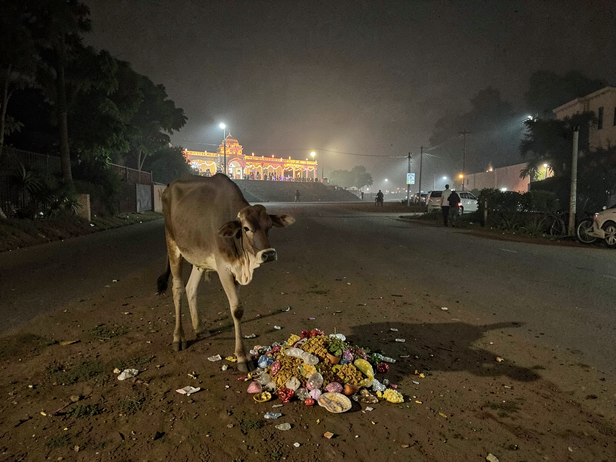
![Night Roadside, Wedding Leftovers, Stray Cow]()
Night Roadside, Wedding Leftovers, Stray Cow
Image credit : AI
A cow scavenges wedding food waste on an Indian roadside, highlighting the issue of shamiana leftovers.
Feeding events at a fixed location condition animals to return. Street dogs that find food at a wedding venue on a Saturday night will patrol that location for days afterward, often becoming territorial and aggressive toward each other. Packs that would otherwise range across a neighbourhood compress into a single block, which increases bite incidents among dogs and between dogs and late-night pedestrians. Animal behaviour research on free-ranging dogs in urban India has documented this clustering effect around irregular food sources, the animals are not being greedy, they are following learned reward geography.
Cattle that eat wedding leftovers and survive without visible illness often develop a habit of approaching lit venues and crowds, reducing their natural wariness of human gatherings. This makes them more likely to wander into traffic, particularly on the roads surrounding popular banquet halls and farmhouses where weddings run late into the night.
What Responsible Disposal Actually Looks Like
The gap between good intention and good outcome is narrow here. Leaving food out in a pile, even with the thought that it helps street animals, concentrates risk. Distributing cooked food in smaller portions across a wider area reduces the acute overload on any one animal. Plain boiled rice, plain roti without spice, and cooked vegetables without onion or garlic are genuinely safe for dogs in moderate amounts. For cattle, dry fodder placed away from the main food waste is far safer than cooked food access.
Several municipal corporations in cities with high wedding density, Jaipur, Lucknow, Surat, have piloted food recovery programmes that redirect edible surplus to registered animal shelters and gaushalas before it reaches the street. The food is assessed, portioned, and fed under supervision. The difference in animal health outcomes between supervised feeding and open shamiana scavenging is not marginal.
The animals outside the venue are not waiting for charity. They are waiting because the smell tells them something is there. What happens to them after depends entirely on what gets left, and how.