Fewer than 200 guide dogs are working in India right now. The country has an estimated 15 million people living with blindness, one of the largest such populations anywhere in the world, and a single functioning guide dog programme, run by the National Association for the Blind in Mumbai. That gap is not an oversight. It is the product of climate, infrastructure, culture, and biology, all pressing against each other at once.
Why Guide Dogs Are So Rare Here
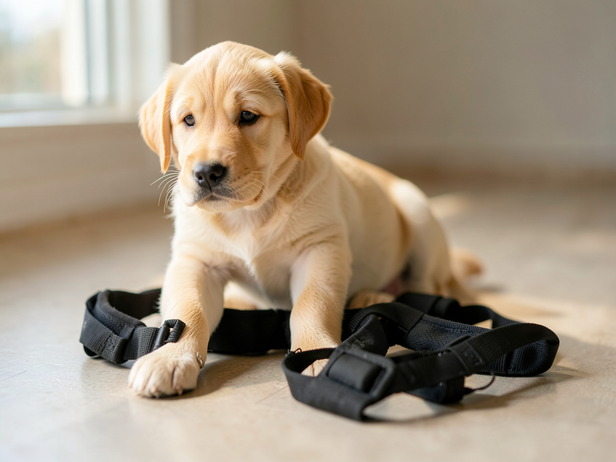
![Puppy and Harness]()
Puppy and Harness
Image credit : AI
Future guide dog in training, a yellow Lab puppy beside its harness. Exploring the world of guide dogs in India.
The breeds that dominate guide dog work globally, Labrador Retrievers, Golden Retrievers, German Shepherds, were developed in temperate climates. Their double coats and metabolic rates make sustained outdoor work in Mumbai in May, or Chennai in August, genuinely punishing. Heat stress is not a training problem; it is a physiological one. Some programmes have experimented with Labradors selectively bred for warmer conditions, but the stock takes generations to stabilise.
Then there is the infrastructure. Guide dog training assumes a handler will encounter kerbs, crossings, and pavements that behave in predictable ways. Indian cities offer broken footpaths, open drains, motorbikes on pedestrian paths, and intersections where traffic signals are advisory at best. A dog trained on a quiet campus in a hill station faces a genuinely different environment on a Bengaluru street. The NAB Mumbai programme runs urban exposure walks specifically because the gap between training ground and real city is so wide.
The training pipeline itself is long. A guide dog takes roughly two years to produce: socialisation with a puppy walker from six weeks, formal obedience and harness work from around fourteen months, then the matching and bonding phase with the handler. Each trainer can manage only a small number of dogs at once. With one programme, the numbers stay small by arithmetic alone.
What the Matching Process Involves
A handler does not simply receive a dog. The NAB programme runs a residential course, typically three to four weeks, where the handler and the dog learn each other's pace, turning radius, and communication style. Guide dogs work on what trainers call intelligent disobedience, the dog is trained to refuse a command if obeying it would put the handler in danger. Teaching a handler to trust that refusal, and to understand when the dog is signalling rather than stalling, takes most of that month.
Matching considers the handler's walking speed, their daily route, their home environment, and whether they live alone. A fast walker paired with a slow dog produces friction. A handler whose building has an unreliable lift needs a dog comfortable with stairs and waiting. These are not preferences; they are functional requirements that determine whether the partnership works at all.
A Handler's Day, From the First Alarm
![Indian City Street at Dawn]()
Indian City Street at Dawn
Image credit : AI
Dawn's golden light bathes a busy Indian street, hinting at the daily life of visually impaired assistance dogs in India.
The day starts before the handler leaves the house. The dog is fed on a fixed schedule, guide dogs are almost always meal-fed rather than free-fed, because a dog with a predictable digestive schedule is a dog whose bathroom needs can be planned around a commute. The harness goes on only when work begins; off-harness time is the dog's signal that it is not navigating, and that boundary matters for the dog's ability to switch focus.
On the street, the dog is reading ahead. Labradors, the most common breed in the programme, have a field of vision of roughly 250 degrees and process motion at the periphery faster than humans do. The dog is not memorising a route; it is responding to the handler's directional commands while simultaneously tracking obstacles, drop-offs, and moving hazards. The handler learns to feel the dog's body language through the harness handle, a slight lean, a pause, a body block, rather than waiting for a visible cue.
Public transport is its own negotiation. Indian law, under the Rights of Persons with Disabilities Act 2016, grants guide dog handlers the right to enter public spaces with their dog. In practice, bus conductors, metro staff, and shopkeepers often do not know this. Handlers carry documentation. Many carry it laminated. The conversation about whether the dog is allowed happens, on average, several times a week.
The Dog's Working Life and What Comes After
A guide dog typically works from around eighteen months to eight or nine years of age, depending on health and the demands of the handler's environment. Urban work in a high-traffic city ages a dog faster than a quieter posting. Retirement does not mean the dog disappears, many handlers keep their retired dog as a pet and receive a new working dog, though the emotional complexity of that transition is real and the NAB programme provides support through it.
The retired dog still knows the harness. Handlers report that putting it on a retired dog, even years later, produces an immediate posture change, the dog squares up and looks forward. The behaviour is so ingrained it does not fully switch off. That is both a testament to the training and a reminder of how completely the work becomes part of what the dog is.
The shortage of guide dogs in India is not going to resolve quickly. It requires more breeding infrastructure, more trainers, more public awareness of handler rights, and city design that does not treat a footpath as optional. What exists now, one programme, fewer than two hundred working teams, is kept alive by the people inside it. The partnership between a handler and a guide dog is one of the more precisely engineered relationships in working animal history. In India, it is also one of the rarest.