Wular Lake in Bandipora district once spread across roughly 260 square kilometres. Today, depending on the season and the survey, that figure sits somewhere between 80 and 130 square kilometres. The rest has become reed beds, agricultural encroachments, and shallow mud flats that dry out in summer. Hokersar, a Ramsar-designated wetland on the outskirts of Srinagar, has lost more than half its open water area over the past five decades. These are not slow, invisible changes. Fishermen who worked the same channels as their fathers now pole through stands of Phragmites reed where there was open water a generation ago.
What Siltation Actually Does to a Wetland
Siltation is the accumulation of fine sediment, sand, clay, and organic matter, carried by rivers and streams into a standing body of water. In a healthy watershed, forests slow runoff and root systems hold soil in place. When those forests are cleared, as they have been across the Jhelum catchment and the surrounding hills, rainfall picks up sediment and delivers it directly into the lake or wetland at the bottom of the slope.
Once silt settles, it raises the bed of the water body. Shallow areas become shallower still. Aquatic plants colonise the new substrate, accelerating the process through a mechanism ecologists call autogenic succession, the wetland begins converting itself into marsh, and marsh into terrestrial land, faster than it would under natural conditions. The water column shrinks in depth and area. Dissolved oxygen levels fall in the remaining water because decomposing organic matter in the silt consumes it. Fish populations that depend on depth, cool temperature, and oxygen, the Schizothorax species, locally called snow trout, that are native to Kashmir's lakes, decline first.
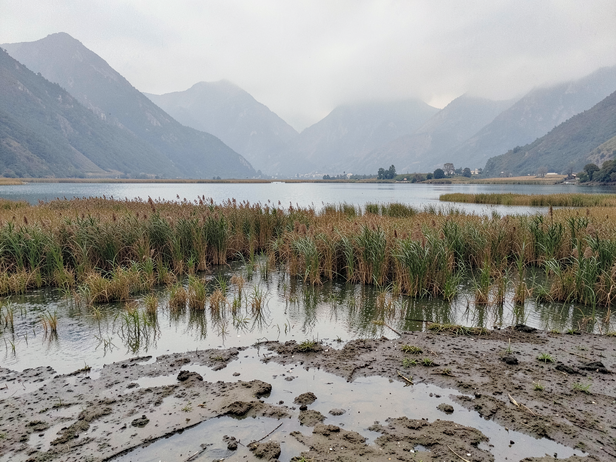
![Himalayan Wetland Dawn]()
Himalayan Wetland Dawn
Image credit : AI
I witness the siltation of this Himalayan wetland, a vital habitat for migratory birds.
What the Birds Lose at Hokersar
Hokersar sits at a critical node on the Central Asian Flyway, the migratory route that connects breeding grounds in Siberia and Central Asia to wintering sites across the Indian subcontinent. At its peak, the wetland hosted between 300,000 and 400,000 waterfowl in a single winter season, bar-headed geese crossing the Himalayas, common teal, northern pintail, ferruginous duck, and the greater white-fronted goose among them. The Bombay Natural History Society documented 21 species of migratory waterfowl using Hokersar regularly.
What migratory birds need from a stopover wetland is specific: open shallow water for feeding, undisturbed reed margins for roosting, and aquatic invertebrates in sufficient density to refuel depleted fat reserves. Siltation compromises all three. As the bed rises, open water shrinks. Reed encroachment reduces the ratio of open water to vegetation, which suits some species but eliminates the feeding habitat that diving ducks and dabbling ducks require. When the invertebrate community collapses, because the oxygen-depleted silt cannot support the chironomid larvae and molluscs that waterfowl feed on, birds either move on without adequate refuelling or do not return the following season.
The Wular Fishery and the Communities Around It
Wular is not only an ecological system. It is the livelihood base for fishing communities across Bandipora, Sopore, and the surrounding villages. The lake supports commercial fisheries for rohu, carp, and the native Schizothorax, and its margins have historically provided water chestnut and lotus rhizome harvesting. As siltation has reduced the lake's productive area, catch volumes have fallen and the fishing grounds that remain are more intensively worked, which compounds the pressure on already stressed fish populations.
The Jhelum River, which both feeds Wular and drains from it, carries an estimated several million tonnes of sediment annually into the lake system, a figure that has increased as construction activity, road-building, and land clearance in the catchment have accelerated. The lake also serves a flood-buffer function for the Kashmir Valley, its capacity to absorb Jhelum floodwater has diminished in direct proportion to its shrinking volume, a connection made visible during the catastrophic 2014 floods.
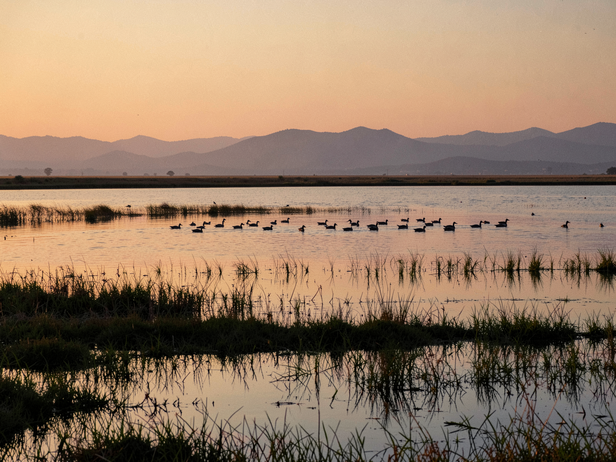
![Waterfowl Descend at Dusk]()
Waterfowl Descend at Dusk
Image credit : AI
I observe waterfowl landing on the tranquil wetland, a scene reflecting the beauty of Hokersar wetland migratory birds.
What Restoration Requires
Dredging is the most commonly proposed intervention, and it has been attempted at Hokersar in limited form. The Wetlands (Conservation and Management) Rules, 2017, brought both lakes under a regulatory framework that restricts encroachment and certain extractive activities. The National Lake Conservation Plan has included Wular in its portfolio. But dredging addresses the symptom without touching the cause. As long as the catchment continues losing forest cover and as long as construction debris and agricultural runoff enter the Jhelum and its tributaries unimpeded, the sediment load will replace whatever is removed.
The biological literature on wetland restoration is consistent on one point: catchment management, reforestation, erosion control, regulation of upstream land use, produces more durable outcomes than in-lake intervention alone. The Wildlife Institute of India has conducted ecological assessments of both Wular and Hokersar that point in this direction. Restoration is possible, but it requires treating the watershed as a single system rather than managing the lake as an isolated problem at the end of a degraded catchment. What Wular and Hokersar have lost in area and depth, they can partially recover. What the migratory birds lose each season they do not return is harder to measure and slower to come back.