The moment a working animal goes lame, the instinct is to look at the leg. The leg is usually the last place the problem started.
Breakdown in bullocks and horses used for draft or load-bearing work follows a chain of mechanical events that begins well before any visible injury. Three variables drive that chain: the weight and distribution of the load, how the harness sits on the animal's body, and what the ground is doing underfoot. Each factor is damaging on its own. Together, they compound in ways that are not simply additive.
How Load Magnitude and Distribution Stress the Musculoskeletal System
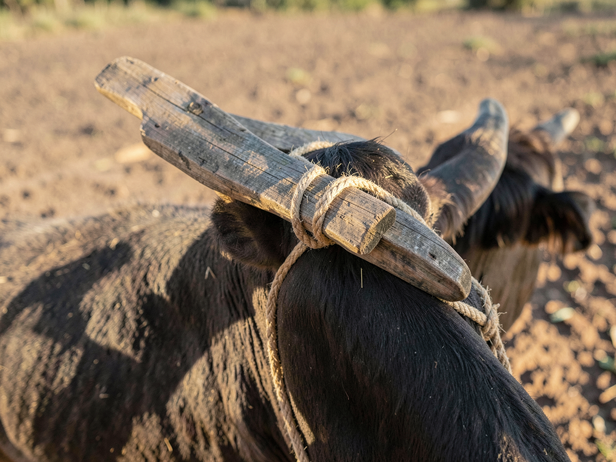
![Bullock Yoke, Morning Light]()
Bullock Yoke, Morning Light
Image credit : AI
Traditional wooden yoke on a working bullock, showcasing the harness fit for draft animal work. Soft morning light.
A bullock's draft capacity is roughly 10 to 15 percent of its body weight for sustained work over several hours, a figure that varies with breed, age, conditioning, and ambient temperature. Horses in draft work operate under similar proportional limits, though their skeletal geometry differs considerably from bovines. When loads exceed this threshold consistently, the damage does not announce itself immediately. It accumulates in the tendons, the navicular structures in horses, and the fetlock and coffin joints in both species before anything is visible from the outside.
Distribution matters as much as magnitude. A load that is heavier at the rear of a cart shifts the tongue weight downward onto the animal's back and withers rather than distributing it forward through the traces. This changes the angle at which the harness collar or yoke presses against the neck and shoulder. In bullocks working under a traditional wooden yoke, an unbalanced load concentrates pressure on one side of the neck crest, producing asymmetric muscle fatigue and, over time, asymmetric gait. An asymmetric gait is a breakdown in slow motion.
The surface area over which a load is transferred also determines whether soft tissue or bone absorbs the stress. A narrow trace or a poorly padded collar concentrates force into a small region of muscle and skin. The underlying tissue, repeatedly compressed and released with each stride, loses blood supply, begins to break down, and eventually produces the collar galls and pressure sores that mark overworked draft animals across India's agricultural districts.
Harness Fit: Where Force Goes When the Geometry Is Wrong
A correctly fitted collar on a horse sits flush against the shoulder blades and the muscles of the lower neck, transferring draft force through the skeletal frame rather than the soft tissue. When the collar is too wide, it drops onto the windpipe under load. When it is too narrow, it pinches the point of the shoulder and restricts the forward reach of the foreleg with every stride. Either error means the animal is working against its own harness.
Bullocks in Indian agricultural and transport contexts most commonly work under a neck yoke rather than a breast collar or fitted horse collar. The yoke rests across the neck crest and is held in place by the dewlap and, in many traditional designs, by a simple rope or wooden pin. There is no adjustment for the individual animal's neck width or height. A yoke that sits too low slides onto the trachea under load. One that sits too high shifts the draft angle upward, reducing the efficiency of the pull and forcing the animal to pitch its weight forward to compensate, loading the forelimbs disproportionately.
Girth and surcingle fit produces a parallel problem further back. A girth that is too tight restricts the full expansion of the ribcage during exertion. A girth that is too loose shifts laterally under load, creating intermittent pressure points that bruise the skin and underlying tissue. In horses, a too-tight girth combined with a heavy load compresses the intercostal muscles, reduces respiratory efficiency, and accelerates fatigue in a way that looks, from the outside, like a fitness problem rather than an equipment problem.
Traces that are set at the wrong angle relative to the animal's point of shoulder direct the pull either upward or downward from the optimal horizontal line. An upward pull lifts the front of the cart and loads the hindquarters. A downward pull digs the collar into the chest and restricts forward movement of the forelimbs. Neither is neutral. Both accelerate wear on specific joints and muscle groups depending on which direction the angle runs.
Road Surface and What the Ground Does to Every Stride
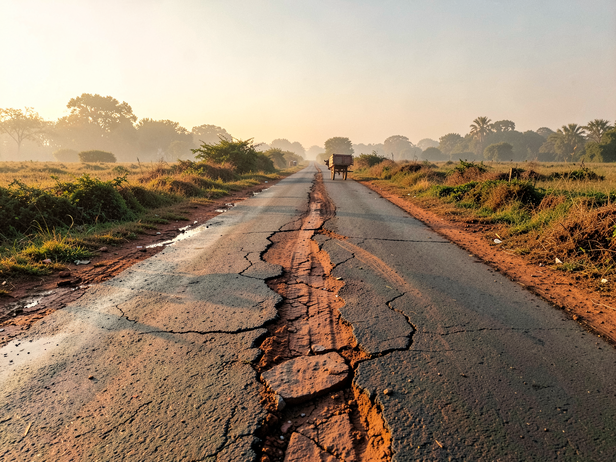
![Rural Indian Road Texture]()
Rural Indian Road Texture
Image credit : AI
Golden light on a rural Indian road, highlighting the transition from wet clay to broken tarmac. Consider the impact of road surface on draft animal harness fit.
A horse or bullock moving on a firm, even surface lands each foot predictably. The hoof or cloven foot strikes, the fetlock drops to absorb impact, the tendons load and release, and the animal moves forward. The system is designed for this sequence. What it is not designed for is the variation that characterises real working conditions across rural and peri-urban India: broken tarmac, laterite gravel, waterlogged clay, and the transition zones between them that can change within a single kilometre.
Soft, deep surfaces such as wet clay or loose sand increase the muscular work of each stride by forcing the animal to pull its foot clear of the ground rather than simply lifting it. Studies in equine biomechanics have documented that moving through deep going increases the metabolic cost of locomotion by a measurable margin and places higher peak loads on the superficial digital flexor tendon, the structure most commonly involved in breakdown in horses doing sustained work. Bullocks working waterlogged paddy field edges show analogous stress patterns in the deep digital flexor and the structures of the cloven hoof.
Hard, uneven surfaces present a different failure mode. A broken road surface or a surface with loose stones creates unpredictable foot placement. The animal cannot pre-load its limb correctly for the next stride because the landing point is uncertain. This produces micro-adjustments in joint angle that, repeated thousands of times over a working day, accumulate as low-grade inflammation in the coffin joint and the navicular region in horses, and in the pedal bone and sole of the hoof in bullocks. The animal does not appear lame. It appears slightly reluctant, slightly slower. By the time it appears lame, the inflammation has had weeks to develop.
The transition between surfaces is often more damaging than either surface alone. Moving from soft ground onto hard tarmac changes the impact force on the hoof within a single step. The limb that was calibrated for soft going suddenly meets a surface with no give, and the excess force travels up through the hoof wall, the joints, and into the tendons and ligaments above. Animals that regularly cross between road types, as most working animals in mixed rural-urban routes do, are exposed to this transition repeatedly.
When the Three Factors Combine
An overloaded animal on a broken road surface with a poorly fitted harness is not experiencing three separate problems. It is experiencing one compounded problem in which each factor removes the margin that would otherwise allow the animal to compensate for the other two.
A well-fitted harness allows the animal to use its skeletal structure efficiently even under a heavy load. A good road surface allows the musculoskeletal system to work predictably even when the harness is imperfect. A moderate load allows the animal to manage both a difficult surface and a less-than-ideal harness without accumulating damage fast enough to cause breakdown. Remove any one of those compensating margins and the system becomes fragile. Remove all three and breakdown is not a risk, it is a schedule.
Veterinary practitioners working with working equines and bovines in India, including those associated with organisations such as the Brooke India network, consistently identify harness-related pressure sores, gait asymmetry from yoke misfit, and tendon stress from hard or uneven surfaces as the primary precursors to the lameness and exhaustion that end a working animal's useful life early. The intervention that extends that life is almost never a treatment. It is a correction made before the animal shows symptoms.
What a Handler Can Actually Check
The load question has a practical answer: if two adults cannot lift the load between them without significant effort, it warrants reassessment against the animal's body weight and the distance and surface of the intended route. This is not a precise calculation, but it establishes an order of magnitude.
Harness fit is checked at rest and then rechecked after five minutes of work, because harness settles under load and a fit that seems adequate at the start of the day may be compressing soft tissue by mid-morning. The test for a collar is whether two fingers can slide between the collar and the windpipe at the lower edge, and between the collar and the point of shoulder at the side. For a yoke, the check is whether the yoke sits on the neck crest without pressing down onto the trachea when the animal lowers its head to pull. A yoke that forces the animal to carry its head high to breathe is a yoke that is fitting the wrong part of the neck.
Surface assessment is the variable handlers have least control over, but the response to a bad surface is within their control: slow the pace, reduce the load, and where the surface changes abruptly, lead the animal across the transition rather than driving it through at working speed.
The three factors that break a working animal down are also the three factors that, managed together, keep one working. The breakdown is mechanical. So is the prevention.