The Indian Army's Remount and Veterinary Corps runs one of Asia's largest military dog programmes, with units deployed across counter-insurgency operations in Kashmir, border surveillance along the Line of Actual Control, and disaster response through the National Disaster Response Force. These are not companion animals with basic obedience. They are working animals whose training begins at eight weeks and whose operational careers typically span seven to nine years.
The Breeds and Why Each One Was Chosen
![Alert Canine Companions]()
Alert Canine Companions
Image credit : AI
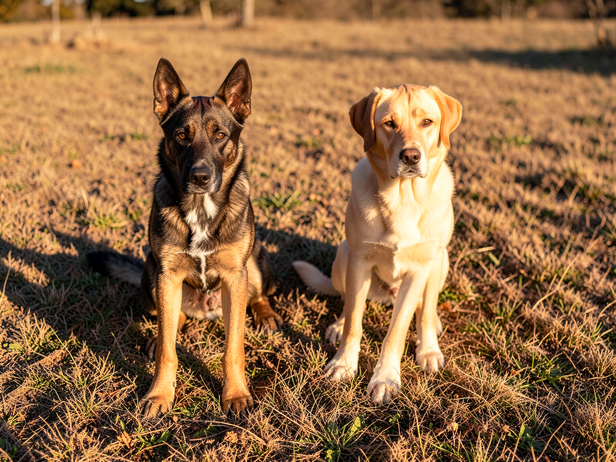
Two alert dogs, a Belgian Malinois and Labrador, in golden light. Ideal for showcasing breeds like those in Indian Army dog units.
The Belgian Malinois is the most widely deployed breed in Indian Army canine units, and the reason is physiological. Malinois have a prey drive, the neurological compulsion to chase, bite, and hold, that sits at a level almost no other breed sustains reliably under stress. In high-altitude operations in Siachen and the Kashmir Valley, where handlers and dogs operate at temperatures below minus twenty degrees Celsius, the Malinois maintains focus in conditions that disorient most working breeds. Their muscle-to-body-weight ratio is higher than the German Shepherd's, which means they cover ground faster and tire later.
The German Shepherd remains in service for tracking and patrol roles, particularly in lower-altitude postings. Their olfactory receptor count, estimated at around 225 million compared to a human's five million, makes them effective trackers over distances where scent trails have aged by several hours. The Indian Army also deploys Labrador Retrievers specifically for explosive detection. Labradors carry a genetic trait that suppresses the satiation signal in their hypothalamus, meaning they remain food-motivated across longer working sessions. Detection training exploits this directly: the dog learns that the odour of a target explosive predicts a food reward, and the drive to find that reward does not diminish the way it would in a breed with normal appetite regulation.
Cocker Spaniels are used in a narrower role: searching confined spaces, vehicles, and baggage in counter-terrorism operations. Their smaller frame allows access to spaces a Malinois or Shepherd cannot enter, and their scenting ability is comparable on a per-receptor-density basis.
What the Training Actually Involves
Military dog training in India is conducted primarily at the Army Dog Unit in Meerut, which falls under the Remount and Veterinary Corps. The foundation phase, running roughly twelve to sixteen weeks, establishes obedience and handler bonding. What follows is specialisation, and the path depends entirely on the individual dog's aptitude scores, not the breed alone.
Explosive detection dogs go through odour imprinting on a library of target compounds, RDX, PETN, ammonium nitrate mixtures, under controlled conditions before being introduced to those compounds in field scenarios. The dog is never trained to alert on a single explosive; the training builds a scent picture of a category, so an improvised device using an unfamiliar mixture still triggers a response if it shares chemical family markers with the training library.
Patrol and attack dogs train on bite work using a sleeve and later a full-body suit, but the more demanding part of their conditioning is environmental: exposure to gunfire, crowd noise, helicopter rotor wash, and darkness, repeated until the stimulus produces no stress response. A dog that hesitates when a rifle fires next to it is a liability in a contact situation. Desensitisation is not a single session. It is hundreds of controlled exposures across months.
Tracker dogs work on aged trails, scent left by a person who passed through hours earlier, because fresh-trail tracking is relatively straightforward for most working breeds. The operational requirement is usually a cold trail in terrain that has had wind, rain, or foot traffic pass through it. Training simulates those conditions deliberately.
What Retirement Looks Like, and What It Has Looked Like
![Empty Military Kennel Corridor]()
Empty Military Kennel Corridor
Image credit : AI
An evocative scene of an empty military kennel corridor, bathed in warm light, hinting at the presence of dedicated Indian Army dog units.
For most of the Indian Army's history, military working dogs were euthanised at the end of their service careers. The official rationale was that a dog trained to bite on command and conditioned to high-stress environments could not safely be rehomed into a civilian household. This was not an unreasonable concern on its face, a Malinois with eight years of patrol training is not a pet in any conventional sense, but it became the default answer rather than a considered one.
That position has shifted under public pressure and internal advocacy from within the veterinary corps. The Army now operates a formal retirement protocol that evaluates each dog individually before a decision is made. Dogs assessed as rehomeable, typically those in detection roles whose bite work conditioning is limited, are offered first to their handlers. A handler who has worked with the same dog for four or six years and wants to take the animal home is the best possible outcome: the dog moves into a familiar attachment, with a person who understands its triggers and its needs.
Dogs that cannot be safely rehomed into civilian life, because their drive levels and conditioning make them genuinely dangerous outside a structured environment, are now retired to kennel facilities rather than euthanised where that is logistically possible. The programme is uneven across commands, and the infrastructure for long-term retired-dog care is not yet standardised across all units. But the shift in policy direction is real.
The Handler Relationship and What It Means Biologically
Military dog handlers and their animals develop what behavioural scientists call a secure attachment, the same category of bond measured between human caregivers and infants. Research published through veterinary behaviour programmes has documented that military working dogs show cortisol spikes when separated from their primary handler that are not triggered by separation from other familiar humans. The dog does not generalise the bond; it is specific to one person.
This has practical consequences for retirement. A dog separated from its handler after years of exclusive partnership enters a state of chronic stress that looks, behaviourally, like grief: reduced appetite, disrupted sleep, hypervigilance, and in some cases self-directed behaviours like repetitive pacing. Handlers who have fought to take their dogs home at retirement are not being sentimental. They are preventing a welfare crisis the dog has no language to report.
The Indian Army's movement toward handler-first adoption at retirement is, in part, a recognition of this biology. It is also, practically, the cheapest and most effective retirement outcome available, no kennel costs, no rehoming risk, no retraining required.
What the Civilian World Can Learn From Military Dog Welfare
The Indian Army's evolving approach to canine retirement sits inside a broader shift in how working-dog welfare is understood globally. The same principles apply to police K9 units run by state forces across India, to detection dogs used by customs and the CISF at airports, and to search-and-rescue animals deployed by the NDRF. Each of those programmes faces the same end-of-career question the Army has been slow to formalise.
The answer that is emerging, assess individually, prioritise handler adoption, provide structured retirement where rehoming is not safe, is not complicated. It requires administrative will more than resources. A dog that spent a decade finding explosives on the roads of Manipur or tracking militants through the forests of Chhattisgarh has done something most animals are never asked to do. The question of what it is owed at the end of that service has a straightforward answer. The infrastructure to deliver it is catching up.