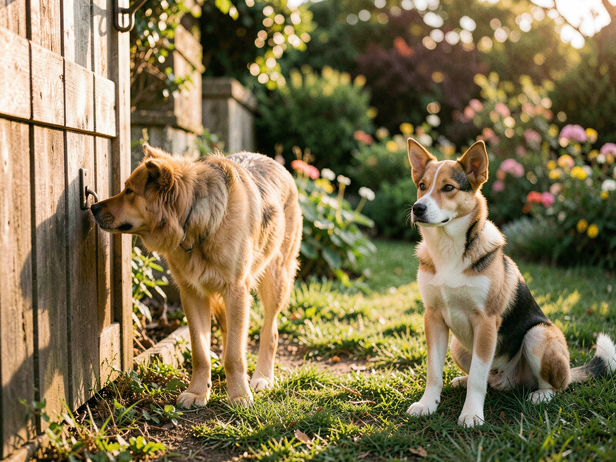
A dog watches another dog nudge a gate latch with its nose. Thirty seconds later, the watching dog walks over and tries the same thing. No treat was offered. No cue was given. The behaviour transferred through observation alone, and that single fact has reshaped how researchers think about canine cognition.
The Do-As-I-Do Foundation
![Canine Curiosity at the Gate]()
Canine Curiosity at the Gate
Image credit : AI
A moment of canine observation. The dog at the gate exhibits curiosity, while its companion demonstrates focused attention, a glimpse into social learning in dogs.
Ádám Miklósi and his colleagues at Eötvös Loránd University in Budapest demonstrated in a series of experiments that dogs can imitate specific actions on command using a protocol called Do As I Do. A trained demonstrator dog performs an action, touching a yellow pail with a paw, circling a cone, and the observer dog, after a short delay, reproduces it. The finding held even after intervals long enough to rule out simple stimulus enhancement, where the observer is merely drawn to the same object rather than copying the method. Dogs were reproducing the action itself, not just the destination.
What makes this biologically interesting is that true imitation, copying the form of an action, not just its outcome, was once considered a marker of higher cognition reserved for great apes and a handful of corvids. Dogs do it reliably, and they do it across the human-dog divide as well: they imitate people with similar fidelity to how they imitate other dogs.
What Actually Transfers, and What Does Not
Social learning in dogs breaks into at least three distinct mechanisms, and conflating them leads to real confusion about what a dog is capable of picking up.
Stimulus enhancement is the most basic: one dog's activity draws another dog's attention to an object or location, increasing the chance the second dog investigates it independently. A dog sniffing a particular corner of a garden makes that corner more salient to any dog watching. No copying of method is involved.
Local enhancement is a step up: one dog's presence in a location increases the probability the observer goes there too. Pack movement through terrain works largely on this principle.
True imitation, copying the specific motor sequence, is the most cognitively demanding and the most studied. It requires the observer to encode what the demonstrator did, hold it in working memory, and then reproduce it with their own body. Dogs can do this, but the conditions matter. The observer needs to be attending to the demonstrator, not distracted by a scent trail or another stimulus. The action needs to be within the observer's physical repertoire. And the delay between demonstration and opportunity cannot be too long without rehearsal, canine working memory for this kind of procedural encoding is real but not deep.
The Role of the Human in the Room
![Focused Dog Training Session]()
Focused Dog Training Session
Image credit : AI
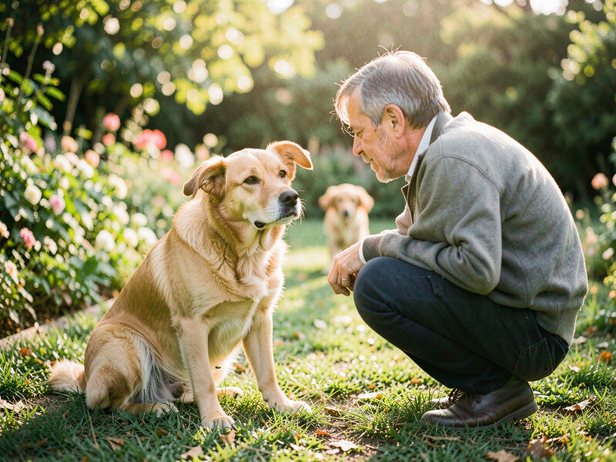
Observational learning in dogs: A focused training session highlights canine cognition and imitation behaviour.
One finding that surprises most dog owners: dogs are more likely to copy a behaviour demonstrated by a human than the same behaviour demonstrated by another dog, when the human is someone they know and trust. The social bond appears to function as an attention amplifier. A familiar person performing an action focuses the dog's observation in a way a stranger dog often does not.
This has a practical implication for multi-dog households. The assumption that a well-trained resident dog will automatically model good behaviour for a new arrival is only partly supported. The new dog may attend more to the owner's cues than to the resident dog's behaviour, particularly in the early weeks before a social hierarchy has settled. Relying on the resident dog as the primary teacher is likely to produce slower results than direct training of the newcomer alongside the resident.
Where Social Learning Stops
The limits are as instructive as the capabilities. Dogs do not appear to engage in what researchers call emulation, understanding the goal behind an action and finding their own method to achieve it. They copy the method or they do not copy at all. This means a dog that watches another dog open a push-door by shouldering it will try shouldering, not experiment with alternatives if shouldering fails.
Emotional states transfer more readily than most owners expect, and this is where social learning shades into something closer to contagion. A dog in a state of high arousal or fear raises the arousal level of dogs around it through posture, vocalisation, and scent, not through any deliberate teaching. A chronically anxious resident dog can elevate baseline stress in a new dog through this mechanism without either dog being aware of it. The new dog is not learning anxiety as a behaviour; it is being kept in a physiological state that makes anxiety responses more likely. The distinction matters for how an owner addresses the problem.
What This Means for Training
Social learning is a tool, not a shortcut. A dog that watches a trained companion receive a reward for sitting is more likely to sit, but only if the observer was watching at the moment of the reward, and only if sitting is already in its behavioural vocabulary. Dogs do not reverse-engineer a behaviour they have never performed by watching it rewarded in another dog. The observation accelerates acquisition; it does not replace it.
The most reliable use of a demonstrator dog in training is as a prompt, not a teacher. The demonstrator performs the behaviour, the reward lands visibly, and the observer's attention is then redirected to the trainer for its own attempt. Leaving the observer to simply watch and absorb, without a structured opportunity to try, wastes the window of heightened attention that the demonstration opened.
Dogs are social animals whose nervous systems are calibrated to extract information from the behaviour of others. That calibration is real and it is useful. It is also specific, bounded, and dependent on attention, memory, and physical capacity in ways that make it something to work with deliberately rather than assume passively.