Mahua trees drop their flowers by morning, Semal blooms open in February darkness, and banana flowers hang heavy through the night, and almost nobody notices who is actually doing the work. The pollinators keeping these plants productive are not the ones on any school poster. They fly after midnight, navigate without eyes, and drink from flowers shaped specifically to exclude everything else.
Why Some Flowers Only Open at Night
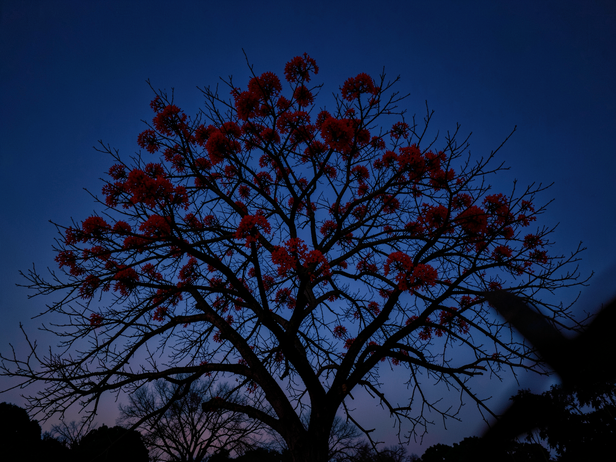
Nocturnal flowers are not simply daytime flowers that forgot to close. They are built around a different set of visitors. Mahua (Madhuca longifolia) produces flowers with a thick, fleshy, sugar-rich corolla that falls whole to the ground by dawn, a trait that makes sense only if the pollinator is visiting in the hours before that. The flowers are cream-white, strongly fragrant, and produce nectar in quantities that would be wasteful if aimed at a small insect. Semal, the silk-cotton tree (Bombax ceiba), opens its large red flowers in the cold dry months when most insects are inactive. Banana inflorescences (Musa species, particularly wild and semi-wild varieties) release pollen and accept it through the night, with the protective bracts lifting in sequence after dark.
![Pre-dawn Semal Bloom]()
Pre-dawn Semal Bloom
Image credit : AI
I observe the Semal tree's nocturnal pollination, a bat silhouetted against the pre-dawn sky.
How Bats Find and Fertilise These Flowers
The bats doing this work in India belong primarily to the family Pteropodidae, the Old World fruit bats, sometimes called flying foxes. Species such as the Indian flying fox (Pteropus giganteus) and the short-nosed fruit bat (Cynopterus sphinx) are the principal nocturnal pollinators of Mahua and Semal across peninsular India. They locate flowers through smell first, then memory of productive trees, and in some species through low-frequency calls that are closer to social communication than the high-frequency echolocation used by insectivorous bats. A fruit bat arriving at a Mahua flower pushes its face into the corolla to reach nectar, and pollen from the stamens coats the fur on its forehead and muzzle. When it visits the next tree, that pollen transfers. Because bats range several kilometres in a single night, they move genetic material between trees that no bee could connect. A study tracking Cynopterus sphinx in South Asia found individuals visiting dozens of trees across multiple kilometres in one foraging bout, a pollination radius no diurnal insect approaches.
The Hawkmoth's Precision Hover
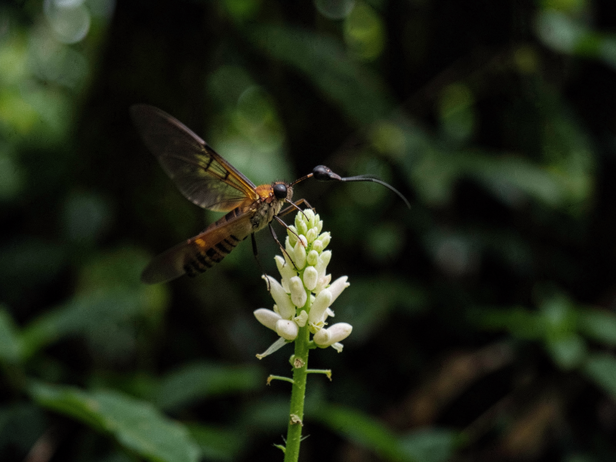
Hawkmoths (family Sphingidae) are the other major player in India's nocturnal pollination system. They are large, fast, and capable of sustained hovering, a behaviour that is energetically expensive and rare among insects. Species such as Agrius convolvuli and several Theretra species are active at dusk and through the night. Their proboscis, which can exceed the length of their body in some species, reaches nectar at the base of long tubular flowers. This is not a coincidence of anatomy. Flowers pollinated by hawkmoths, a syndrome botanists call phalaenophily when moths are the agent, tend to be white or pale yellow, strongly scented at night, and structured so that a hovering visitor at a specific distance will contact both the stigma and the anthers. The banana plant, particularly wild Musa species and traditional cultivated varieties that retain some seed fertility, fits this profile closely. Hawkmoths visiting banana flowers at night pick up pollen on their head and thorax and carry it between plants with a consistency that wind pollination cannot match in a forest understorey where air movement is minimal.
![Moth drinks from flower]()
Moth drinks from flower
Image credit : AI
I witness nocturnal pollination as a hawkmoth feeds from a pale flower in the dark forest.
What Happens When the Night Shift Disappears
Bat populations in India face pressure from habitat loss, hunting in some regions, and the felling of large old trees that serve as roost sites. Hawkmoth larvae depend on specific host plants, Agrius convolvuli larvae feed on morning glory and related species, so agricultural simplification that removes host plants from field margins reduces adult moth populations the following season. The consequences for the plants are not always immediate or visible, but they are measurable. Mahua is economically significant across central and eastern India: its flowers are eaten, fermented, and sold, and its fruit produces an edible oil. Tribal communities in Chhattisgarh, Jharkhand and Odisha depend on the flower harvest. A reduction in bat pollination does not kill Mahua trees, but it reduces fruit set, which reduces seed production and regeneration of the next generation of trees. Semal's cotton-like seed dispersal depends on successful pollination producing viable seeds inside those capsules. Banana varieties that retain partial seed fertility, important for breeding programmes and for wild relatives that anchor forest understorey ecology, become genetically isolated when their nocturnal pollinators thin out. The night shift is not a backup system. It is the primary system for these plants, and it has no daytime substitute.
Mahua, Semal and banana did not evolve to wait for bees. They evolved to be ready when the bats came in, when the hawkmoths lifted off the bark and began to move through the dark. The relationship is old enough that the plants have shaped their chemistry, their architecture and their timing around animals most people never see. Protecting the roost tree of a flying fox or the hedgerow where a hawkmoth larva overwinters is, in a direct biological sense, protecting the flower harvest that follows.