The first bar-headed geese appear over Bharatpur before most farmers have finished harvesting their kharif rice. They descend in loose skeins, trading altitude for the smell of standing water and cut grain, and within a week the field edges are loud with them. What looks like a seasonal spectacle is, underneath, a feeding contract written in crop cycles, soil temperature, and the physics of long-distance flight.
The Indo-Gangetic Plain as a Flyway Corridor
The Central Asian Flyway runs from Siberia and Central Asia down through Afghanistan, Pakistan, and into the Indian subcontinent, and the Indo-Gangetic Plain sits directly across its southern reach. Birds using this route, demoiselle cranes, greater white-fronted geese, common cranes, Eurasian wigeons, pintails, are not wandering. They are following a corridor shaped by prevailing winds, river systems, and the location of wetlands that have existed for millennia. The plain's flat topography and its dense network of canals, jhils, and seasonal floods make it one of the most reliable refuelling stops on the flyway. Bharatpur's Keoladeo National Park in Rajasthan and the Harike wetlands in Punjab are the most studied nodes, but the actual feeding ground extends across millions of hectares of ordinary agricultural land between them.
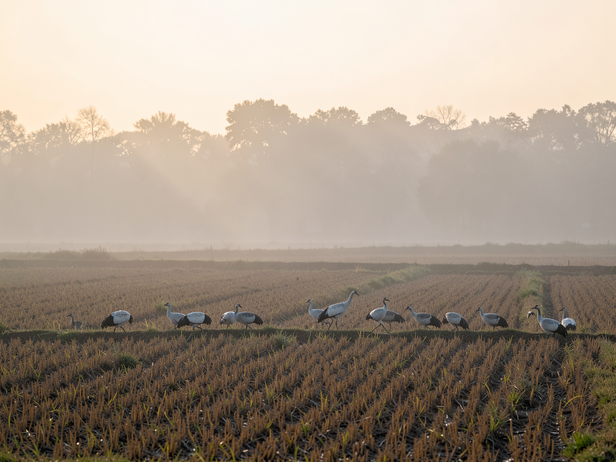
![Cranes Cross Foggy Field]()
Cranes Cross Foggy Field
Image credit : AI
A line of common cranes walks through a foggy harvested rice field in north India, a beautiful sight of winter birds.
What Stubble and Standing Crops Actually Offer
A harvested rice field in October leaves behind something a bird in caloric debt desperately needs: spilled grain at ground level, soft turned soil full of invertebrates, and open sightlines that make predator detection possible. Stubble fields are not waste, they are a larder. Common cranes and sarus cranes work them methodically, moving in lines, the larger birds flushing insects that smaller ones catch. Demoiselle cranes, which breed in the steppes of Kazakhstan and Mongolia and cross the Himalayas in one of the most demanding migrations in avian biology, arrive having burned through fat reserves crossing passes above five thousand metres. They need high-energy grain quickly. Harvested bajra and jowar fields in Rajasthan and Haryana are where they find it. Standing rabi crops, young wheat and mustard in December and January, offer a different resource. Geese graze the green shoots directly. Wigeons and other dabbling ducks feed at the flooded edges of mustard fields where irrigation water pools. The crop calendar of north Indian agriculture, built around two growing seasons separated by a fallow or stubble period, maps almost perfectly onto the wintering window of these species.
The Fog Factor
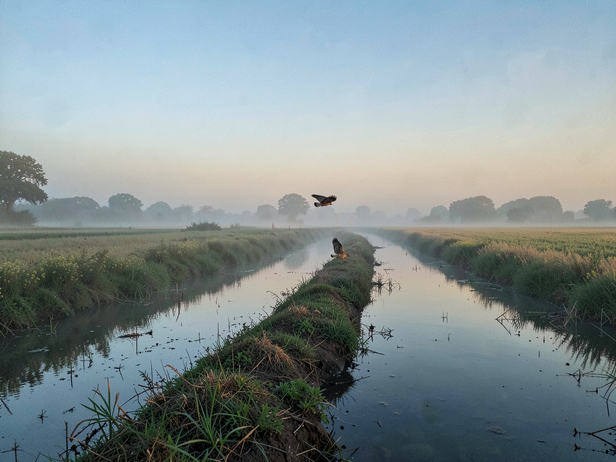
Dense winter fog across the plain, the kind that closes Delhi's airport for days, is not an obstacle for most of these birds, it is a thermal blanket. Ground temperature stays higher under fog cover than under clear winter skies, which keeps invertebrate activity in the topsoil going longer into the season. Black-winged lapwings and red-wattled lapwings, both year-round residents rather than migrants, concentrate in fogged-in fields precisely because earthworm and beetle activity remains accessible. Raptors work the fog differently. Hen harriers and marsh harriers quarter low over stubble at dawn when visibility is just a few metres, relying on hearing as much as sight to locate small birds and rodents. Pallid harriers, which winter across the plain in significant numbers, have been recorded hunting in fog dense enough to ground aircraft. The fog also suppresses thermal uplift, which keeps migrant flocks lower and slower, concentrating them in valleys and river corridors rather than dispersing them across altitude.
![Dawn Flight Over Flooded Fields]()
Dawn Flight Over Flooded Fields
Image credit : AI
A hen harrier hunts over flooded mustard fields, a common sight for winter birds in Punjab Haryana farmland.
Species That Depend on Farmland, Not Wetlands
Conservation attention in north India has historically focused on wetland birds, the Siberian crane, once a Bharatpur regular, is the most famous example of what wetland loss costs. But a parallel and less-discussed community depends entirely on agricultural land. The Indian courser, the black-bellied sandgrouse, and the Eurasian dotterel use open dry fields and fallow ground. The demoiselle crane roosts on sandbanks but feeds almost exclusively in cultivated fields. The greater spotted eagle, a globally vulnerable species, winters in the plain's agricultural matrix, hunting across stubble and canal margins. Critically, the sarus crane, the world's tallest flying bird and a species with strong cultural resonance across rural Uttar Pradesh, nests in agricultural wetlands and feeds in surrounding fields year-round, meaning its survival is tied not to protected areas but to the tolerance of individual farmers. Studies by the Wildlife Institute of India have tracked sarus pairs nesting within metres of active cultivation, their chick survival linked directly to whether the field is harvested before or after fledging.
How Agricultural Change Reshapes the Pattern
The relationship between farmland and wintering birds is not static. Combine harvesters, now widespread across Punjab and Haryana, leave less spilled grain than manual harvesting did, the machine is more efficient, and efficiency is the enemy of the gleaner. Stubble burning, practiced to clear fields quickly before the rabi sowing window, destroys the invertebrate layer in the soil and removes the structural cover that small birds use at night. The shift toward shorter-duration rice varieties has compressed the post-harvest window when fields are most productive for birds. None of this has collapsed the system yet. The plain still holds extraordinary concentrations of wintering birds. But the margin between abundance and scarcity in a migratory system is thinner than it looks from the outside: a species that arrives having burned its fat reserves crossing a mountain range has no buffer if the fields below are bare.