In Delhi, Lucknow, and Kolkata, ground-level PM2.5 concentrations in November and December regularly exceed 200 micrograms per cubic metre, ten times the WHO guideline of 15. Street dogs sleep, eat, and spend every hour of their lives at that level, with their muzzles often less than thirty centimetres from the road surface where particulate concentrations are highest.
How a Dog's Respiratory System Handles Particulates
A dog's nasal cavity is anatomically more complex than a human's. The turbinate bones, scroll-like structures lining the nasal passage, create a large surface area that filters and warms incoming air before it reaches the lungs. In controlled laboratory settings, canine nasal mucosa has been shown to trap a significant proportion of coarse particles (PM10 and above). The problem with PM2.5 is precisely its size: at 2.5 micrometres or smaller, these particles bypass the turbinate filtration almost entirely and penetrate deep into the alveolar tissue, where gas exchange happens. Dogs have no structural advantage over humans at this scale. Their alveolar macrophages, the immune cells that attempt to clear deposited particles, respond to chronic particulate load in the same way mammalian macrophages do: with persistent low-grade inflammation that, over months and years, can progress to fibrotic scarring of lung tissue.
![Autumn Dust on Cracked Pavement]()
Autumn Dust on Cracked Pavement
Image credit : AI
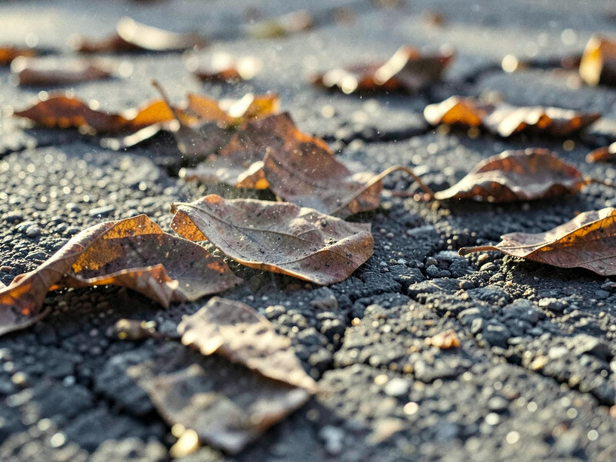
Dry leaves and dust settle on cracked pavement, a subtle reminder of urban air pollution effects on dogs.
What Roadside Positioning Actually Means for Exposure
Traffic-generated particulate matter does not disperse evenly. Studies on pedestrian exposure in Indian cities, including work published under the National Environmental Engineering Research Institute's urban air quality monitoring programmes, have documented a steep vertical gradient: PM2.5 concentrations drop measurably between ankle height and shoulder height. A dog resting on a roadside median or sleeping against a boundary wall is breathing air that is consistently more particle-dense than what a standing adult human beside it inhales. Add to this the fact that dogs have a higher resting respiratory rate than humans, typically 15 to 30 breaths per minute compared to 12 to 20 in adults, and cumulative daily particle deposition in canine lungs at the roadside is substantially higher than the equivalent calculation for a human spending the same hours outdoors.
The Winter Compounding Factor
Winter worsens the exposure in two distinct ways. First, cold air is denser and suppresses the vertical mixing that normally disperses pollutants upward through the day. In November and December across the Indo-Gangetic Plain, a temperature inversion layer traps particulates close to the ground through most of the morning, exactly the hours when traffic is heaviest. Second, street dogs in cold weather seek warmth at ground level, against sun-warmed walls, near idling vehicles, beside burning waste, all of which are point sources of additional particulate and carbon monoxide exposure. The behaviour that protects them from the cold places them closer to the highest-concentration zones.
![Foggy Dawn on Indian Road]()
Foggy Dawn on Indian Road
Image credit : AI
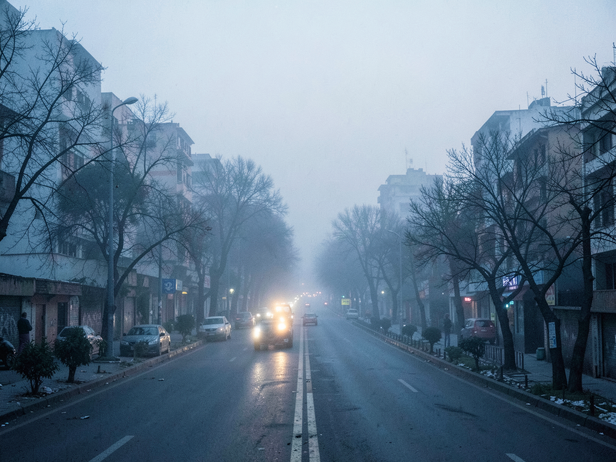
The dense haze on this Indian road highlights the impact of air pollution effects on dogs and other street animals.
What the Veterinary Evidence Shows
Systematic research on street dog lung health in India is limited, but the available evidence is consistent. Post-mortem examinations of urban street dogs in several Indian cities, documented in veterinary pathology literature, have found anthracosis, black carbon deposition in lung tissue, at rates and severities comparable to those seen in long-term human smokers in occupational exposure studies. The Indian Journal of Veterinary Pathology has carried case reports of pulmonary fibrosis and chronic bronchitis in urban street dogs with no infectious aetiology, findings that attending veterinarians attributed to chronic particulate inhalation. Companion dogs living in high-traffic urban apartments show elevated markers of airway inflammation compared to dogs in semi-rural areas, according to work from veterinary institutions in Europe examining the same question with better-controlled populations, findings that are biologically plausible in the Indian street dog context even though direct Indian comparative data remain sparse.
The Limits of What Is Known
Honest accounting of the evidence requires acknowledging what is missing. There is no large longitudinal cohort study tracking respiratory function in Indian street dogs over multiple winters. Pulmonary function testing in free-roaming dogs is logistically difficult. Most veterinary pathology data comes from animals that died or were euthanised, introducing survivorship bias: the dogs whose lungs are examined are not representative of the population. What can be said with confidence is that the biological mechanism for PM2.5-driven lung damage is identical in dogs and humans, that street dogs in Indian cities face chronic exposures that would be classified as occupational health emergencies for human workers, and that winter concentrations make the exposure substantially worse. The gap in the research is not a reason to discount the risk, it is a reason to close it. Every winter that passes without a structured study of street dog respiratory health in Indian cities is data that will never exist.