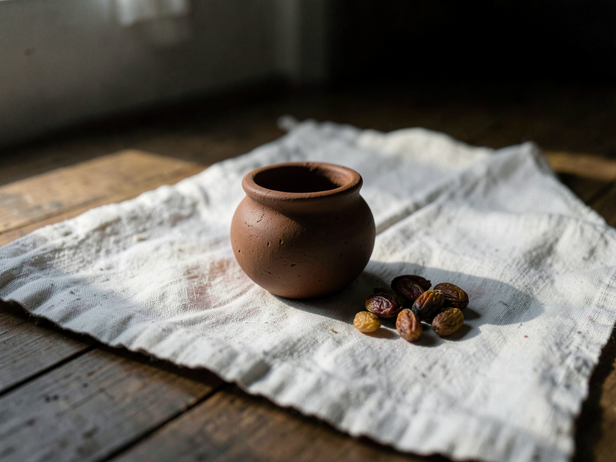
The fast begins the night before, with sargi she prepares herself, a banana, a glass of water, a handful of dry fruit she bought on the way home from work. There is no mother-in-law to wake her at four in the morning and press a thali into her hands. There is no sanction for what she is doing. She does it anyway.
What the ritual carries when no one is watching
Karva Chauth was never only about the husband. It was always about a woman staking something, her comfort, her hunger, her day, on a love she had chosen to believe in. The ceremony formalised that, gave it a moon and a sieve and a circle of women to witness it. But the belief came first. She is not performing a ritual without permission. She is doing what the ritual was always built on: choosing, privately, to hold something as real before the world has agreed to call it that.
She does not post about it. She does not tell her best friend, who would ask too many questions. She keeps it the way she keeps the relationship itself, in the space between her ribs, tended carefully, shown to no one who might try to talk her out of it.
![Karva Pot and Dry Fruits]()
Karva Pot and Dry Fruits
Image credit : AI
I observe Karva Chauth alone, a quiet fast for an unapproved relationship.
The particular loneliness of loving without a witness
There is a grief that comes with loving outside approval. It is not the grief of loss, he is there, he calls, he is real. It is the grief of incompleteness. A joy that cannot be spoken to her mother at dinner. A milestone that does not make it into the family WhatsApp group. She is living a love story that exists in full inside her own body and in almost no one else's awareness.
Karva Chauth sharpens this. The festival is communal by design. Women gather, sing, dress, eat together before dawn. They tell each other their husband's names. She is doing this alone, in her apartment, and the solitude is not romantic. It is the specific ache of wanting to share something you cannot share, not yet, maybe not for a long time.
She knows this. She fasts anyway. That is not foolishness. That is the shape of what she feels for him.
What she is not doing
She is not waiting for her parents to give her permission to love him. That decision was made months ago, maybe the first time he stayed on the phone past midnight because she was upset about something small and he did not make her feel small for it. She is waiting for the moment she can bring two parts of her life into the same room without someone she loves getting hurt. Those are different kinds of waiting.
She is not fasting to prove something to him, either. He did not ask her to. He does not fully understand what it costs her to do it this way, without the structure the festival was built for. She is fasting because it is the only form available to her right now for saying: I am serious about this. I am willing to be uncomfortable for it. I am holding this as real even when the world I grew up in has not yet agreed to see it.
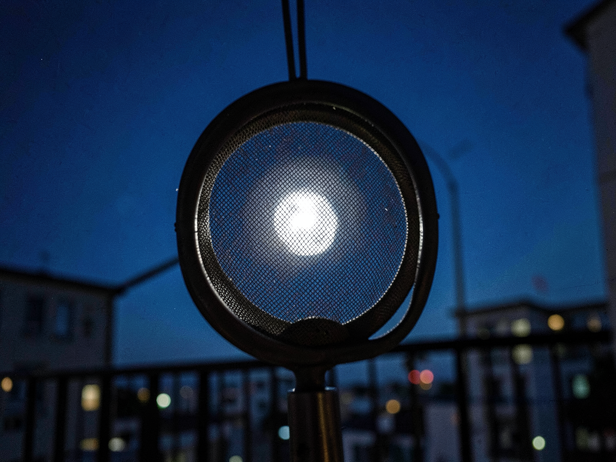
![Moon Through Strainer]()
Moon Through Strainer
Image credit : AI
I observe the moon, a solitary vigil for a love without parental approval.
The moon, when it comes
She will find it through the window of her apartment, or from the building terrace if the sky is clear. She will not have a sieve, probably, or she will improvise one, a strainer from the kitchen, which is not how her mother does it, which is fine. She will look at the moon. She will think of him. She will eat.
There will be no puja thali arranged by someone who loves them both. There will be no photograph for the relatives. The moment will be entirely interior, hers, held between her and the sky, and later between her and him on a call where she may or may not tell him what she did today.
That interiority is not a lesser version of the festival. It is what the festival looks like when a woman is carrying the whole weight of a choice by herself, before anyone else is ready to help her carry it.