The sun is already setting on the fourth day when she realizes she has been listening for sounds that are not here, the dhol from the lane, her mother-in-law's voice calling the children back from the water, the particular wet smell of a river ghat in November. The rented room in the city has a window that faces another building. There is no ghat within walking distance. The money for the train ran out before October did.
What the Festival Carries That No One Names
Chhath is not a temple festival. It asks for open sky, moving water, and the body standing in both. It is one of the oldest solar observances still practiced in its original form, no priest required, no intermediary, just the worshipper and the sun and the river between them. For families from Bihar, eastern Uttar Pradesh, and Jharkhand who have migrated to cities for work, the festival is also the one moment in the year when the distance between where they live and where they are from becomes physical, measurable, painful. The four days of Chhath, Nahay Khay, Kharna, Sandhya Arghya, Usha Arghya, are not four days of ritual. They are four days of being somewhere specific with specific people. When the money is not there, what goes missing is not the ritual. It is the place and the people.
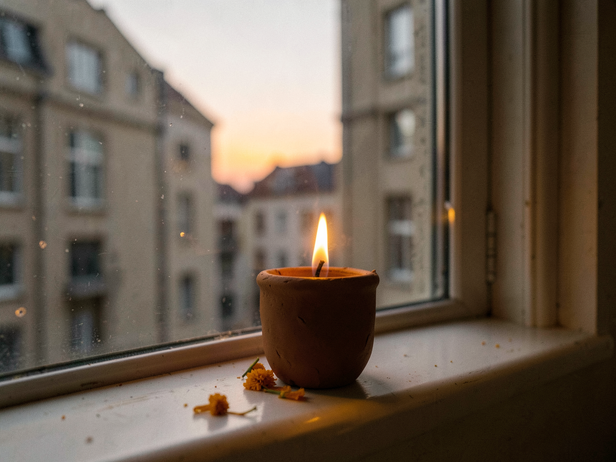
![Dusk Lamp and Marigolds]()
Dusk Lamp and Marigolds
Image credit : AI
A quiet moment of Chhath Puja longing, the lamp's glow a reminder of home.
The Room That Has to Become Enough
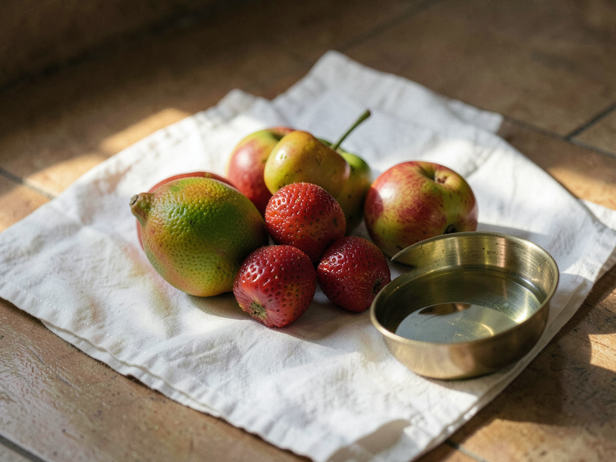
She fills a large steel vessel with water and sets it on the floor near the window. She has found a small clay lamp and a piece of sugarcane from the market two streets away. The offerings, thekua, gur, seasonal fruit, she has made herself, the way her mother taught her, though her mother's kitchen had a courtyard and hers has a gas cylinder wedged between the wall and the door. The children watch. They do not fully understand what is missing because they have never stood at the actual ghat. She is not sure whether that is a mercy.
What she does inside the room is not a lesser version of Chhath. It is Chhath held in different hands. The faith does not require the river to be sacred, the river is sacred because the faith is brought to it. She brings the faith to the vessel of water. The sun still rises at the same hour. She still faces east.
What the Longing Is Actually For
The ache she feels is not for a ritual. Rituals can travel. The ache is for her mother standing beside her in the water, for the cold that moves up from the river floor, for the exact pitch of the chanting from the women on the bank. It is for a version of herself that exists only in that geography, that can only be accessed by going back. The rented room cannot give her that. Nothing can, this year.
She knows this. She is not confused about what she is grieving. That clarity is its own kind of dignity, to name the loss without dressing it as something smaller, without telling herself she doesn't mind, without performing a contentment she does not feel. The children eat the thekua. She stands at the window as the sun goes down. She says what she has always said. The sun does not know she is in a rented room.
![Morning Offering, Simple Devotion]()
Morning Offering, Simple Devotion
Image credit : AI
My Chhath Puja in the city, a quiet moment of devotion with thekua and fruit.
What Holds When the Journey Cannot
There are women across every major Indian city doing exactly this, in exactly this kind of room, in exactly this kind of year. The migration that brought their families to the city for work is the same migration that makes the return expensive, precarious, dependent on whether the month's numbers worked out. Chhath travels with them because it must. It has always been a festival of the working body, of farmers, of laborers, of people who cannot afford to stop asking the sun for one more good season.
The festival was never only for people with the means to make the journey beautiful. The thekua she made in a city kitchen is the same thekua. The arghya she offered from a steel vessel is the same arghya. Her mother, standing at the ghat four hundred kilometers away, is offering the same thing to the same sun at the same hour. They are not separated by the ritual. They are separated by everything else, by rent, by train fares, by the particular arithmetic of a difficult year. The ritual holds them together in spite of it.