You already know which invitations those are. You receive the card, and before you have even read the venue, something in your chest has made the decision. One kind of invitation is a summons dressed in cream cardstock. The other is information you are free to act on or not. What separates them is not geography, not expense, not even how much you like the couple getting married. It is the architecture of obligation your family built around you, and the wedding invitation is just the moment it becomes visible.
The Invitation That Was Never Really a Question
Some weddings you attend because not attending would require an explanation that costs more than the flight. The family member who would ask, quietly, at every subsequent gathering, whether you had been unwell. The group chat that would go silent in a specific way. The parent who would not say anything but whose silence would say everything for the next six months. You go not because you want to, and not even because you love the person getting married, though you might. You go because the social infrastructure of your family has made absence a statement, and you are not ready to make that statement yet. This is not manipulation in any dramatic sense. It is simply how certain families hold themselves together, through presence as proof, through attendance as loyalty. The wedding is not the point. The point is the register of who showed up.
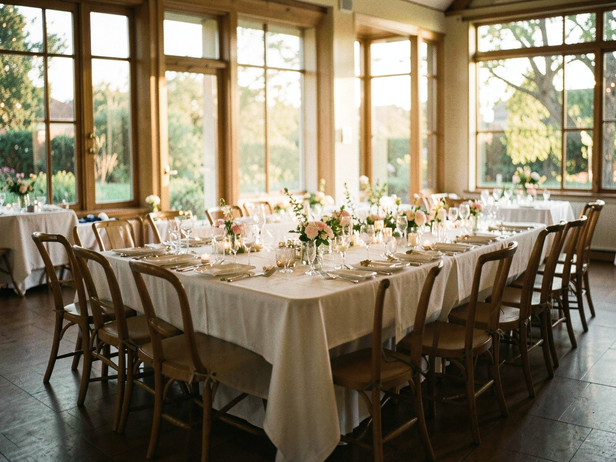
![Golden Hour Banquet Setup]()
Golden Hour Banquet Setup
Image credit : AI
The quiet anticipation before the celebration, a moment of reflection on family obligation wedding.
The Invitation You Decline Without Losing Sleep
Then there is the other kind. A cousin twice removed, or a family friend's child, or someone from a branch of the family that only convenes at funerals and weddings. You send a gift, you send a message, you wish them well, and you do not go. Nobody calls. Nobody brings it up. The invitation was genuinely optional, which means it was a different kind of gesture entirely, an inclusion rather than a requirement. These invitations, the ones you can decline without consequence, tell you something too. They tell you where the emotional stakes are low, where your presence is wanted but not load-bearing, where the relationship can hold the weight of your absence without cracking. That is not a lesser relationship. It is sometimes a freer one.
What the Gap Between Them Reveals
The distance between those two categories, the ones you cannot miss and the ones you quietly skip, is a portrait of your family's emotional economy. It shows you who holds leverage and who does not. It shows you which relationships are maintained through genuine warmth and which are maintained through the fear of what happens if you stop maintaining them. Most families contain both. The question worth sitting with is not which invitations fall into which category, but whether you ever had a say in how those categories were assigned. Some people discover, usually in their thirties, that they have been attending the mandatory ones their whole lives without ever asking themselves whether they actually wanted to. The invitation never asked. It assumed.
![Sealed, Unaddressed Envelope]()
Sealed, Unaddressed Envelope
Image credit : AI
This unaddressed envelope, a symbol of potential obligation, sits waiting. It makes me think about family obligation wedding events.
The Quiet Negotiation Nobody Names
Declining a wedding you are supposed to attend is one of the cleaner ways a person begins to renegotiate the terms of their family membership. Not because the wedding matters, but because the act of declining, and surviving it, and watching the family absorb the absence without collapsing, is information. It tells you that the consequence you feared was smaller than the fear itself. Or it tells you the opposite: that the fallout was real, and now you know the cost of that particular boundary more precisely than you did before. Neither outcome is comfortable. Both are clarifying. The invitation you cannot refuse is worth examining not because you should refuse it, but because understanding why you cannot is the first honest look at what your family actually asks of you, and what you have been quietly agreeing to all along.