Every October or November, the same conversation finds her. Someone asks, gently or not so gently, where she is keeping Chhath this year. The question sounds like scheduling. It is not scheduling.
The Ritual Carries the Weight of Belonging
Chhath is not a festival you observe from a comfortable distance. It asks for the body, four days of it, fasting and standing in cold river water at hours when the rest of the world is asleep. The ghat you stand at is not incidental. It is a declaration. In many families across Bihar, Jharkhand, eastern Uttar Pradesh, and the diaspora communities that carried this tradition to Delhi, Mumbai, and beyond, keeping Chhath at your sasural is understood as the completed act of marriage. You have crossed over. This is your house now.
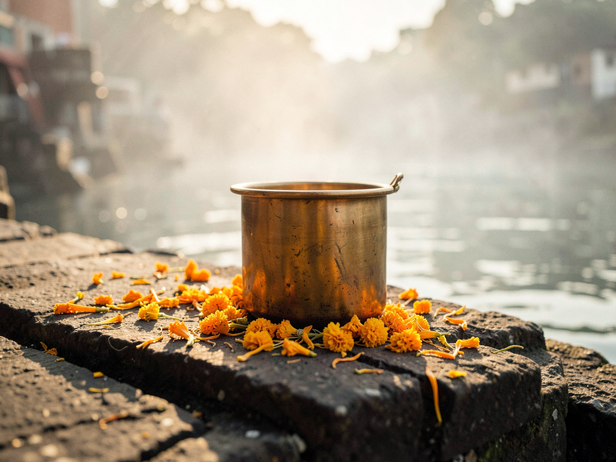
![Brass pot, marigolds, morning fog]()
Brass pot, marigolds, morning fog
Image credit : AI
My Chhath puja dilemma: maika or sasural? This pot holds my devotion.
What She Is Actually Being Asked to Choose
The question of which house she keeps Chhath in is really a question about which grief she is willing to perform. If she goes to her maika, she will hear, in some form, that she has not fully arrived at her husband's home. If she stays at her sasural, she will spend the festival standing at a ghat that does not yet feel like hers, next to women who have been doing this for thirty years, and she will miss her mother in a way that has no polite name.
Neither choice erases the other. She does not stop belonging to her parents' home the moment she stands at her in-laws' ghat. But the ritual asks her to enact that erasure anyway, and she is supposed to do it with a full heart.
The Compromise That Is Not Really One
Some families allow her to alternate, one year here, one year there. It sounds fair. What it actually produces is a woman who belongs fully to neither ghat and spends every Chhath calculating whose turn it is instead of standing in the water. Alternating is not a solution. It is a postponement of a reckoning that the family has agreed not to have.
Other families let her keep Chhath wherever her husband is posted or living. This is the most pragmatic version, and it sidesteps the emotional charge by replacing it with geography. It works until someone in the family decides geography is not a good enough reason.
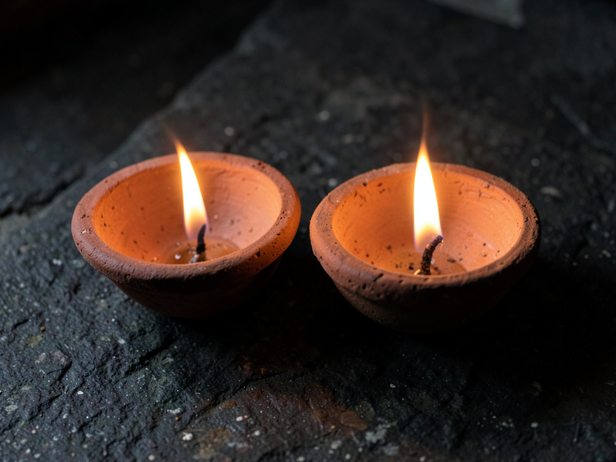
![Diyas Illuminate Darkness]()
Diyas Illuminate Darkness
Image credit : AI
Warm amber light pools between two diyas, one steady, one just lit. A married daughter's Chhath dilemma.
What the Festival Is Actually About
Chhath is, among other things, a festival of gratitude to Chhathi Maiya and to the sun, for fertility, for the survival of children, for the continuity of the family line. The vrat is most commonly kept by women, for their children or for the children they hope to have. The ritual is already doing something complex: it centres a woman's body and her devotion while simultaneously tethering both to the family she married into.
She is the one standing in the river. She is the one who fasted. And yet the question of where she does this is decided by everyone around her.
The Thing She Is Allowed to Know
You are not being unreasonable when this question tightens something in your chest. The discomfort is not ingratitude and it is not a failure of love for your husband's family. It is the accurate recognition that you are being asked to perform a loyalty that was never asked of him. He did not leave his ghat. You left yours. The festival makes that visible once a year, in the early morning, in cold water, in front of everyone.
Some women find that standing at the new ghat eventually becomes its own thing, not a replacement, but a different relationship with the same river. That shift happens on its own time, if it happens. It cannot be scheduled into the second year of marriage because the family needs it to have happened already.
The question of which house she keeps Chhath in will keep arriving. What changes, slowly, is that she stops needing the answer to tell her where she belongs. The ghat she stands at is the one she chose to stand at this year. The one she stood at before is still hers too. The river does not ask her to pick.