The spare key still works. That is the first disorienting thing, how seamlessly the lock accepts you, as if no time passed, when everything inside the house insists that years did.
Your room is not your room. It is a guest room now, or a storage room, or your mother's reading corner, and the particular way she has arranged her things in it tells you, without a word, that she stopped holding the space. She did not do this cruelly. She did it the way anyone does when they finally accept that someone has actually gone.
The House Has Its Own Rhythms Now
Dinner happens at a different time. Your father watches something you don't recognise on a channel you've never seen. Your mother has a friend who calls every Thursday evening and they talk for forty minutes, and you learn this not because anyone tells you but because you are there on a Thursday and the house simply does its Thursday thing around you.
You are twenty-nine. You have lived alone, or with flatmates, or with a partner. You have made your own grocery lists and chosen your own silence and decided, unilaterally, what time the lights go off. And now you are back in a house where someone else has already decided all of that, and they decided it without you, and it works perfectly well without your input, and this is both a relief and a small, persistent grief.
The grief is not about the room or the dinner time. It is about the realisation that the family you left is not the family you returned to. They grew, too. They just grew in a direction that did not require you to be present for it.
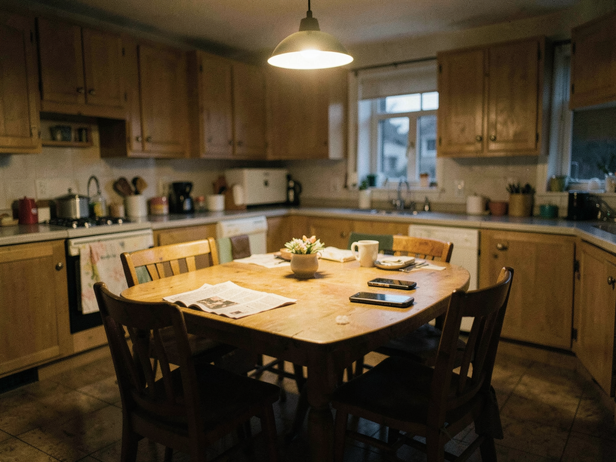
![Kitchen Dusk, Table Set]()
Kitchen Dusk, Table Set
Image credit : AI
The quiet hum of home, a space for everyone. Navigating living with parents in your late twenties.
What You Expected to Feel and What You Actually Feel
You expected to feel like a child again. You expected the old helplessness, the old resentments, the old pull of wanting to be seen differently than they see you. Some of that is there. But underneath it is something you didn't anticipate: the strange loneliness of being loved by people who no longer know your daily texture.
Your mother knows who you were at nineteen. She knows the version of you that left. She does not know how you take your coffee now, or that you've stopped eating meat, or that you sometimes need an hour alone after a difficult conversation before you can speak again. She is learning you as a person she has not yet met, and she is doing this while also being your mother, and the two roles keep colliding in small, tender, exhausting ways.
You did not expect to have to introduce yourself to your own parents. But that is, quietly, what is happening.
The Old Roles Come Back Faster Than You Expect
There is a particular regression that happens in the parental home, and it does not care how old you are or how capable you have become. You walk into the kitchen and your mother moves to take the pan from you, not because she thinks you can't cook but because in this kitchen, in this house, the grooves of old habit are deep and she has been the one at the stove for thirty years.
You let her, because it is easier. And then you let her again. And then you notice, two weeks in, that you have stopped doing the things you do when you are living as yourself. You have slipped back into the shape the house made for you a decade ago, and the shape is not wrong exactly, but it is not yours anymore.
This is the thing no one warns you about: the house doesn't just hold your absence. It holds a version of you. And that version is right there, waiting, and it is very easy to become it again without meaning to.
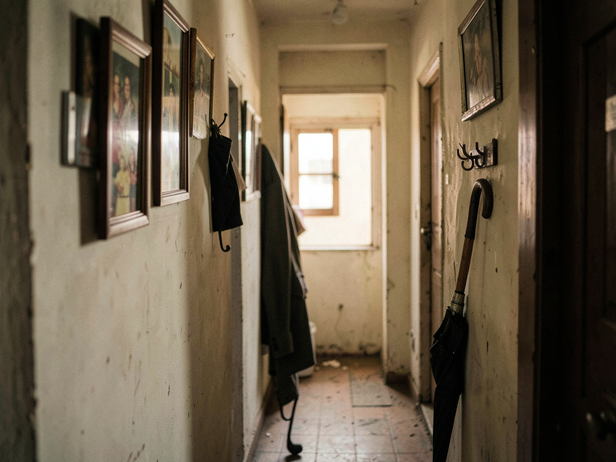
![Echoes of Time]()
Echoes of Time
Image credit : AI
The quiet coexistence of different eras in a familiar space. A subtle reminder of returning home.
How You Stay Yourself Inside Someone Else's Home
It requires more deliberateness than it should. Small things: keeping your own schedule where you can, even if it means eating separately sometimes. Telling them, plainly, what has changed about you, not as a correction but as an introduction. Letting your mother learn that you need that hour of quiet after a hard conversation, so she doesn't read it as withdrawal or anger.
And asking them the same questions. Your father has an opinion about something that happened in the neighbourhood three years ago. Your mother has a fear she hasn't named to anyone. They are not the people you left either. The version of them you carry in your head was formed when you were young enough to see them mostly as parents and not yet as people with their own interior weather.
Moving back is, if you let it be, a chance to meet them. Not to recover the family you had, which is gone, but to build something with the family that exists now, the one that rearranged itself in your absence and kept going, and is now, cautiously, making room for you again.
What This Is Actually About
It is not failure. You know this. You tell yourself this. And yet the twenty-nine-year-old standing in the doorway of a room that used to be theirs feels something that rhymes with failure, even when the facts don't support it.
That feeling is worth sitting with rather than arguing against. It is telling you something about what you thought adulthood was supposed to look like by now, and how attached you were to that picture, and how the picture was always more about proving something than about actually living.
The house closed around your absence. That is true. But it also kept the key working. Both things are the shape of what love looks like when it has had time to become realistic about you, which is, in the end, the only kind that lasts.