You have watched her do this your whole life without understanding it. She rises when the house is still dark, wraps herself in the older sari, not the good one, and walks to the ghat alone. She does not take you. She does not explain. She is back before the chai is made, her feet leaving small wet prints on the kitchen floor, and she never says what she went for.
The River Knows What She Cannot Say at Home
The ghat on a full moon is not a quiet place, but she finds something in it that the house cannot give her. The house holds her in her roles: mother, wife, the one who knows where everything is. At the river's edge, under the Purnima light, she is only herself. Whatever she carries to the water, the worry she has not named, the grief that has no occasion, the hope she is afraid to say aloud in case saying it breaks it, she sets it down there. The river does not ask her to be fine. It does not need her to be managing. This is the only hour in the month that belongs entirely to her, and she has never once invited anyone into it.
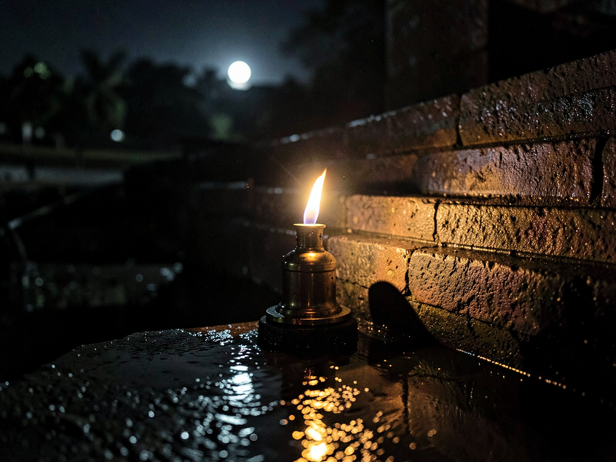
![Moonlit Lamp on Wet Stone]()
Moonlit Lamp on Wet Stone
Image credit : AI
The full moon illuminates a solitary lamp, its warm glow a beacon against the night. I ponder what mothers pray for alone.
What She Is Asking For Is Not What You Think
You have guessed, over the years. You thought she was praying for your marks, your marriage, your health. You thought her asking was always on your behalf, because that is the story you were given about mothers, that their inner life is a mirror of yours, their desires a list of your needs. But the woman who stands at the ghat in the dark is not standing there for you. She is standing there for the part of herself she has never been able to bring into the house. The asking is hers. It has her name on it, not yours. You do not know what it is, and she will not tell you, and this is not withholding, it is the last private thing she has kept for herself in a life that has been very generous with everything else.
The Silence She Keeps Is Not Distance
There is a particular loneliness in being the child of a woman who has an interior life she does not share with you. You wanted to be let in. You thought closeness meant knowing everything. But she has understood something you are still learning: that the self which has no room of its own eventually stops existing. The ghat is her room. The full moon is her door. The silence she keeps when she comes back is not the silence of someone who has shut you out, it is the silence of someone who has just returned from somewhere real, and has not yet crossed back into the language of the house.
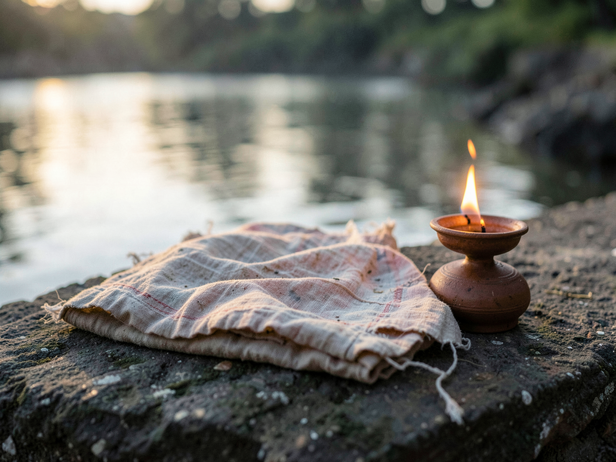
![River Dawn Diya Stillness]()
River Dawn Diya Stillness
Image credit : AI
Dawn's gentle light illuminates a sacred moment, a single diya burning, a quiet ritual. What mothers pray for alone.
What You Inherit From Her Asking
She never taught you this in words. But you have watched her go, and come back, and go again, twelve times a year for as long as you can remember, and something in you has learned from it. That wanting is allowed to be private. That hope does not have to be explained to be real. That a woman can have a relationship with the water and the light that belongs to no one else in the family. You will carry this without knowing you are carrying it. One day you will find yourself at a threshold, a riverbank, a temple step, a window at 4 a.m., and you will understand that she gave you permission to be unreachable, too.