She woke before the rest of the house. She arranged the fruits, the sugarcane, the thekua, the earthen lamp. She carried the daura to the ghat on her head, stood in the river as the light changed, and held the offering toward the setting sun with arms that had not eaten in thirty-six hours. The vrat has her name on it in the sense that she performed it. In every other sense, it belongs to someone else.
The labour is hers. The story isn't.
The preparation for Chhath begins days before the ghat. The kitchen runs on her schedule. The nirjala fast, no water, no food, is hers to keep. The waking before sunrise on the fourth day is hers. And yet the vrat is described, in most households, as something she does for her husband, for her children, for the family's prosperity. The blessing flows outward. The suffering stays with her. This is not incidental to the ritual. It is the ritual's architecture.
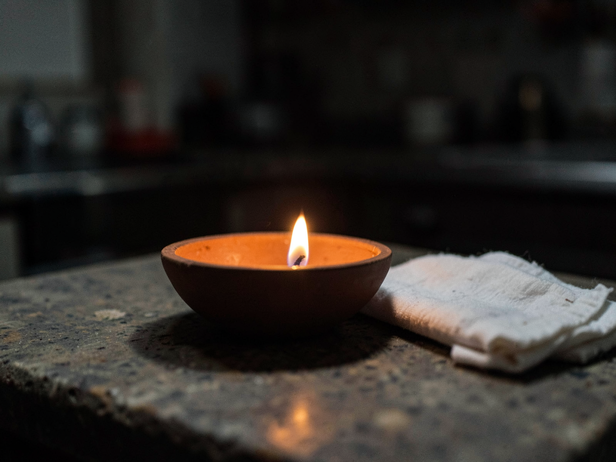
![Earthen Diya's Gentle Glow]()
Earthen Diya's Gentle Glow
Image credit : AI
The subtle glow of an earthen diya, a symbol of devotion, illuminates the quiet preparation. This scene evokes the deep meaning of Chhath vrat.
What devotion looks like when it has an audience and when it doesn't
The ghat is public. The hours at the ghat, the standing in cold water, the lifting of the soop, the chanting, are witnessed. Neighbours are there. The family is there. Photographs are taken. But the days before the ghat, and the night after, when she is too exhausted to sit upright, happen in a room with no audience. Devotion that is photographed at the ghat and invisible in the kitchen is still devotion. It is also something else: a performance of wifely sacrifice that the household consumes and the woman funds entirely with her body.
The vrat she keeps and the vrat she is asked to explain
There is a version of this conversation that happens in educated, self-aware households: someone asks her whether she believes in it, whether she does it by choice, whether she feels it is imposed. The question assumes that belief and imposition are opposites. They are not. She may believe completely and still understand that opting out would cost her something the believer asking the question would never have to pay. Choice inside a structure of consequence is still a choice. It is just not a free one. The honest thing is to name the structure, not to decide on her behalf whether her belief is real.
![River Ghat at Dawn]()
River Ghat at Dawn
Image credit : AI
Dawn's quiet devotion. The river ghat awaits, a symbol of Chhath vrat emotional meaning.
The man at the ghat
He is often there. He carries something, the daura, sometimes, or he drives. In many families, the husband keeps a partial fast in solidarity, or attends the arghya at the ghat. This is spoken of as support, as participation, as partnership. It is not the same thing as what she did. The asymmetry is not about who is more devoted. It is about whose body the ritual runs on, and whose name the ritual is filed under in the family's memory. Both things can be true: he was present, and the cost was hers.
What gets passed down
The daughter watches. She watches who wakes first, who arranges the thali, who stands longest in the water, who eats last when the fast breaks. She also watches who is thanked, whose fast is spoken of as a gift to the family, and whose exhaustion is treated as a natural feature of the season rather than something one person chose to endure. What she learns is not only the ritual. She learns the accounting, who the sacrifice belongs to, and who it is for. That accounting is what gets passed down alongside the recipe for thekua, and it is harder to examine than the recipe, because it has never been written anywhere.