You have made a home before. More than once, probably. You arranged the furniture the way you wanted it, learned which floorboard creaks, memorised the quality of light in the late afternoon. And still, at some point, you looked around the room and felt like a guest who had overstayed a welcome she was not sure had been extended in the first place.
Vedic astrology places Ketu, the south lunar node, the headless half of the shadow axis, in the fourth house for a specific kind of person. Not a broken one. Not a damaged one. One who carries the memory of many homes in her bones, and finds that memory makes the present one harder to settle into, not easier.
What the Fourth House Actually Holds
The fourth house in a Jyotish chart is not simply about property or real estate, though those things live there too. It holds the feeling of belonging. The mother, or the primary caregiver who shaped your first understanding of safety. The land you come from. The interior emotional life you carry everywhere, regardless of address.
When a planet occupies a house, it colours everything that house governs. Ketu is not a planet in the conventional sense, it has no physical body, no mass, no light of its own. It is a mathematical point, a node, and its nature in Vedic thought is one of release, dissolution, and the residue of past lives. It does not build. It completes.
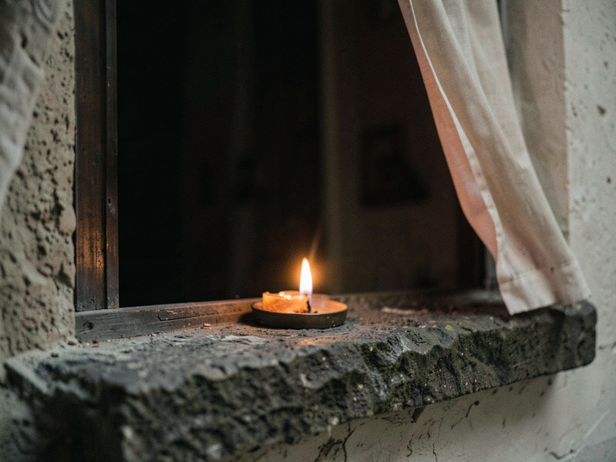
![Warm Light on Old Stone]()
Warm Light on Old Stone
Image credit : AI
The warm light of the diya illuminates the aged stone, hinting at a feeling of temporary home. Ketu in 4th house.
The Specific Texture of This Restlessness
Ketu in the fourth does not produce homesickness. It produces something closer to the opposite: a faint, persistent sense that the home you are in is not quite the one you are looking for, combined with the unsettling suspicion that the one you are looking for does not exist in any geography you can reach.
This shows up in recognisable ways. You might redecorate frequently, not because you are indecisive, but because no arrangement ever feels final. You might feel more like yourself in transit, in airports, on trains, in the particular suspension of being between places, than you do sitting in your own living room. You might have a complicated relationship with your mother, or with the idea of what a mother is supposed to provide, without being able to name exactly what went missing.
None of this is pathology. In Vedic thought, Ketu in the fourth suggests that the soul has already done the work of rooting deeply in a previous existence. This life, the work is different. The rootedness is not what you are here to build. You are here to learn something that does not require a permanent address.
What It Does to Relationships Inside a Home
The fourth house governs not just where you live but how you inhabit shared space with the people you love. A woman with Ketu here often finds that intimacy is easier when it is not domesticated, when she and her partner are travelling together, or navigating something new, rather than settled into the ordinary rhythm of a shared household.
The ordinariness of home can feel like a slow erasure. The same kitchen, the same arguments about the same things, the same quality of Sunday afternoon light. She may pull away not because she loves less but because familiarity triggers the old Ketu signal: this is not it. Keep moving.
The people who love her sometimes experience this as emotional unavailability, or as a refusal to commit to the life they are building together. What they are feeling is real. So is what she is feeling. The tension between those two realities is not a problem to be solved so much as a condition to be understood, by her first, and then, if the relationship can hold it, together.
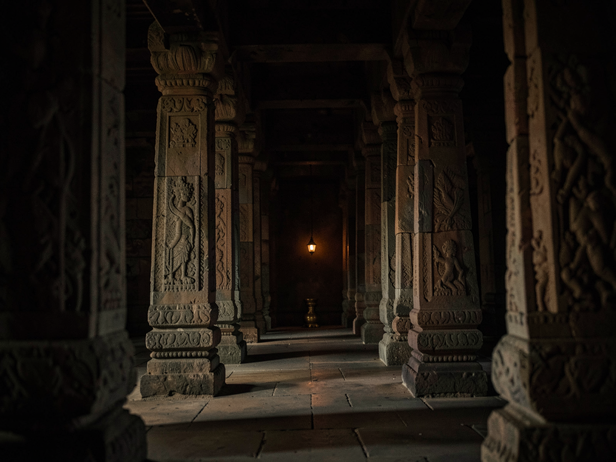
![Temple Corridor's Dim Glow]()
Temple Corridor's Dim Glow
Image credit : AI
The deep shadows of the temple corridor evoke a feeling of temporary home, a quiet journey.
Rahu Across the Axis: The Pull Toward the World
Ketu never sits alone. Where Ketu occupies the fourth house, Rahu, its opposite node, occupies the tenth: the house of career, public life, status, and the self that the world sees. This axis is not incidental. It is the whole story.
The woman with this placement is often more comfortable in her professional life than in her domestic one. She knows how to build something in the world. She is capable, visible, driven in ways that feel natural to her. The tenth house is where she feels at home, which is precisely the irony the chart is pointing at. The place she is supposed to rest is where she feels most like a visitor. The place she is supposed to strive is where she feels most like herself.
Vedic astrology does not read this as a flaw. It reads it as the particular shape of this soul's learning. The invitation, and it is an invitation, not a sentence, is to let the home become less about permanence and more about presence. Not to stop feeling like a temporary resident, but to stop using that feeling as a reason to stay at a distance from the life that is actually happening around her.
The Question the Chart Is Really Asking
There is a difference between a home you have not found yet and a home you are not ready to inhabit. Ketu in the fourth often keeps a woman in the first story when the second is closer to true.
The restlessness is real. The sense of not-quite-belonging is real. But Ketu's nature is completion, not absence. What it is completing, slowly, across this lifetime, is the attachment to the idea that safety must come from a place. The soul that has already been deeply rooted is now learning that the ground can be carried.
That is not a comfortable lesson. It does not resolve into a tidy address. But it does, eventually, resolve into something steadier than any house has ever offered: the knowledge that you are not a guest in your own life, even when you feel like one in your own home.