You were told to wake up before sunrise to eat. Nobody told you that his mother would already be awake, watching which foods you chose and how much, filing it somewhere behind her eyes.
The Morning Belongs to Them
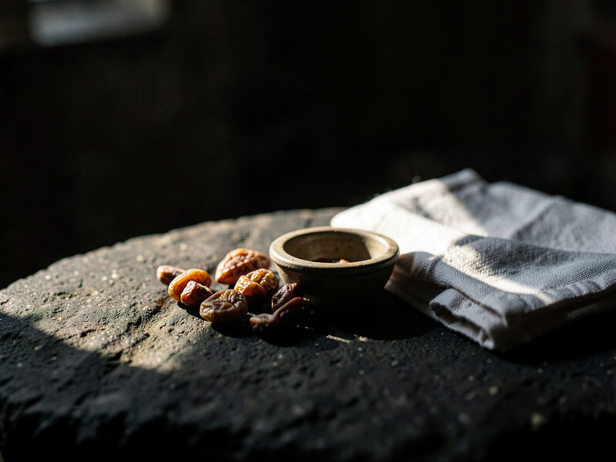
The sargi arrives the night before, arranged by his mother or his maasi or whoever holds that role in his family, the woman whose opinion will outlast the wedding flowers by decades. You eat from it in the dark hours before dawn, alone or nearly alone, and the solitude feels like a gift until you realise it is the last quiet you will have all day. By the time the house fills, you are already fasting, already a little light-headed, already at a disadvantage. They are not. They have done this before. Some of them have done it for thirty years.
![Sargi Thali Before Dawn]()
Sargi Thali Before Dawn
Image credit : AI
Preparing for my first Karva Chauth, the sargi thali awaits the dawn. A quiet moment before the day begins.
What the Gathering Is Actually For
The puja circle, the thali, the sieve through which you will later look at the moon and then at his face, these are the visible architecture of the day. The actual event is the women in that circle deciding what kind of woman you are. They are not cruel. Most of them are not even conscious of doing it. They are simply running the same assessment that was run on them, on their mothers, on every new wife who sat where you are sitting. You will be evaluated on whether you know the right moment to touch his feet, whether you hold the thali correctly, whether you look appropriately devoted without looking theatrical about it. There is no rubric. There is only the feeling, afterward, that you passed or didn't.
The Hunger Is Not the Hard Part
Sixteen hours without water is a physical fact, and your body will manage it or it won't. What is harder to manage is the performance of not managing it. You are supposed to be visibly sustaining yourself on love, on the idea of his long life, on the spiritual weight of the vow. If you look too fine, you seem indifferent. If you look too wrecked, you seem weak. The women who have done this longest have found the exact register, a kind of luminous endurance, and you have one day to locate it without a rehearsal. What helps, if anything helps: stop trying to find it. Let the hunger be what it is. The women watching you have been hungry too. Some of them will soften when they see you stop pretending.
![Moon Through Brass Sieve]()
Moon Through Brass Sieve
Image credit : AI
My first Karva Chauth, a moment of quiet anticipation under the moon's glow.
The Moon and What Comes After
The moment with the sieve is brief and a little absurd and genuinely moving, which is the precise combination that makes a ritual work. You look at the moon through the mesh, then at his face through the mesh, then at his face without it. He gives you water. Something that was taut all day loosens. What loosens is not the hunger, that takes another hour and a real meal, but the watching. The women stop their inventory when the ritual closes, not because they have finished, but because the formal portion of the assessment is over. What remains will be decided over the next several years, in smaller rooms, in ordinary moments. The first Karva Chauth is not the test. It is the introduction to the testing.