The refusals have started to add up. Three in six months, or seven in a year, or one every time your mother opens the app. The number doesn't matter as much as the pattern: someone suitable arrives, and something in you quietly exits before you can name what left.
The Explanation You're Expected to Have
There is a script for refusing an arranged match. He was too short, or the families live too far apart, or he seemed arrogant in the way he held his chai cup. These reasons land cleanly. They give the aunts something to file away and the next shortlist a cleaner brief. What doesn't land is the truth, which is that you cannot locate a single thing wrong and still cannot say yes. That gap, between a reasonable match and your own refusal, is where the confusion lives. Not in him. In the fact that you don't know what you're waiting for, only that you haven't met it yet.
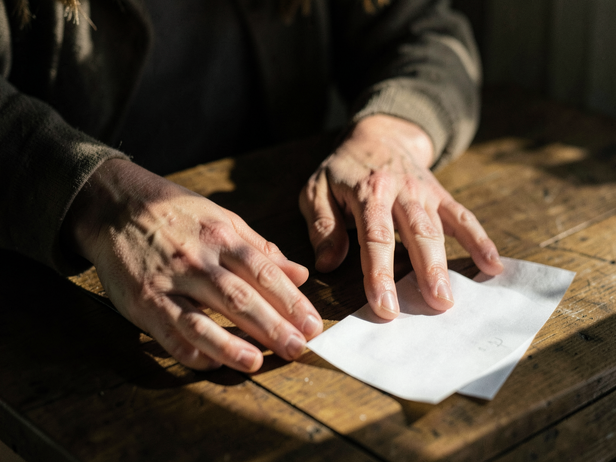
![Hands, Paper, and Light]()
Hands, Paper, and Light
Image credit : AI
I hold my breath, the folded paper a silent testament to my refusal of an arranged match. The light catches the texture of the wood.
What Gets Mistaken for Fear
Everyone around you has a theory. Your mother thinks you're scared of commitment. Your father thinks you're being too selective, that you've watched too many films. Your closest friend, the one who married at twenty-six and seems happy enough, says you're overthinking it. They are not entirely wrong. Fear is in there somewhere. But fear of what, exactly? Not of marriage as a concept. Not of this particular man. Something subtler, the fear of choosing something that feels like settling, and the equal fear that you wouldn't even recognise the right thing if it arrived. Fear and discernment wear the same face from the outside. Only you know which one is speaking, and some days even you aren't sure.
The Weight the Refusals Carry
Each no costs something. Not just socially, though the social cost is real, the conversations that go quiet when you walk in, the relatives who have stopped asking because they've decided you're difficult. The cost that lands harder is internal. Every refusal is a small act of faith in something you cannot describe. You are betting on a feeling you haven't had yet over a reality that is right in front of you. That bet gets harder to justify the longer it goes unmade. And the longer it goes, the more you start to wonder whether the feeling you're waiting for is real, or whether you invented it to protect yourself from the ordinary work of choosing.
![Shadows and Empty Chairs]()
Shadows and Empty Chairs
Image credit : AI
The weight of unspoken decisions hangs in the air, a quiet refusal to an arranged match.
What You're Actually Protecting
There is something you haven't said out loud, possibly not even to yourself. That the version of you who says yes to the next reasonable match will be a different person than the one who waited. Not better or worse, different. Something closes when you choose. Not in a tragic way, but in the way all choices close off their alternatives. You are not afraid of him. You are afraid of the foreclosure. Of becoming someone who stopped looking for the thing she couldn't name, because she agreed to something she could. That's not selfishness. It's not immaturity. It is a very specific kind of grief, pre-emptive and almost impossible to explain to someone who has never felt it.
Living Without the Answer
There is no resolution at the end of this. No formula that tells you when instinct becomes avoidance, or when waiting becomes a story you're telling yourself. What there is: the recognition that not knowing your reason is not the same as not having one. You are allowed to be in the middle of figuring it out. The people who love you may not be able to wait that long, and that is its own grief, separate from yours. But the refusals that come from somewhere real, even somewhere you can't yet see clearly, are not the same as the ones that come from fear. You don't have to prove the difference to anyone. You only have to keep being honest with yourself about which one is speaking.