Mercury is 77 million kilometres from Earth at its closest. Neptune is roughly 4.3 billion. Yet New Horizons reached Pluto in nine years on a near-straight trajectory, while BepiColombo needs seven years of looping gravity assists just to park in orbit around the innermost planet. Distance is almost irrelevant here. The problem is the Sun.
The Sun Is a Trap for Inbound Spacecraft
Anything falling toward the Sun accelerates. That is straightforward orbital mechanics: gravitational potential energy converts to kinetic energy as an object descends. A spacecraft leaving Earth's orbit and heading inward picks up speed continuously. By the time it reaches Mercury's orbital distance, 0.39 astronomical units from the Sun, it is moving far faster than Mercury itself, which orbits at about 47 kilometres per second. To enter orbit rather than fly straight past, the spacecraft has to shed that excess velocity. Shedding velocity in space means firing a rocket engine against your direction of travel. The fuel required scales with the speed change needed, and the speed change needed at Mercury is brutal. Engineers call this delta-v. The delta-v budget for a direct Mercury orbit insertion is among the highest in the solar system, comparable in difficulty to landing on the Sun. Sending a spacecraft to Jupiter, by contrast, requires far less delta-v because Jupiter sits far from the Sun, gravity has not been accelerating the spacecraft as violently, and a large planet's own gravity can be used to capture the probe without burning much fuel at all.
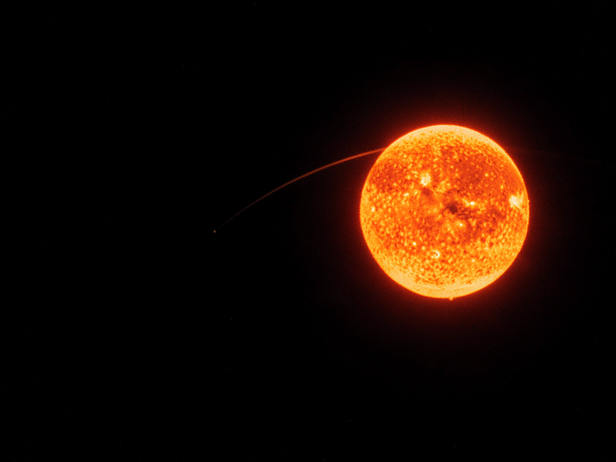
![Sun's Gravitational Embrace]()
Sun's Gravitational Embrace
Image credit : AI
I witness the Sun's dominance, a sharp orange disc, as an orbital path curves away. Understanding Mercury orbit gravity assist is key to reaching this innermost planet.
How BepiColombo Solves the Fuel Problem
BepiColombo, the joint mission of the European Space Agency and the Japan Aerospace Exploration Agency, launched from Kourou in October 2018. Rather than carrying the impossible fuel load a direct trajectory would demand, the mission uses planetary gravity assists, flybys of Earth, Venus, and Mercury itself, to bleed off velocity gradually over years. The sequence is precise: one Earth flyby in April 2020, two Venus flybys in October 2020 and August 2021, and six Mercury flybys between 2021 and 2025. Each Mercury flyby slows the spacecraft a little more relative to the planet, so that by the final approach in late 2026, the speed difference between BepiColombo and Mercury's orbit is small enough for the onboard propulsion system to handle. The spacecraft's solar electric propulsion, ion thrusters that expel xenon gas at high velocity, provides continuous low-level thrust throughout the cruise, trimming the trajectory in ways chemical rockets cannot. The result is a seven-year journey to a planet that light crosses in under five minutes.
What BepiColombo Is Actually Carrying to Mercury
The spacecraft is in fact two orbiters stacked together for the cruise phase: ESA's Mercury Planetary Orbiter and JAXA's Mercury Magnetospheric Orbiter, called Mio. They travel locked to a transfer module that provides power and propulsion. Once in Mercury orbit in late 2026, the stack separates and the two orbiters settle into different orbits to study the planet simultaneously from different angles and altitudes. Mercury is poorly understood relative to the other rocky planets. Mariner 10 made three flybys in 1974 and 1975. NASA's MESSENGER orbited from 2011 to 2015 and revealed a planet with a surprisingly large iron core, making up about 85 percent of the planet's radius, a thin but measurable magnetic field, and water ice sitting in permanently shadowed craters at the poles despite surface temperatures that swing from minus 180 to over 430 degrees Celsius. BepiColombo carries instruments designed to map the surface in higher resolution than MESSENGER managed, measure the magnetic field in detail using both orbiters simultaneously, and probe the planet's interior structure. One open question is why Mercury's core is so disproportionately large. One hypothesis is that a giant impact stripped away much of the original mantle. Another is that the early solar wind, far more intense this close to the young Sun, eroded the lighter silicate layers. BepiColombo's gravity and geophysics instruments are designed to distinguish between these scenarios by measuring how the planet's gravity field deviates from a simple sphere.
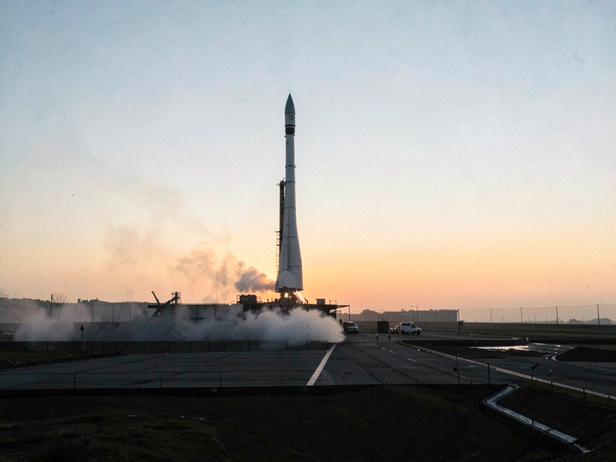
![Dawn Rocket Launch Silhouette]()
Dawn Rocket Launch Silhouette
Image credit : AI
I prepare for my journey, a silhouette against the dawn. Reaching Mercury is a challenge, but my mission is set.
The Flybys Themselves Are Science Opportunities
Each of the six Mercury flybys before orbit insertion is not just a braking manoeuvre, it is an observation campaign. During the fourth Mercury flyby in September 2024, BepiColombo's flyby cameras captured the planet's surface at closest approach, adding detail to maps of regions MESSENGER did not image well. The magnetospheric instruments measured Mercury's magnetic field and its interaction with the solar wind at different local times and latitudes than MESSENGER could access. These flyby datasets are already being published and analysed. The spacecraft is doing science seven years before it reaches its primary operating phase, which is an unusual feature of a mission designed around constraints rather than convenience. The gravity-assist route that looks like a compromise is, in practice, a distributed observing campaign.
Why This Matters Beyond Mercury
BepiColombo's navigation is a demonstration of what orbital mechanics allows when direct trajectories are physically impossible. The same logic applies to any mission targeting a destination with an extreme gravity environment. Parker Solar Probe, NASA's mission to study the Sun's corona, uses repeated Venus flybys to progressively lower its perihelion, its closest approach to the Sun, over years, because no rocket could place it on a tight solar orbit in a single burn. The physics that makes Mercury hard to reach is the same physics that makes the Sun hard to study up close. Mercury is also the only planet in the inner solar system whose geology, magnetic field, and core structure remain poorly constrained. Understanding it better constrains models of how rocky planets form and differentiate, models that apply to Earth, Mars, and the thousands of rocky exoplanets being catalogued by missions like TESS. The difficulty of getting there is not incidental. It is why so little is known, and why BepiColombo's seven-year approach, flyby by flyby, represents one of the more patient and methodical pieces of planetary science currently in progress.