The Big Dipper you can find on any clear night looks nothing like the Big Dipper that existed 100,000 years ago, and nothing like the one that will exist 100,000 years from now. The handle will flatten, the bowl will warp, and the shape that has guided travellers and anchored mythologies across cultures will be gone, not destroyed, just rearranged into something no one has a name for yet.
Stars Are Not Nailed to the Sky
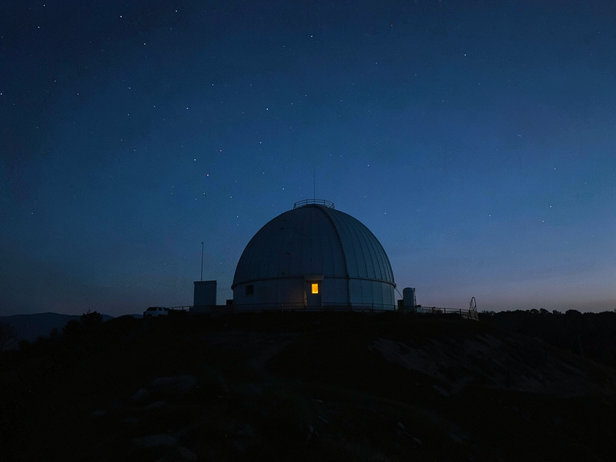
![Twilight Observatory Silhouette]()
Twilight Observatory Silhouette
Image credit : AI
Observatory at dusk, hinting at the vastness of space and the proper motion of stars. A lone light guides the way.
Every star in the Milky Way is orbiting the galactic centre, and none of them orbit at exactly the same speed or along exactly the same path. From our vantage point on Earth, this means every star is drifting across the sky relative to every other star. Astronomers call this proper motion: the angular shift of a star's position against the background of more distant objects, measured in arcseconds per year.
Most proper motions are tiny. The Sun itself moves through the galaxy at roughly 220 kilometres per second, but the stars near us are moving at comparable speeds in their own directions, so the relative drift is slow. Barnard's Star holds the record for the fastest proper motion of any star visible from Earth, it shifts about 10.3 arcseconds per year, which means it takes 180 years to move a distance equal to the apparent diameter of the full Moon. On a human timescale, the sky looks still. On a geological one, it is in constant, slow churn.
What Proper Motion Does to a Constellation
A constellation is not a physical structure. It is a line-of-sight coincidence: stars that happen to lie in roughly the same direction from Earth, at wildly different actual distances, grouped by the human eye into a pattern. Orion's belt is a good example. Mintaka, Alnilam, and Alnitak are not neighbours in space, they sit at distances ranging from roughly 900 to 1,200 light-years from Earth, and each one is moving on its own trajectory.
Because the stars in any constellation are unrelated to each other physically, there is no gravitational bond holding the pattern together. Each star follows its own orbit around the galactic centre, and over long enough timescales, the apparent alignment that produces the belt, the sword, the shoulder dissolves. Simulations of the sky 50,000 years from now show Orion's familiar hourglass shape significantly distorted. The Big Dipper's handle, currently a graceful arc, bends into something closer to a right angle.
How Astronomers Measure It
![Ancient Celestial Observatory]()
Ancient Celestial Observatory
Image credit : AI
Ancient stone observatory, showcasing geometric precision. Understanding the proper motion of stars.
The first systematic measurements of proper motion came from Edmond Halley in 1718, who compared his observations of Sirius, Arcturus, and Aldebaran against the positions recorded by ancient Greek astronomers. The stars had moved. Not by much, but measurably. It was the first direct evidence that the sky was not the static backdrop that every civilisation before him had assumed.
Modern measurement is done by space-based astrometry. The European Space Agency's Gaia mission, launched in 2013, has catalogued the positions, distances, and proper motions of over a billion stars with a precision that earlier astronomers could not have imagined. Gaia data has made it possible to run the sky forward and backward in time with genuine accuracy, turning proper motion from a theoretical concern into a mapped, quantified reality. India's astronomical tradition contributed to positional star catalogues long before the telescope, and ISRO's growing investment in space science places Indian researchers among those working with Gaia data today.
The Constellations the IAU Froze in Place
In 1930, the International Astronomical Union divided the entire celestial sphere into 88 official constellations, each with fixed boundaries drawn in lines of right ascension and declination. The boundaries are administrative, not astronomical, they define regions of sky, not the shapes of the asterisms inside them. The shapes themselves, the dipper, the hunter, the scorpion, are already drifting out of those regions in slow motion.
The IAU boundaries will not move. The stars inside them will. In roughly 50,000 years, the star Thuban, which served as the pole star for ancient Egyptians around 2800 BCE, will be nowhere near the pole, it has already moved significantly from that position due to Earth's axial precession working alongside proper motion. Polaris, our current pole star, will yield that role to Gamma Cephei in about 4,000 years. The sky that any given civilisation inherits is a snapshot, not a permanent arrangement.
What Remains When the Shapes Are Gone
Proper motion does not erase the stars. Rigel will still burn blue-white. Betelgeuse will still be a red supergiant with an uncertain future. Sirius will still be the brightest star in the night sky as seen from Earth for the next several million years, because it is genuinely close, about 8.6 light-years away, and its proper motion will keep it in our neighbourhood for a long time yet.
What changes is the grammar of the sky: the patterns that cultures used to mark seasons, navigate oceans, and anchor stories. The Navagraha, the nakshatra system, the Greek mythological figures mapped onto star groups, all of these were built on a sky that is, by cosmic standards, a momentary arrangement. Future civilisations, if they look up and try to make sense of what they see, will draw entirely different lines between entirely different groupings and tell entirely different stories. The sky is not a fixed text. It is a sentence that never stops being written.