In January 1610, Galileo pointed a 20x telescope at Jupiter and noticed three, then four, small stars that moved. They did not behave like background stars. They kept company with the planet, swapping positions night after night, sometimes disappearing behind it or into its shadow. He logged them for weeks before concluding they were orbiting Jupiter. The same four moons, Io, Europa, Ganymede, and Callisto, are bright enough to see with binoculars you already own, and their motion is fast enough that a single night of watching will show you something different from the night before.
What You Actually Need
Any binoculars with an aperture of 35mm or larger will show the Galilean moons when Jupiter is well placed in the sky. The standard notation is magnification x aperture: 7x50, 8x42, and 10x50 are all fine. The challenge is not the optics, it is keeping the binoculars still enough for the moons to resolve into points rather than smears. Brace your elbows on a railing, press the eyepieces against a door frame, or lie on your back and prop the binoculars on your forehead. A camera tripod with a binocular adapter costs a few hundred rupees and solves the problem permanently.
Jupiter itself will be unmistakably bright, the brightest thing in that part of the sky. Look for a steady, cream-coloured light that does not twinkle the way stars do. The moons appear as faint dots arranged roughly along a straight line passing through the planet's equator. You will see between one and four of them on any given night, depending on which are currently behind the planet, in its shadow, or transiting its face.
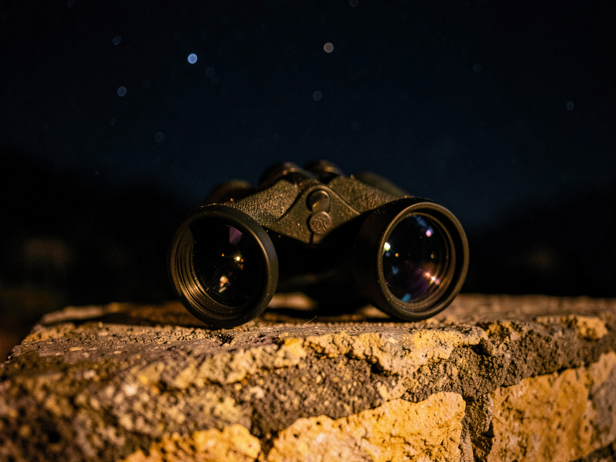
![Binoculars on Stone Wall]()
Binoculars on Stone Wall
Image credit : AI
I observe the night sky with my binoculars, hoping to see Jupiter moons tonight.
The Orbits and Why the View Changes
The four moons move at very different speeds because they orbit at very different distances. Io, the innermost, completes one orbit in 1.77 Earth days. Europa takes 3.55 days. Ganymede takes 7.15 days. Callisto, the outermost of the four, takes 16.69 days. These numbers are exact to two decimal places, confirmed by centuries of observation and refined by spacecraft including Voyager 1, Voyager 2, and the Juno mission, which is still in orbit around Jupiter.
The practical consequence: Io moves fast enough that its position relative to Jupiter changes noticeably within a few hours. If you look at 9 pm and again at midnight, Io will have shifted. Europa moves more slowly but will be in a clearly different position the following evening. Ganymede and Callisto shift on a timescale of days, so you track them across a week rather than a night.
What makes one night genuinely different from the next is the combination of all four moving simultaneously. There is no repeating pattern that a casual observer will notice. The arrangement on any given evening is specific to that evening.
Reading the Configuration
On a night when you see three moons on one side of Jupiter and one on the other, you are seeing an orbital snapshot. The lone moon is not special, it is simply at a point in its orbit where it has moved to the opposite side of the planet from the others. When you see only two moons, one or two are hidden: either behind the planet (occultation) or passing in front of it (transit), or sitting in Jupiter's shadow (eclipse). When you see all four spread evenly, it is a coincidence of orbital timing, not a rare event.
A free app such as Sky Map, Stellarium, or SkySafari will show you the predicted positions of all four moons for any time and date. Check it before you go out, note the expected layout, then look. Matching what you see to the prediction is the moment the geometry stops being abstract.
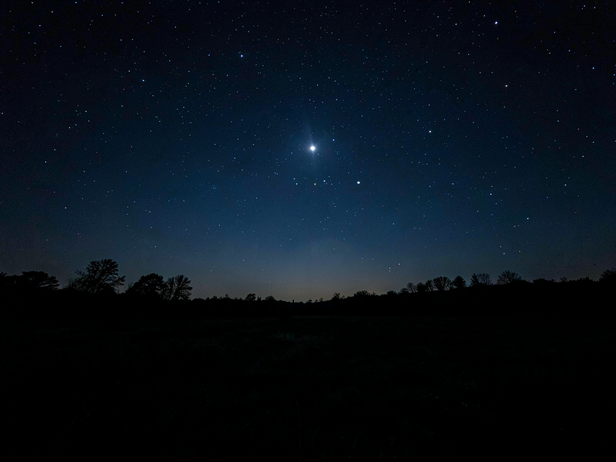
![Jupiter and its Moons]()
Jupiter and its Moons
Image credit : AI
I witness Jupiter and its Galilean moons, a breathtaking celestial display visible tonight.
Ganymede Is the One to Watch First
Ganymede is the largest moon in the solar system, larger than the planet Mercury. It is also the brightest of the four in binoculars, because it is big and reflective. If you are new to this and want to anchor your observations to something consistent, start with Ganymede. Its 7.15-day orbit means it will be on the opposite side of Jupiter from where you found it roughly three and a half days later. That is a visible, trackable change across a week of clear evenings.
Callisto is the outermost and moves most slowly. On a week of nightly observations, it will appear to drift gradually rather than jump. Io and Europa, by contrast, will seem to swap positions or cross to the other side of Jupiter between one evening and the next. Io in particular moves fast enough that experienced observers sometimes time its disappearance into Jupiter's shadow and reappearance, because the event takes minutes, not hours.
What This Observation Actually Demonstrates
Watching the Galilean moons is not a novelty. It is a working demonstration of orbital mechanics at a scale you can follow across a fortnight. Kepler's third law, that a moon's orbital period is related to its distance from the planet, is visible in the difference between Io's frantic pace and Callisto's slow drift. The same law governs the planets around the Sun, the Moon around the Earth, and every satellite humans have ever launched. The binoculars are just the instrument. The moons are the proof.
The configuration you see on any given night will not repeat in a simple cycle. The four orbital periods are not in whole-number ratios with each other, except for the 1:2:4 resonance linking Io, Europa, and Ganymede, which keeps their orbits stable and is itself a consequence of gravity doing what gravity does over billions of years. Callisto sits outside this resonance. The result is a system that is orderly enough to predict precisely and varied enough to look different every time you check.