The sun touches the horizon and something happens to its light that most people never notice because they look away a second too soon. For a brief instant, sometimes less than a second, rarely as long as two, the upper rim of the disc turns a vivid, unambiguous green before it vanishes. This is the green flash, and it is not a legend or a trick of tired eyes. It is refraction, doing exactly what physics says it should.
Why the Atmosphere Splits Sunlight at the Horizon
When the sun is high, its light travels a short path through the atmosphere and reaches your eye with all its wavelengths arriving together. At the horizon, that path stretches to roughly forty times its overhead length. The atmosphere acts like a weak prism over that distance, bending shorter wavelengths, violet, blue, green, more sharply than longer ones like orange and red. Violet and blue scatter away before they reach you. Green bends just enough to survive the journey. In the final second before the disc disappears, the green rim of the sun is the last part geometrically above the horizon, briefly separated from the red and orange that have already set. That separation, measured in fractions of a degree of arc, is what the eye reads as a flash of colour.
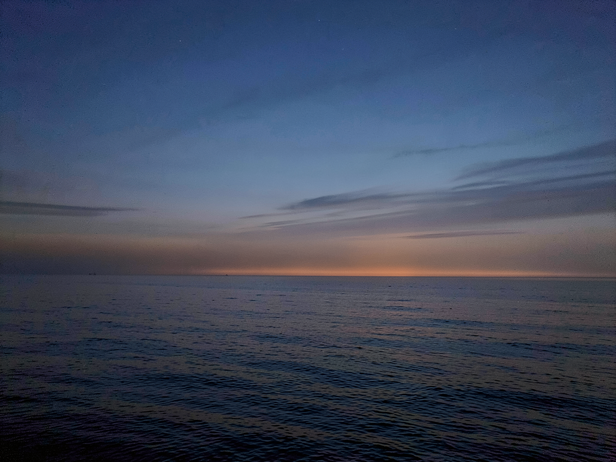
![Ocean Horizon at Dusk]()
Ocean Horizon at Dusk
Image credit : AI
Atmospheric refraction paints the horizon with warm amber hues as dusk settles over the calm ocean.
The Conditions That Make It Visible
A clear horizon is necessary but not sufficient. The atmosphere between you and the setting sun must be stable, not churned by heat rising off warm land or disturbed by dust and haze. A temperature inversion, where a layer of cooler air sits above warmer air near the surface, acts as an additional lens that magnifies and holds the green rim long enough for the eye to register it. Without an inversion, the flash exists but lasts too briefly to see. With a strong one, it can stretch to a genuine two-second event. Humidity matters too. A moist marine layer close to the surface enhances the inversion effect. This is why the phenomenon is far more reliably observed over open ocean than over land.
Where the Indian Coast Lines Up
India's western coastline faces the Arabian Sea, which means the sun sets over open water from Kutch in the north to Kanyakumari at the tip. That geometry alone puts the west coast ahead. The months that matter are October through February, when the post-monsoon atmosphere settles, marine haze clears, and temperature inversions form over the cooling sea surface. The Konkan coast, from Ratnagiri down through Goa, offers flat, unobstructed sea horizons from headlands and beaches with little light pollution behind you. Kanyakumari is technically both a western and a southern horizon at the same time, and the confluence of two seas there creates atmospheric conditions that have produced documented sightings. Kerala's beaches at Kovalam and Varkala face west with clean sightlines. The key is elevation: even a metre or two above sea level, on a rock or a low dune, adds horizon distance and marginally improves the geometry. Goa's rocky promontories at Cabo de Rama and Chapora headland offer this naturally.
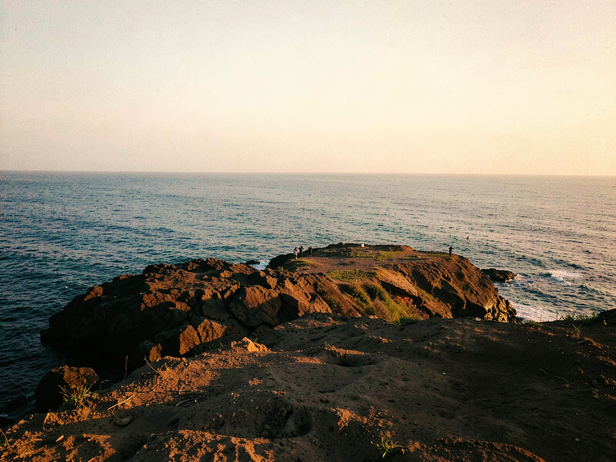
![Konkan Coast Golden Hour]()
Konkan Coast Golden Hour
Image credit : AI
I witness the magical golden hour on the Konkan coast, a breathtaking sunset over the Arabian Sea.
How to Actually Watch for It
The preparation is simple and the execution is harder than it sounds. Arrive fifteen minutes before sunset. Fix your eyes on the exact point where the sun's lower rim will meet the horizon, not on the disc itself, which is bright enough to leave an afterimage that masks the flash. As the disc drops below halfway, shift your gaze to the upper rim. The flash, if it comes, occupies the last half-second of the upper rim's visibility. Binoculars help considerably: they compress the angular distance to the horizon and magnify the rim separation. A calm sea surface on a day when the horizon looks razor-sharp rather than smeared is the best predictor. A hazy, orange, diffuse sunset, the kind that looks dramatic, is almost always a sign that the atmosphere is too turbid. The nights that look less spectacular at dusk are the ones worth watching carefully.