Solar retinopathy, permanent scarring of the retina caused by looking at the Sun, can happen in under sixty seconds of unprotected viewing, and the eye sends no pain signal while it is happening. The damage shows up hours later, sometimes as a crescent-shaped blind spot that never closes. That delay is the reason people keep making the same mistake: nothing hurts at the time, so nothing feels wrong at the time. Understanding how to observe the Sun safely is not a niche skill for eclipse chasers. It applies every morning the sky is clear and you own anything that magnifies.
Why the Sun Is Different From Every Other Target
The Sun concentrates an extraordinary amount of energy into a small area of your retina. A telescope or binocular without a proper solar filter does not just let in more light, it focuses infrared radiation alongside visible light, and infrared heats tissue without triggering the blink reflex. The lens inside your eye has no pain receptors. By the time you feel discomfort, the burn is already done. This is why the methods that feel safe, squinting, using sunglasses, looking through smoked glass, looking through a CD, or holding up a phone screen, are not safe. They reduce glare. They do not block the infrared and ultraviolet that do the structural damage. The Indian Astronomical Society and solar observation bodies worldwide classify these as high-risk methods with documented harm.
![Eclipse Glasses and Film]()
Eclipse Glasses and Film
Image credit : AI
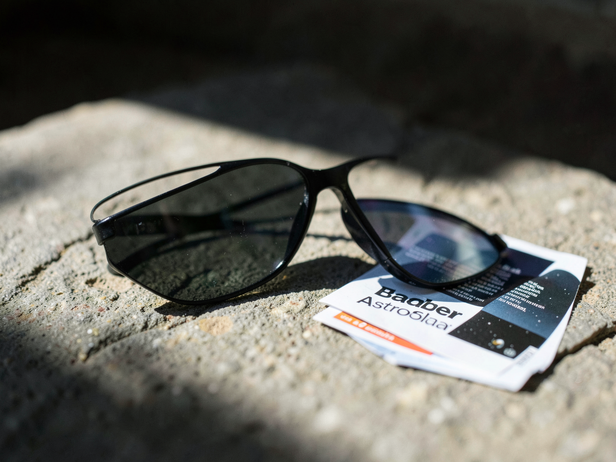
Ensuring solar observation safety with certified eclipse glasses and AstroSolar film. Learn how to look at the sun safely.
Methods That Have Blinded People
Smoked glass was the standard folk method for generations, including during the 1995 and 1999 solar eclipses visible across parts of India. It is not optically uniform, it does not block infrared, and it fails unpredictably. Exposed photographic film was widely recommended before the digital era. Modern film has no silver halide layer and blocks almost nothing useful. CDs and DVDs reflect some light but have no consistent optical density and can crack under heat, creating a clear patch mid-observation. Stacked sunglasses provide no protection against infrared. A welding filter at shade 12 or lower is insufficient; solar observation requires shade 14. Each of these has a documented history of causing solar retinopathy, with case clusters appearing in ophthalmology literature after every major eclipse event. The 2009 total solar eclipse, whose path crossed parts of South Asia, produced a measurable increase in retinal injury presentations at hospitals in the days that followed.
Projection: No Filter, No Risk to the Eye
Projection is the safest method because your eye never looks at the Sun at all. Point a small telescope or one barrel of a binocular at the Sun, remove the eyepiece cap, and project the image onto a white card held or fixed behind the eyepiece. The Sun's disk appears on the card and you observe the card. Sunspots are clearly visible this way. The telescope or binocular does heat up internally, so keep sessions short, under five minutes per instrument, and never leave it unattended pointing at the Sun. A cardboard shade around the telescope tube, with a hole for the tube, makes the projected image easier to see in daylight. This method requires no special purchase and has been used by school astronomy clubs across India for decades. Its limitation is that it shows only the photosphere; solar prominences and the corona require either a dedicated filter or a total eclipse.
![Dusk Observatory Landscape]()
Dusk Observatory Landscape
Image credit : AI
I gaze at the twilight sky, contemplating the universe and the importance of solar observation methods.
Proper Filters: What Certified Means
ISO 12312-2 is the international standard for solar viewing filters. A filter certified to this standard blocks all but roughly 0.00032 percent of visible light and attenuates infrared and ultraviolet to safe levels across the full optical path. Solar eclipse glasses meeting this standard cost between fifty and two hundred rupees and are manufactured by several suppliers; the certification number should be printed on the frame. For telescopes, a full-aperture solar filter screws or slides over the objective lens, the large end, not the eyepiece. A filter at the eyepiece concentrates heat from the full aperture onto a small glass disk and can shatter. Baader AstroSolar film is a commonly available material for making objective-end filters at home; the film itself is ISO-certified, and the cell holding it needs to fit securely so it cannot blow off mid-session. ISRO's public outreach events during Chandrayaan and Aditya-L1 milestones have distributed certified eclipse glasses, and the Nehru Planetarium network in Delhi, Mumbai and Pune stocks or recommends certified suppliers. The Aditya-L1 mission, launched from Sriharikota in September 2023 and positioned at the Sun-Earth Lagrange point L1, studies the Sun's corona and solar wind continuously without any of these constraints, it carries its own instruments designed for exactly this radiation environment. For the rest of us, the filter is not optional.
Photographing the Sun With a Phone or Camera
A phone camera pointed at the Sun without a filter will damage the sensor. More importantly, if you are using the screen to frame the shot and the Sun drifts into your direct line of sight, the risk shifts to your eye. A certified solar filter sheet held over the phone lens is sufficient for photography. The image will be orange or yellow depending on the filter type; white-light solar filters show the photosphere and sunspots in a pale gold tone. Dedicated solar telescopes such as those using hydrogen-alpha filters show the chromosphere and prominences in deep red, but these instruments cost significantly more and are a separate category. For a phone shot of a partial eclipse or a large sunspot group, a certified eclipse glass held flat against the lens and taped in place produces a usable image. Nothing else does. The Sun is the one subject where the instinct to improvise should be replaced entirely by the instinct to use the right tool.