Every culture that looked up long enough eventually built a story around the Sun. The Rigveda addresses Surya in over two hundred hymns, describing him as the eye of Mitra and Varuna, the one who measures out the days, whose chariot the seven mares pull across the sky. The Egyptians gave Ra a solar barque to navigate the heavens. The Aztecs fed Tonatiuh human hearts to keep him burning. The Inca called their emperor the son of Inti. These traditions did not share a language or a continent, but they arrived at several of the same conclusions, and a handful of them turn out to be closer to astrophysics than they have any right to be.
What the traditions got strikingly right
The most consistent insight across solar worship is that the Sun is not a fire in the ordinary sense. The Rigveda describes Surya as self-luminous, a source rather than a reflector, distinct from the light of the Moon. This is not a small thing. The intuition that the Sun generates its own light, rather than being, say, a burning bowl or a polished mirror, is correct. The mechanism is nuclear fusion at the core, where hydrogen nuclei combine under immense pressure to form helium, releasing energy in the process. The priests did not know about proton-proton chains, but they sensed the qualitative difference between a thing that shines by itself and a thing that borrows light.
Several traditions also understood that the Sun is central and that life depends on it in a way that is not merely symbolic. The Gayatri Mantra, drawn from Rigveda 3.62.10, is addressed to Savitr, the solar deity in his aspect as the stimulator of minds and life. The mantra asks to be illuminated by that divine radiance, an acknowledgement that the Sun's energy is not decorative but foundational. Modern biology agrees: photosynthesis, the base of almost every food chain on Earth, runs on solar radiation. The Sun drives weather, ocean currents, and the water cycle. The Vedic framing of the Sun as the sustainer of all living things is, stripped of its mythological register, accurate.
The Konark Sun Temple in Odisha, built in the thirteenth century, is oriented so that the first light of the rising Sun strikes the sanctum sanctorum directly. This is precise solar architecture, and it required careful observation of the Sun's path across the year. The builders understood the Sun's motion well enough to engineer for it. The same observational precision shows up in Stonehenge, in the Caracol observatory at Chichén Itzá, and in the Jantar Mantar instruments built by Maharaja Jai Singh II in Jaipur and Delhi in the early eighteenth century. These are not myths. They are applied solar astronomy, and the measurements they produced were real.
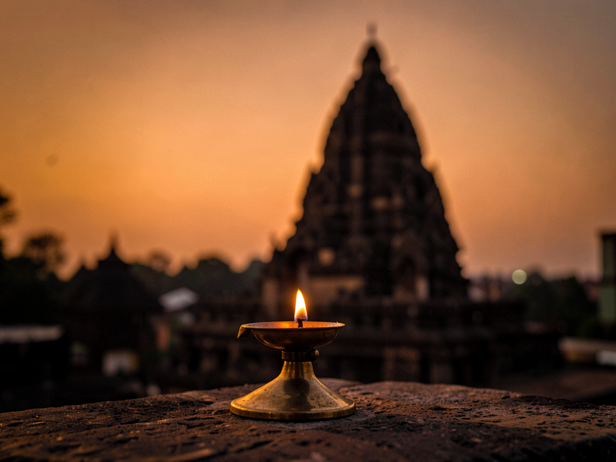
![Dawn's Golden Lamp]()
Dawn's Golden Lamp
Image credit : AI
I witness the dawn's golden light, a symbol of ancient sun worship and its connection to science.
Where mythology and physics part company
The divergence begins with scale. The Sun in most worship traditions is a traveller, it moves across the sky, descends at night, and must be coaxed or helped back. Ra's barque was threatened each night by the serpent Apophis; the Aztecs feared the Sun would not return without sacrifice. This is the geocentric picture, and it is wrong. The Sun does not move across the sky. The Earth rotates. The Sun is not going anywhere; we are the ones turning.
Scale is the second rupture. The Sun in mythological traditions is large, but it is a chariot, a disc, a boat, something that fits in a sky a human can imagine. The actual Sun has a diameter of about 1.39 million kilometres. Earth could fit inside it roughly 1.3 million times. Its surface temperature is around 5,500 degrees Celsius; at the core, temperatures reach approximately 15 million degrees Celsius. The corona, the outer atmosphere visible during a total solar eclipse, is paradoxically hotter than the surface, reaching temperatures above a million degrees, a puzzle that modern solar science, including observations by the Parker Solar Probe launched in 2018, is still working through. No mythological tradition scaled the Sun to anything close to these numbers, because nothing in human perceptual experience could have suggested them.
The third divergence is the Sun's nature as an ordinary star. In every solar worship tradition, the Sun is singular and supreme, the great light set apart from the lesser lights of the night. This is understandable, it is overwhelmingly brighter from where we stand. But the Sun is a G-type main-sequence star, middle-aged at roughly 4.6 billion years, unremarkable by stellar standards. There are stars in the Milky Way that dwarf it. Betelgeuse, the red supergiant in Orion, has a radius roughly 700 times larger. The Sun's singularity is a matter of proximity, not cosmic rank. Worship traditions, by definition, required a singular and supreme object. Astrophysics offers a field of billions.
The Indian sky tradition and where it sits between the two
The Navagraha system, which positions Surya as the central and most powerful of the nine celestial bodies, is interesting precisely because it is not purely mythological. The nine grahas, which include the Sun, Moon, Mars, Mercury, Jupiter, Venus, Saturn, and the shadow bodies Rahu and Ketu, were tracked observationally. Indian astronomers of the classical period calculated planetary positions, predicted eclipses, and built mathematical models of celestial motion. The Aryabhatiya, composed by Aryabhata in 499 CE, correctly proposed that the Earth rotates on its axis and gave a remarkably accurate estimate of its circumference. Aryabhata's solar year calculation, 365 days, 6 hours, 12 minutes, and 30 seconds, is close to the modern figure of 365 days, 5 hours, 48 minutes, and 46 seconds.
This is the Indian tradition at its most interesting: a simultaneous holding of the mythological and the mathematical. Surya is worshipped. The Sun is also measured. The same civilisation that built the Konark temple produced Brahmagupta and Bhaskara. These were not separate projects. The observational precision fed the ritual calendar, and the ritual calendar motivated the observation. Whether that dual holding represents a synthesis or a productive tension depends on what you think science and myth are for.
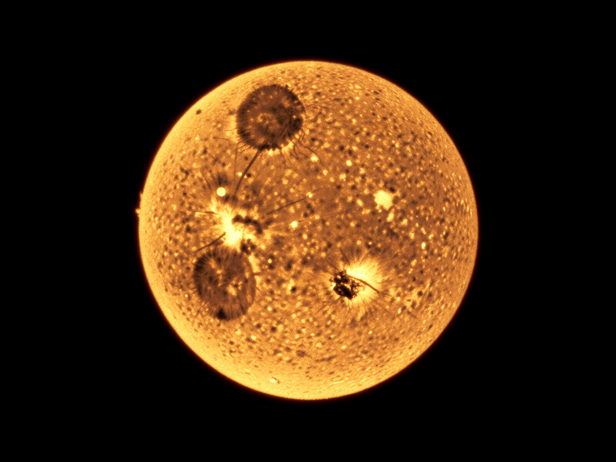
![Sunspot Clusters Revealed]()
Sunspot Clusters Revealed
Image credit : AI
My astrophotography reveals sunspot clusters, a testament to solar science and ancient Vedic sun traditions.
What modern solar science has added that no tradition anticipated
The Sun is not static. It has an eleven-year activity cycle during which the number of sunspots, regions of intense magnetic activity on the surface, rises and falls. At solar maximum, the Sun produces more coronal mass ejections: massive bursts of magnetised plasma that can travel toward Earth and disrupt satellites, power grids, and communications. The most powerful recorded geomagnetic storm, the Carrington Event of 1859, was caused by one such ejection. No worship tradition modelled the Sun as a magnetically variable object with a measurable cycle, because the tools to detect that variability did not exist.
ISRO's Aditya-L1 mission, launched from Sriharikota in September 2023, is positioned at the Lagrange point L1 between Earth and the Sun, about 1.5 million kilometres from Earth. From there it observes the Sun's corona, solar wind, and magnetic field continuously without the interference of Earth's shadow. It is the first dedicated Indian solar observatory, and it is doing exactly what the Jantar Mantar instruments did in their era, watching the Sun carefully, with the best instruments available, to understand what it is actually doing.
The traditions watched the Sun and built meaning from what they saw. The instruments now watch the Sun and build models. The watching is the same act. What changes is what the watching is able to find.