The odds of a civilisation-ending asteroid strike in any given century are low. The odds of a smaller, city-flattening impact are not negligible. Planetary defence is the collective name for the science, engineering, and international coordination that sits between those two facts and the rest of us. It is younger than the smartphone, better funded than it was a decade ago, and still, by most honest assessments, incomplete.
What We Are Actually Watching For
Not every rock in the solar system is a threat. Planetary defence focuses on a specific category: near-Earth objects, or NEOs, which are asteroids and comets whose orbits bring them within 1.3 astronomical units of the Sun, close enough that a gravitational nudge could eventually put them on a path toward Earth. Within that group, the ones that cross Earth's orbital path and measure more than 140 metres across are classified as potentially hazardous objects, or PHOs. An object that size, striking at typical asteroid velocities of 15 to 20 kilometres per second, would release energy in the range of thousands of nuclear weapons. It would not end the species. It would end a region.
The threshold for genuine civilisation risk sits around one kilometre across. Objects of that size and larger hit Earth roughly once every 500,000 years, and the good news is that the survey of objects in that size range is close to complete, NASA estimates that more than 95 percent of kilometre-scale near-Earth asteroids have been catalogued, and none of the known ones are on a collision course. The survey of smaller objects, the 140-metre-to-one-kilometre range, is the open problem. As of the early 2020s, surveys had found roughly 40 percent of the estimated population in that bracket. The rest are untracked.
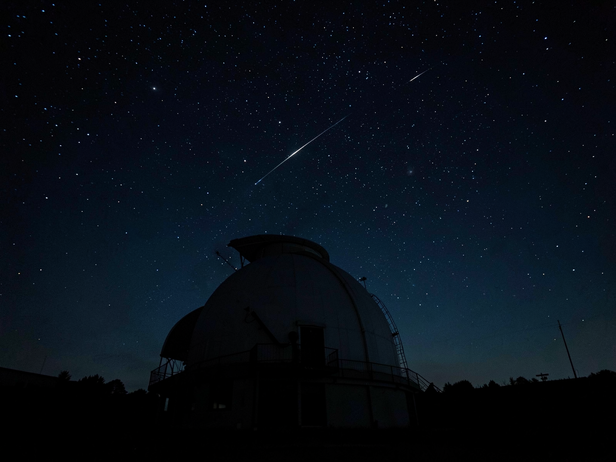
![Observatory Tracks Celestial Object]()
Observatory Tracks Celestial Object
Image credit : AI
I monitor the cosmos, searching for near-Earth objects and potential threats to our planet.
The Telescopes and the Surveys
The primary instruments of planetary defence are ground-based survey telescopes running automated sky patrols every clear night. The Catalina Sky Survey, operating from observatories in Arizona, and Pan-STARRS, running from Haleakalā in Hawaiʻi, together account for the majority of new NEO discoveries. The ATLAS system, also based in Hawaiʻi with additional nodes in Chile and South Africa, is optimised for short-warning detection, objects that slip through the survey net and appear close. These telescopes do not look like the instruments of dramatic science. They are wide-field cameras that photograph the same patches of sky repeatedly, comparing images to catch objects that have moved between frames. The movement is the signature.
NASA's Jet Propulsion Laboratory runs the Center for Near Earth Object Studies, CNEOS, which maintains the catalogue of known NEOs and runs the orbital calculations that determine whether any of them pose a future threat. The European Space Agency runs a parallel operation through its Planetary Defence Office in Darmstadt. When a new object is flagged, both centres independently compute its orbit and cross-check. A discovery only becomes a public alert when the data is solid enough to survive scrutiny.
The next step in the survey infrastructure is space-based. NASA's NEO Surveyor mission, a dedicated infrared space telescope, is designed to find a large fraction of the remaining untracked population in the 140-metre-and-above range. Infrared is the key advantage: asteroids absorb sunlight and re-emit it as heat, making them easier to detect at infrared wavelengths than in visible light, particularly for the dark, carbon-rich types that a visible-light telescope can miss entirely.
The DART Test and What It Proved
Knowing an object is coming is only half the problem. The other half is doing something about it. In September 2022, NASA's Double Asteroid Redirection Test, DART, became the first mission to deliberately change the motion of a solar system body. The target was Dimorphos, the moonlet of the asteroid Didymos, chosen because the pair posed no threat to Earth and because Dimorphos's orbit around Didymos could be measured precisely before and after impact.
DART was a kinetic impactor: a 570-kilogram spacecraft travelling at roughly 6.1 kilometres per second, aimed directly at Dimorphos with no explosive payload. The impact shortened Dimorphos's orbital period around Didymos by 33 minutes, well above the mission's minimum success threshold of 73 seconds. The result confirmed that kinetic impaction works, at least on an object of that size and composition. ESA's Hera mission, launched in October 2024, is en route to Didymos to study the crater and the ejecta cloud in detail, because understanding why the deflection worked as well as it did is as important as knowing that it did.
Kinetic impaction requires years of warning, ideally decades, to move an object enough to change a collision into a near miss. The geometry is unforgiving: a deflection applied early, when the object is still far away, requires only a tiny velocity change. The same deflection applied late, when the object is close, is orders of magnitude harder and may not be possible at all. This is why the survey problem and the deflection problem are the same problem. You cannot deflect what you have not found.
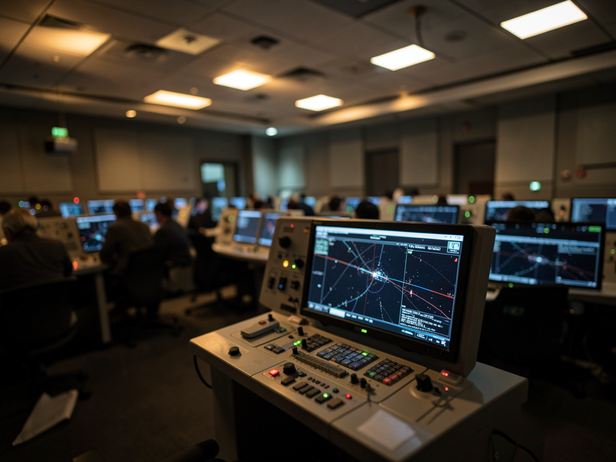
![Mission Control Ready]()
Mission Control Ready
Image credit : AI
I monitor the mission control room, a hub for tracking near-Earth objects and planetary defence.
India's Place in the Watch
India's contribution to planetary science has grown substantially with ISRO's deepening capability. While India does not yet operate a dedicated NEO survey telescope, the scientific infrastructure built around Chandrayaan and Mangalyaan, and the deep-space communication and tracking networks that support them, is directly relevant to planetary defence. The proposed Chandrayaan-4 mission and the ongoing development of the ISRO Telemetry, Tracking and Command Network reflect the kind of independent deep-space capability that planetary defence coordination depends on. Gaganyaan, India's crewed spaceflight programme, and the longer-term ambitions around an Indian space station, represent the institutional depth that makes a country a meaningful partner in any large-scale international response.
The international dimension matters because planetary defence is, by its nature, a problem that cannot be solved by one country. An asteroid does not aim. An impact on the Indian Ocean affects India, Sri Lanka, and every coastal nation in the region. The International Asteroid Warning Network, IAWN, and the Space Mission Planning Advisory Group, SMPAG, exist precisely to coordinate observation data and response planning across agencies. India is a participant in both.
What a Warning Actually Looks Like
The public picture of an asteroid warning tends toward the dramatic. The operational reality is quieter and more uncertain. When a new object is flagged, it carries a probability of impact, often a fraction of a percent, that either rises or falls as more observations come in. The Torino Scale, a one-to-ten index of impact threat, exists to communicate these probabilities without causing unnecessary alarm. In the entire history of the scale, only one object has ever reached Torino 4: asteroid 99942 Apophis, briefly in 2004. Additional observations brought it back to zero. Apophis will make a close pass of Earth in April 2029, coming within 32,000 kilometres, inside the orbital distance of geostationary satellites, but it will not hit.
A real warning, for an object with a genuine non-zero impact probability that does not resolve to zero with more data, would involve a sustained period of observation, independent verification, and eventually a political decision about response. The technical community has rehearsed this sequence through a series of tabletop exercises run by the Planetary Defense Conference. The consistent finding is that the science is ahead of the governance. The telescopes know what to do. The question of who authorises a deflection mission, who pays for it, and who decides what counts as an acceptable risk during the deflection itself, those questions do not yet have clean answers.
The sky is being watched. The catalogue is growing. The deflection technology has been tested and it works. What planetary defence has not yet solved is the gap between a credible warning and a credible response, and that gap is not a technical one.