On 14 July 2015, after travelling roughly 6.4 billion kilometres over nine and a half years, NASA's New Horizons spacecraft made its closest approach to Pluto at a distance of about 12,500 kilometres. The flyby lasted a matter of hours. The data it sent back took more than a year to fully download, at a transmission rate so slow that a single image could take hours to arrive. What that data contained upended nearly every assumption the mission's scientists had built the flyby around.
The World They Expected
Pluto sits in the Kuiper Belt, the vast disc of icy bodies beyond Neptune. Before New Horizons, the best images of Pluto came from the Hubble Space Telescope and showed a blurry, pixelated smear of reddish-brown and pale patches. Scientists knew Pluto had a thin nitrogen atmosphere, a large moon called Charon, and a surface composition that included methane and carbon monoxide ices. What they expected, based on Pluto's size, its distance from the Sun, and the absence of any significant tidal heating, was a geologically inactive world. Old. Cratered. Quiet. A fossil from the early solar system, preserved in cold storage. Mission scientists built their observation sequences around documenting that fossil record, not around explaining why a world this far from the Sun would still be moving.
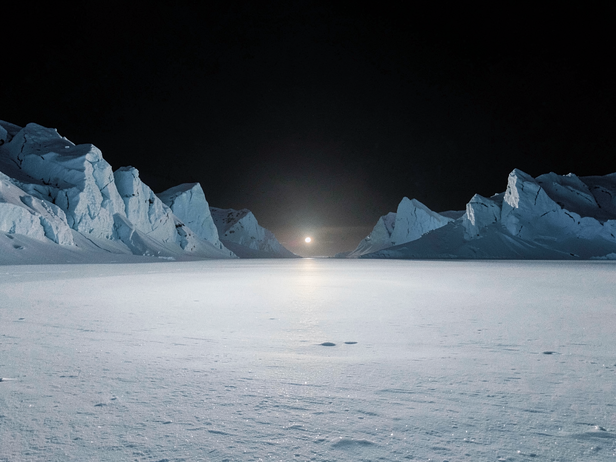
![Pluto's Icy Expanse]()
Pluto's Icy Expanse
Image credit : AI
I witness Pluto's vast nitrogen glacier, a key finding from the New Horizons mission.
Tombaugh Regio and the Glacier That Should Not Be There
The first processed images showed a vast, pale, heart-shaped region now named Tombaugh Regio, after Clyde Tombaugh, who discovered Pluto in 1930. The western lobe of that heart, called Sputnik Planitia, is a roughly 1,000-kilometre-wide basin filled with nitrogen ice. The surface of Sputnik Planitia is almost entirely free of impact craters. In planetary science, craters are a clock. A surface without craters is a young surface, one that has been reshaped recently enough that the craters have been erased. The models suggested Sputnik Planitia's surface is no older than about ten million years, which is geologically recent. On a world that formed 4.5 billion years ago, that means something is actively renewing it. The leading explanation is convection: the nitrogen ice is warm enough at depth to slowly overturn, like a lava lamp in extreme slow motion, each cell taking perhaps half a million years to complete one cycle. The heat source driving that convection is still not fully resolved. Residual heat from Pluto's formation, the decay of radioactive elements in its rocky core, and the weight of the ice itself pressing down are all part of the current models. None of them alone is clean.
Mountains Made of Water Ice
At the edges of Sputnik Planitia, New Horizons found mountains. Not metaphorical mountains, actual ranges rising three to four kilometres above the surrounding plains. The surprise was what they are made of. Nitrogen ice and methane ice are far too soft to hold a mountain's shape at Pluto's surface temperatures, which sit around minus 230 degrees Celsius. The mountains are water ice. At those temperatures, water ice behaves like rock. It is rigid enough to stand. The discovery confirmed that Pluto has a substantial water-ice bedrock beneath its more volatile surface layers, a structural fact the pre-flyby models had not ruled out but had not emphasised either. The mountains appear geologically young as well, with few craters on their flanks, suggesting they formed within the last hundred million years.
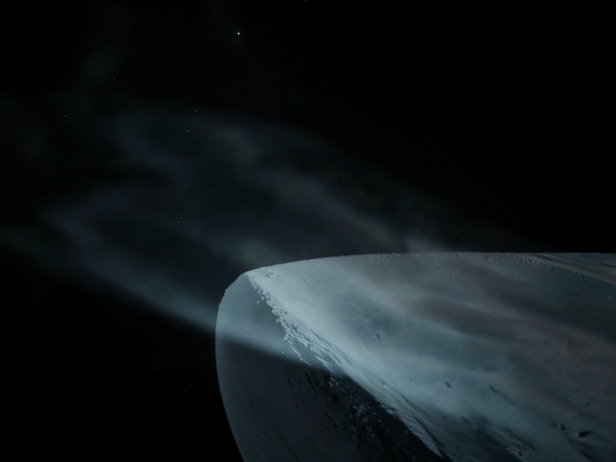
![Icy World's Hazy Limb]()
Icy World's Hazy Limb
Image credit : AI
Observing the layered atmospheric haze above Pluto's icy limb, a key finding from the New Horizons mission.
An Atmosphere With Weather
Pluto's atmosphere was known before New Horizons, but the spacecraft's instruments measured it in a way no Earth-based observation could. The atmosphere is mostly nitrogen, with traces of methane and carbon monoxide, and it extends much higher above the surface than models had predicted, up to around 1,600 kilometres. More striking was the haze. New Horizons captured backlit images of Pluto's limb showing multiple distinct haze layers, similar in structure to the haze layers in Titan's atmosphere, though far thinner. The haze forms when ultraviolet sunlight breaks apart methane molecules in the upper atmosphere, producing complex organic compounds called tholins, which drift down and coat the surface in reddish-brown material. The reddish tinge visible in Pluto's colouring was already suspected to come from tholins, but the layered haze structure, the height of the atmosphere, and the complexity of the chemistry happening there were not anticipated at the level the data showed.
Why the Surprise Matters
The mission team's principal investigator, Alan Stern of the Southwest Research Institute, had spent decades fighting to get New Horizons funded and launched. He and his colleagues had argued that Pluto was worth visiting precisely because it was an unexplored world. What they did not fully anticipate was how wrong the baseline assumptions would turn out to be. The assumption that small, cold, distant bodies are geologically dead has now been tested and failed at Pluto. It had already been complicated by the discovery of active geysers on Enceladus and volcanic activity on Io, but both of those worlds have tidal heating from nearby gas giants. Pluto has no such neighbour. Its activity, if it is real and ongoing, comes from somewhere else. That question has reshaped how planetary scientists think about the Kuiper Belt as a whole, not as a graveyard of inert primordial debris, but as a region that may contain worlds with their own internal dynamics, their own weather, their own geological clocks still running. New Horizons is now travelling deeper into the Kuiper Belt. In January 2019 it flew past a small contact-binary object called Arrokoth, about 1.6 billion kilometres beyond Pluto, returning the most distant close-up images of a solar system body ever taken. The spacecraft still has power and instruments functioning. Pluto, meanwhile, remains the thing that made the mission's scientists realise they had underestimated what a dwarf planet could be.