On any given night, a Vedic astrologer and a Western astrologer looking at the same sky will place the same planet in signs that are roughly 23 to 24 degrees apart. Neither is misreading the sky. They are measuring from different starting lines, and the reason those starting lines drifted apart is a motion of Earth's axis so slow that a single human lifetime barely registers it.
The Wobble That Moves the Sky
Earth spins on a tilted axis, and that axis does not stay fixed. It traces a slow circle, the way a spinning top wobbles before it falls. One full circuit takes approximately 25,772 years. Astronomers call this axial precession. Its effect on the sky is that the point where the Sun crosses the celestial equator heading north, the March equinox, drifts westward through the background of stars at roughly 50.3 arcseconds per year. That sounds negligible. Over two thousand years, it adds up to about 23 to 24 degrees: almost one full zodiac sign.
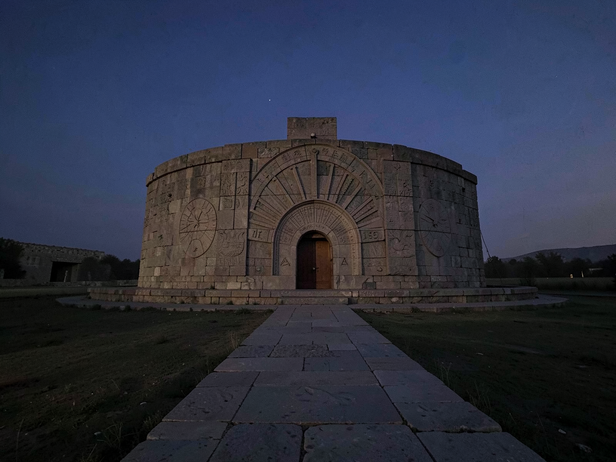
![Ancient Observatory at Dusk]()
Ancient Observatory at Dusk
Image credit : AI
I observe the Jantar Mantar style instrument at dusk, a testament to ancient precision. Understanding the precession of equinoxes astrology is key to its function.
Two Zodiacs, Two Choices
Western astrology, as it was codified in the Hellenistic world around the second century CE, tied its zodiac to the seasons. The sign Aries begins at the March equinox, every year, regardless of where the stars are. This is the tropical zodiac, anchored to Earth's relationship with the Sun, not to the constellations behind it. When Ptolemy wrote the Tetrabiblos, the equinox sat close to the stars of Aries, so the seasonal and the stellar zodiacs roughly agreed. They have been separating ever since.
Indian astronomy took a different path. The Panchang, the traditional almanac used across Hindu calendar systems, works with the sidereal zodiac, which is fixed to the actual star background. The starting point is a fixed reference among the stars, not a moving seasonal moment. When Vedic astrology says the Sun is in Mesha, it means the Sun is near the stars historically associated with that region of sky. The position is real in the sense that a telescope would confirm it.
What the Ayanamsa Actually Is
The ayanamsa is the angular gap between the two starting points at any given moment. It is not a single agreed number. Several schools of Vedic astronomy have calculated it differently, and the differences matter. The Lahiri ayanamsa, adopted by the Indian government's Calendar Reform Committee in 1952 for the national Saka calendar, currently sits close to 23 degrees 51 minutes. The Raman ayanamsa and the Krishnamurti ayanamsa give slightly different values, each tracing back to a different assumption about where the sidereal zodiac's zero point sits among the stars.
To convert a Western tropical position to a Vedic sidereal one, you subtract the ayanamsa for that date. A planet at 15 degrees tropical Taurus in 2025 sits at roughly 21 degrees sidereal Aries under the Lahiri system. That is not an error in either system. It is the same physical object described from two different coordinate frames.
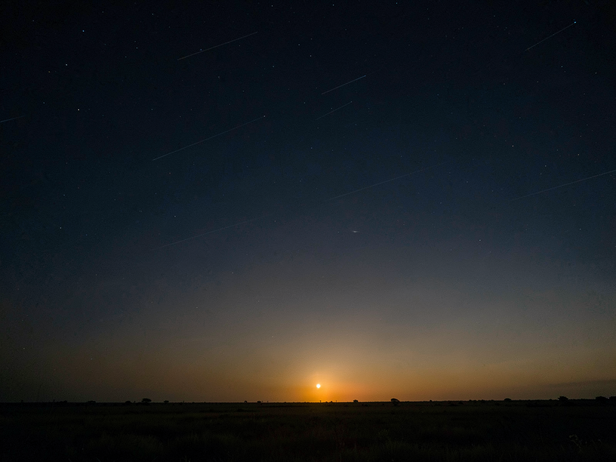
![Indian Night Sky Planet]()
Indian Night Sky Planet
Image credit : AI
I observed a bright planet on the horizon during a long-exposure astrophotography session, showcasing the deep blue-black sky and warm amber glow. This reminds me of the precession of equinoxes astrology.
Why the Gap Keeps Growing
Precession does not stop. The ayanamsa increases by roughly 50 arcseconds, about 1 degree, every 72 years. Around 285 CE, depending on which historian's calculation you accept, the two zodiacs were briefly aligned. Before that date the sidereal zodiac was ahead of the tropical; after it, the tropical pulled ahead. The gap will continue to widen until, in roughly 23,000 years, the equinox will have completed its full circuit and the two zodiacs will briefly coincide again before separating once more in the other direction.
This also means that the familiar Western star signs and the actual constellations they are named after no longer match. Someone born under tropical Aries is, in terms of where the Sun physically sits among the stars, born under the stars of Pisces. The constellation Aries, in the stellar sense, now hosts the Sun during what the tropical zodiac calls Taurus. Neither system is wrong about this, they simply are not trying to do the same thing.
The Astronomy Behind the Almanac
The Panchang's precision on this point is not incidental. Classical Indian astronomy, Aryabhata in the fifth century, Brahmagupta in the seventh, the Surya Siddhanta as a working computational text, treated precession as a known and measurable phenomenon. Aryabhata's value for the sidereal year, the time it takes Earth to complete one orbit relative to the fixed stars, was accurate to within a few seconds of the modern figure. The tradition that produced the Panchang was doing positional astronomy with real numbers, not only ritual calendar-keeping.
The ayanamsa is where that astronomy surfaces in everyday life. Every time a Panchang gives a nakshatra position, a tithi, or a planetary longitude, it is applying a correction that accounts for 2,000 years of accumulated axial wobble. The correction is not mystical. It is the same physical fact that makes GPS satellites require relativistic adjustments to stay accurate, a universe that does not hold still, measured by people who noticed it was moving.