The first stage of a rocket burns out roughly two minutes after liftoff. At that point it is an empty aluminium cylinder tumbling toward the ocean, and the spacecraft above it is already moving faster than a rifle bullet. Jettisoning that dead weight is not a design quirk, it is the only reason orbit is reachable at all.
The tyranny of the rocket equation
To reach low Earth orbit, a vehicle needs to accelerate to about 7.8 kilometres per second. The Tsiolkovsky rocket equation, derived in 1903, makes the problem brutally clear: the fuel required to accelerate a given mass grows exponentially with the velocity change demanded. If you carry your empty fuel tanks all the way to orbit, you are spending enormous energy hauling dead weight that contributes nothing to the final velocity. The numbers close only if you shed mass continuously as fuel is consumed.
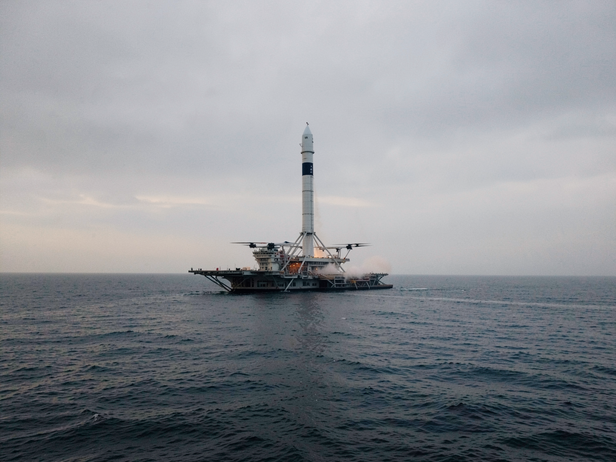
![Coastal Rocket Launch]()
Coastal Rocket Launch
Image credit : AI
I observe the initial ascent of a rocket, a faint streak against the stars, highlighting the early stages of how rockets reach orbit.
What staging actually does
A staged rocket is several complete rocket vehicles stacked on top of each other, each with its own engines and propellant. The first stage, the largest, lifts the whole stack off the ground and burns until its tanks are dry, typically at altitudes between 60 and 80 kilometres. It then separates and falls away. The second stage ignites in the near-vacuum above, pushing a much lighter vehicle. Some missions add a third stage or a kick motor for the final insertion burn. Each separation event is the rocket discarding mass it no longer needs, which makes the next engine's job dramatically easier. Saturn V, which carried Apollo missions to the Moon, used three stages. The first stage alone weighed about 2.3 million kilograms at liftoff. By the time the third stage finished its burn, the payload heading to the Moon was roughly 47,000 kilograms, about two percent of the launch mass.
What gets thrown away and where it lands
First stages typically separate over the ocean downrange from the launch site. For rockets launching from Sriharikota, ISRO's Satish Dhawan Space Centre on the Andhra Pradesh coast, spent stages fall into the Bay of Bengal. Second stages, which separate at much higher altitudes and velocities, often end up in uncontrolled reentry trajectories, burning up in the atmosphere weeks or years later. Payload fairings, the clamshell nose cone that protects the satellite during ascent through the atmosphere, are jettisoned at around 120 kilometres altitude, once aerodynamic pressure drops below a threshold. They are among the more expensive single-use components on a rocket, which is why SpaceX began catching them with ships using large nets. ISRO's PSLV has flown over 60 missions with a four-stage design alternating solid and liquid propulsion, a configuration chosen specifically to balance the performance needs of different orbital regimes.
![Rocket Lands on Drone Ship]()
Rocket Lands on Drone Ship
Image credit : AI
I observe a rocket booster on a drone ship, showcasing reusable rocket technology. The landing legs are deployed after a successful descent.
The economics of throwing things away
A PSLV first stage costs a significant fraction of the total launch vehicle cost and is used exactly once. Across the industry, this single-use logic kept launch costs high for decades. The shift began when SpaceX demonstrated that a first stage booster could reenter the atmosphere under powered control, deploy landing legs, and touch down vertically, first on land in December 2015, then routinely on drone ships at sea. Falcon 9 boosters have now flown more than twenty missions each. Reusability does not eliminate staging; it eliminates the throwaway part of the first stage. The upper stage is still expended. The fairing is recovered when possible. The logic of the rocket equation does not change, reusability just means the hardware comes home instead of sinking. ISRO is developing its own reusable launch vehicle technology under the RLV programme, with demonstrator flights testing the landing and reuse concept from the Challakere test range.
Why some stages are solid and some are liquid
Solid rocket motors are simple, storable, and produce high thrust quickly, useful for the first moments of flight when the vehicle needs to clear the launch tower fast. They cannot be throttled or shut down once lit, which is why they suit the first stage or strap-on boosters rather than the precision burns needed for orbital insertion. Liquid engines burn a fuel and an oxidiser pumped from separate tanks; they can be throttled, restarted, and shut down on command. The trade-off is complexity: turbopumps, cryogenic handling for liquid oxygen, and plumbing that must work in vacuum. ISRO's GSLV Mk III, the vehicle that carried Chandrayaan-3 to its transfer orbit in July 2023, uses solid strap-on motors for initial thrust, a liquid core stage, and a cryogenic upper stage developed entirely in India after years of technology denial from foreign suppliers. The cryogenic stage was the hardest piece. It is also the piece that makes heavy payloads to geostationary orbit possible.
Staging is not an engineering preference. It is a mathematical necessity written into the physics of propulsion. Every kilogram that separates and falls away is a kilogram the next engine does not have to accelerate, and in a regime where velocity requirements are exponential, that arithmetic compounds fast. The question the industry is now answering is not whether to stage, but whether the stages that fall away have to stay fallen.