A spacecraft has no plug socket and no fuel station. Every watt it uses must be generated onboard, stored carefully, and spent on exactly the right thing at exactly the right moment. That constraint, the power budget, is the quiet architect behind almost every decision a mission makes, from which camera turns on to whether a lander survives its first night.
Where the power comes from
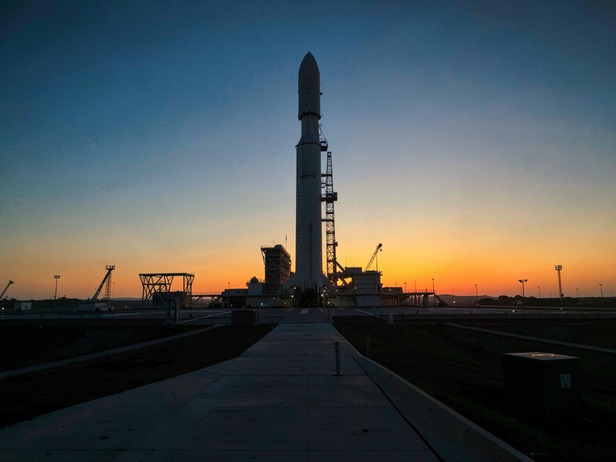
![Dawn Rocket Launch Preparation]()
Dawn Rocket Launch Preparation
Image credit : AI
A rocket awaits its ascent at dawn, highlighting the intricate infrastructure of space missions. Understanding spacecraft power systems is crucial for success.
Solar panels are the default answer for missions within roughly the orbit of Jupiter. The International Space Station carries about 2,500 square metres of solar arrays and generates close to 120 kilowatts at peak, enough to power around 40 average Indian homes. Chandrayaan-3's Vikram lander carried a far more modest 738-watt solar panel, sized precisely for what the mission needed to do during a single lunar day of 14 Earth days.
The further a spacecraft travels from the Sun, the weaker that source becomes. Solar intensity falls with the square of distance: at Mars, panels receive roughly 43 percent of what they would at Earth. At Jupiter, about 3.5 percent. Beyond that, solar power becomes impractical. Voyager 1 and Voyager 2, now in interstellar space, run on radioisotope thermoelectric generators, RTGs, that convert the heat from decaying plutonium-238 into electricity. Each Voyager launched with roughly 470 watts. Decades later, each produces around 250 watts, and NASA engineers schedule instrument use around that shrinking allowance with the precision of a household managing a power cut.
The battery problem on a body with nights
Generating power in sunlight is one challenge. Surviving darkness is another. The Moon's night lasts 14 Earth days, with temperatures dropping to around minus 180 degrees Celsius. Vikram and Pragyan were designed for a single lunar day, not a night. When the Sun set over the Shiv Shakti Point landing site in September 2023, ISRO put both into sleep mode hoping the batteries and electronics would survive the cold. They did not resume contact. That outcome was not a failure of design, it was the power budget making an honest statement about what the hardware was built to endure.
Mars rovers face the same arithmetic. Opportunity, NASA's golf-cart-sized rover, landed in 2004 with a design life of 90 Martian days. It ran for 5,111 Martian days, nearly 15 Earth years, because its solar panels kept producing enough power and engineers learned to manage dust accumulation and Martian winters carefully. The rover finally fell silent in 2018 after a global dust storm cut solar input to near zero and drained the batteries beyond recovery. The power budget had held for 15 years. One storm settled the account.
Nuclear power and the outer solar system
![RTG Unit on Stone]()
RTG Unit on Stone
Image credit : AI
A compact RTG nuclear power unit, essential for deep space exploration, rests on dark stone under directional light.
Curiosity and Perseverance, NASA's later Mars rovers, use Multi-Mission Radioisotope Thermoelectric Generators rather than solar panels. Curiosity's MMRTG produces about 110 watts at the start of a mission and degrades slowly over years. That number sounds small, a single incandescent bulb, but it runs continuously, day and night, through dust storms, through winter, through everything. The power budget becomes more predictable, and the mission can be designed around a steady baseline rather than a variable one.
The Cassini spacecraft, which orbited Saturn from 2004 to 2017, carried three RTGs producing around 880 watts at launch. Saturn receives only about 1 percent of the solar energy that Earth does, making RTGs the only practical option. Cassini used that power to run cameras, spectrometers, a radar mapper, and a magnetometer simultaneously, transmitting data back across more than a billion kilometres to receiving stations on Earth including ISRO's Deep Space Network antenna at Byalalu near Bengaluru.
How engineers actually write a power budget
Every instrument, heater, transmitter, and computer on a spacecraft carries a power number in watts. Mission designers add those numbers up against the available supply and find they almost never balance on the first attempt. The process of trimming, prioritising, and scheduling is called power mode planning. A spacecraft in safe mode, the emergency configuration it falls into when something goes wrong, typically runs only the bare minimum: the radio, the attitude control system, and the heaters keeping critical components above their survival temperature. Everything else waits.
Aditya-L1, India's solar observatory launched in September 2023 and now stationed at the Sun-Earth Lagrange point L1, carries seven scientific payloads drawing power from solar panels and a battery system designed to handle the brief eclipses the spacecraft experiences. The power budget there is generous by deep-space standards, L1 sits only about 1.5 million kilometres from Earth, well within efficient solar range, but the engineering team still maps every instrument's duty cycle against available watts before deciding what runs when.
What the power budget decides that you never see
The power budget is where mission ambition meets physical reality. It decides whether a camera can take a high-resolution image or must settle for a lower-resolution one that costs fewer watts to process and transmit. It decides whether a heater keeps a battery warm enough to hold charge through a cold night, or whether that power goes to a spectrometer instead. It decided, in the case of the Philae lander that touched down on Comet 67P in 2014, that a landing in shadow rather than sunlight would end the mission in 60 hours rather than months, which is exactly what happened.
Gaganyaan, India's crewed orbital mission in development, faces a version of this problem at human scale. Life support, thermal control, communication, propulsion, and crew equipment all draw from the same solar-powered supply. The difference is that the margin for error is a person sitting inside the spacecraft. Power budgets on crewed missions carry reserves that robotic missions cannot always afford. The arithmetic is the same. The stakes are different. Every mission that has ever left Earth carried a number, total watts available, and everything it achieved happened inside that number.