At 9:20 a.m. local time on 15 February 2013, commuters in Chelyabinsk, Russia, watched a point of light brighter than the sun streak across a cloudless winter sky. Thirty-two seconds later, the object, a stony asteroid roughly 20 metres across and weighing around 500,000 tonnes, disintegrated in a superheated airburst at an altitude of about 30 kilometres. The shockwave that followed shattered windows across six cities, damaged over 7,000 buildings, and sent 1,500 people to hospital, most of them cut by flying glass. Not a single professional telescope had seen it coming.
What the atmosphere did to a 500,000-tonne rock
The asteroid entered at roughly 19 kilometres per second, about 55 times the speed of a rifle bullet. At that velocity, the air in front of it cannot move out of the way fast enough. It compresses, superheats, and begins to ablate the rock's surface. Pressure built so fast that the object did not survive long enough to reach the ground as a single mass. Instead, it fragmented and released most of its kinetic energy in one violent pulse at altitude: an airburst estimated by NASA at around 500 kilotons of TNT equivalent, thirty times the yield of the bomb dropped on Hiroshima. The fireball briefly outshone the sun as seen from the ground. Fragments did reach the surface, the largest recovered piece weighed 654 kilograms and was pulled from the bottom of Lake Chebarkul, but the real damage came from the shockwave, not the debris.
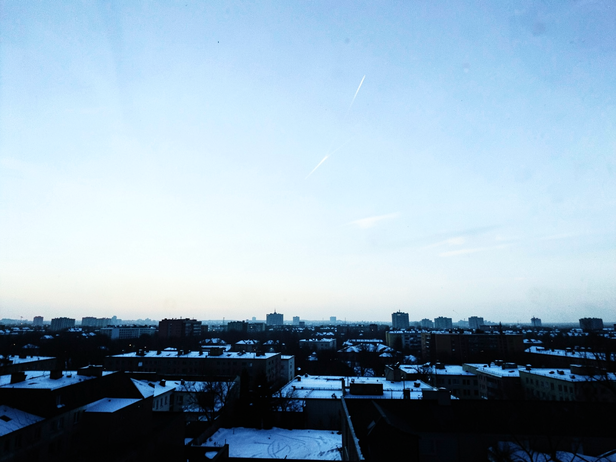
![Winter Sky Over City]()
Winter Sky Over City
Image credit : AI
A bright streak cuts through the cold winter sky over a snow-covered city, reminiscent of the Chelyabinsk asteroid event.
Why nobody saw it until it was already overhead
The Chelyabinsk impactor arrived from the direction of the sun. Ground-based telescopes cannot point sunward, which means there is a permanent blind spot in every asteroid survey ever conducted. The object was also small by the standards of what planetary defence programmes track. NASA's Spaceguard survey, launched in the 1990s, was designed to find near-Earth objects larger than one kilometre, the civilisation-ending class. A 20-metre rock carries enough energy to flatten a city, but it is roughly the size of a four-storey building and reflects very little light. At the distances where it would have been detectable weeks out, it was simply too dim. On the same day as the Chelyabinsk event, a completely separate asteroid called 2012 DA14, 45 metres across, made a record-close pass of Earth that had been tracked for a year. The two events were unrelated and coincidental, which made the point about survey gaps harder to ignore.
What the data showed that no laboratory could have staged
Because Chelyabinsk is a large industrial city with dashboard cameras in nearly every car, the airburst was recorded from dozens of angles simultaneously. Scientists ended up with an accidental sensor array. Infrasound stations, microphones designed to detect nuclear tests, picked up the shockwave at monitoring posts as far away as Antarctica. Seismometers registered the ground impact of the pressure wave. Satellite instruments measured the thermal flash. Together, the data let researchers reconstruct the object's trajectory, composition, mass, and energy release with a precision no planned experiment could have achieved. The asteroid was classified as a LL chondrite, a common stony type, not iron, which is partly why it broke apart rather than punching through to the surface intact.
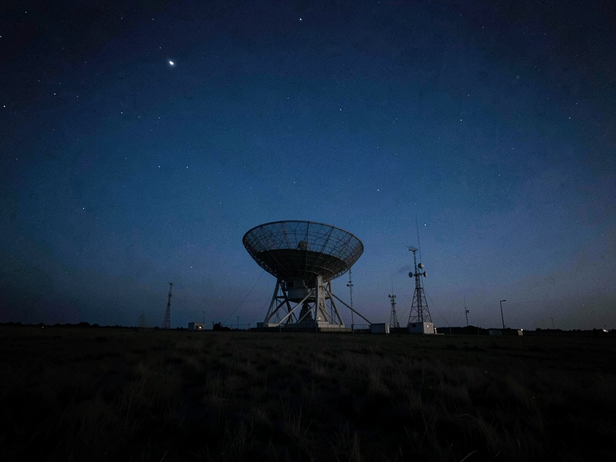
![Remote Observatory at Twilight]()
Remote Observatory at Twilight
Image credit : AI
I witness the vastness of the sky from a remote observatory, a silent sentinel against the encroaching night. The Chelyabinsk asteroid event reminds us of the need for such vigilance.
What changed after Chelyabinsk
The event accelerated funding and political attention for planetary defence in a way that years of scientific argument had not. NASA formally established its Planetary Defense Coordination Office in 2016. The European Space Agency expanded its Space Situational Awareness programme. The joint NASA-ESA DART mission, launched in 2021, deliberately impacted the asteroid Dimorphos in September 2022 and successfully altered its orbit, the first time humanity had intentionally changed the trajectory of a natural space object. ISRO has not yet launched a dedicated planetary defence mission, but Indian researchers contribute to global near-Earth object cataloguing networks, and Gaganyaan-era infrastructure is part of a broader conversation about India's role in space situational awareness. The specific gap that Chelyabinsk exposed, sunward blind spots, is the primary motivation behind the proposed NEO Surveyor space telescope, designed to orbit at a vantage point where it can scan the sky regions ground telescopes cannot reach.
The 32 seconds over Chelyabinsk were not an anomaly in the statistical sense. Objects of that size hit Earth's atmosphere roughly every few decades. What was anomalous was that one finally did it over a large city, in daylight, in the age of ubiquitous cameras and global infrasound networks, and left behind enough data to turn a near-disaster into the most thoroughly studied impact event in history. The lesson was not that the sky is more dangerous than we thought. It was that the part of the sky we had been watching was a fraction of the whole.