The clock on a launch day is not counting down to a decision. It is counting down to a moment the solar system has already scheduled, and the rocket either meets it or waits. That gap in time, sometimes ninety seconds wide, sometimes thirty minutes, occasionally a few hours, is the launch window, and everything on the pad is arranged around it.
The solar system does not wait for a checklist
Every destination in space is moving. The Moon is moving. Mars is moving. The International Space Station completes an orbit every ninety minutes. A rocket launched at the wrong moment would arrive where its target was, not where it is. The launch window is the slice of time during which a spacecraft, if it leaves Earth right now, can reach its destination using an amount of fuel that actually fits inside the vehicle.
For a mission to Mars, the window opens roughly every 26 months, when Earth and Mars reach a geometry called a Hohmann transfer opportunity, the moment when the two planets are positioned so that a spacecraft coasting on an elliptical arc will intercept Mars after about seven months of travel. India's Mangalyaan, launched from Sriharikota in November 2013, had to leave during that window. ISRO had one chance. The next window would have arrived in early 2016, and the spacecraft would have sat on the ground for over two years, draining budget and risking component degradation.
For low Earth orbit missions, crew transfers to the ISS, for instance, the window is set by the station's orbital plane. Earth rotates beneath that plane, and a launch site passes through the correct alignment for only a few minutes each orbit. Miss the pass and the next one arrives ninety minutes later. The fuel penalty for chasing the wrong plane can be enormous, sometimes mission-ending.
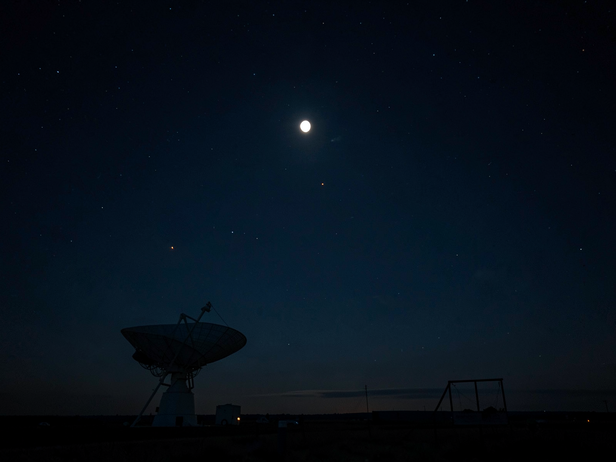
![Moonlit Mars Observation]()
Moonlit Mars Observation
Image credit : AI
I witness the celestial dance of the full moon and Mars, a scene framed by a radio telescope, reminding me of the precision needed for a Mars mission launch window.
What the trajectory planners are actually calculating
The engineers who compute a launch window are solving a problem with many moving parts locked together. The departure point is fixed, Sriharikota, Kennedy Space Center, Baikonur. The destination's position is known precisely. The rocket's performance is known. The question is: at what moment does the departure point, rotating with Earth at roughly 1,670 kilometres per hour at the equator, align with the trajectory the spacecraft needs to follow?
That alignment is called the launch azimuth, the compass bearing the rocket must fly immediately after liftoff. Most launch sites have safety corridors that restrict which azimuths are legal. Sriharikota's geography pushes most ISRO missions to a south-easterly azimuth over the Bay of Bengal, keeping debris away from populated land. If the required azimuth for a given window falls outside the legal corridor, that window closes regardless of the orbital geometry. The window that looks open on a celestial chart may be closed on a map.
Planetary missions add another layer: the parking orbit. Chandrayaan-3, launched in July 2023, did not go straight to the Moon. It circled Earth in progressively larger ellipses before the final burn sent it moonward. Each manoeuvre had to happen at a specific point in the orbit. The launch window set the starting conditions for a chain of burns that had to land Vikram on the lunar south pole in late August, when the Sun would be at the right angle to power the solar panels and illuminate the surface for the rover. A launch a week earlier or later would have shifted the entire chain.
What closes a window before the button is pressed
Weather is the most common reason a window closes on the day. This is not about rain on the pad. A rocket punching through the atmosphere generates enormous electrical charge. If there is a thunderstorm within a defined radius, or if the clouds at altitude carry enough electric field, the vehicle could trigger a lightning strike on itself, a phenomenon called triboelectric discharge. The US Air Force's 45th Weather Squadron, which clears Florida launches, uses a set of lightning launch commit criteria that can halt a countdown even under a blue sky if the upper-atmosphere electric field is wrong. ISRO's meteorological team at Sriharikota performs the same function for launches from the second launch pad.
Beyond weather, a window closes when another object is in the way. Space is not empty along a departure trajectory. The conjunction assessment teams at mission control check whether any tracked object, a defunct satellite, a rocket body, a catalogued fragment, will occupy the same volume of space during the first minutes of flight. If the probability of collision exceeds a threshold, the window closes. As the number of objects in low Earth orbit grows, this check is becoming more consequential.
Hardware holds close windows too. The Gaganyaan programme, India's human spaceflight mission, carries abort systems that must be verified live before crew boards. A sensor reading outside its expected range can pause the count. The window does not pause with it. If the hold runs past the window's end, the crew deboards and the attempt is scrubbed.
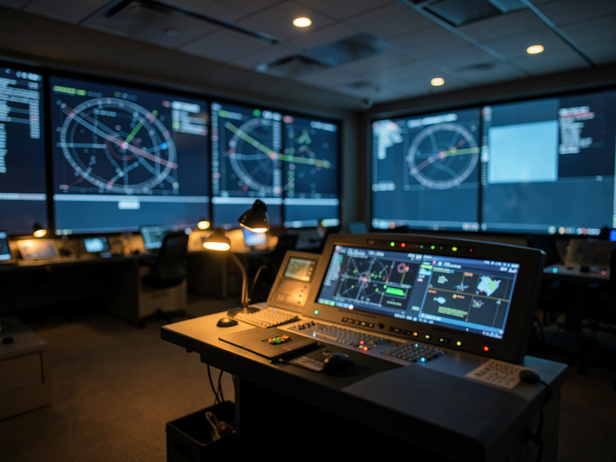
![Mission Control Ambience]()
Mission Control Ambience
Image credit : AI
I see orbital track diagrams on large screens, hinting at the complexities of a rocket launch window.
What happens when the window closes
A scrub, the technical term for a cancelled attempt, is not a failure. It is the system working. The cost is time: the vehicle must be safed, propellants sometimes drained and replaced, systems re-checked, and the next window scheduled. For a mission to the ISS, the next window may be the following day. For a Mars mission, it is 26 months away.
The most famous near-miss in window history is Apollo 13. The mission launched on time in April 1970, within its window. The explosion in the service module happened two days later, on the way to the Moon. The window that mattered then was not the departure window but the free-return trajectory, a path that used the Moon's gravity to sling the crew back to Earth without a working engine. That path was available only because the mission had launched when it did. A different window would have produced a different free-return geometry, and the outcome might not have been a safe splashdown.
The window, in other words, is not just a bureaucratic formality on a countdown sheet. It is the moment when the physics of the solar system briefly agrees with the engineering of the vehicle and the safety of the corridor and the patience of the weather. All three have to say yes at the same time. When any one of them says no, the clock stops and the solar system keeps moving.