The rocket goes up. The rocket comes down. That is the whole of a suborbital flight, and it is genuinely impressive, but the word orbital describes something so different in kind that the two share almost nothing except the launch pad.
A suborbital vehicle needs enough velocity to punch through the atmosphere and reach a target altitude, then it falls. An orbital vehicle needs to go sideways fast enough that as it falls, the Earth curves away beneath it at the same rate. It is not higher. It is moving so quickly, roughly 7.9 kilometres per second at low Earth orbit, that it is perpetually falling and perpetually missing the ground. That distinction is the entire story of why orbital spaceflight costs a hundred times more, takes years longer to develop, and demands engineering that suborbital flight simply does not.
The Numbers That Separate the Two
ISRO's Gaganyaan capsule, designed to carry Indian astronauts to orbit, must reach approximately 7.8 km/s of horizontal velocity. Blue Origin's New Shepard, the most-flown suborbital vehicle currently operating, peaks at around 1 km/s. The gap is not a rounding error. Kinetic energy scales with the square of velocity, so an orbital vehicle carries roughly sixty times more kinetic energy than a suborbital one at apogee. All of that energy has to be shed on reentry, which is why orbital heat shields are thick ablative structures engineered to survive temperatures above 1,600 degrees Celsius, while suborbital vehicles reenter slowly enough that a simpler thermal protection system handles the job.
Mangalyaan, India's Mars Orbiter Mission, had to reach escape velocity of about 11.2 km/s to leave Earth's gravitational well entirely. Suborbital flight sits at the other end of that scale, closer to a very tall ballistic arc than to anything that could reach another world.
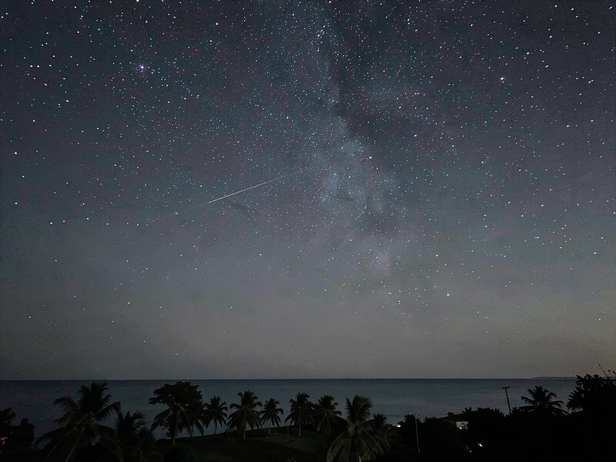
![Starry Indian Coastline]()
Starry Indian Coastline
Image credit : AI
I witness the vastness of space above a serene Indian coast, a reminder of our journey towards orbital missions.
What Orbital Actually Means for a Mission
Because an orbital spacecraft is in continuous free fall around Earth, everything aboard it is weightless. Astronauts aboard Gaganyaan will experience genuine microgravity for the duration of their mission. A passenger on a suborbital hop gets three to four minutes of weightlessness at the top of the arc, real weightlessness, the same physics, before the vehicle begins its descent. The experience is authentic; the duration and the orbital mechanics are not comparable.
Orbital flight also means the vehicle crosses time zones, passes through the Van Allen radiation belts on the way to higher orbits, and must manage attitude, power, thermal control, and life support for hours or days rather than minutes. The Chandrayaan-3 mission spent roughly forty days travelling to the Moon after achieving Earth orbit, adjusting its trajectory through a series of orbit-raising manoeuvres before the final lunar transfer. None of that complexity exists in a suborbital profile.
Why Suborbital Is Still a Hard Problem
Calling suborbital flight simpler is not the same as calling it easy. Reaching the Kármán line, 100 kilometres, the conventional boundary of space, requires a vehicle that can survive extreme aerodynamic stress on ascent, manage propellant efficiently, and return intact. Vikram Sarabhai's early sounding rockets launched from Thumba in Kerala in the 1960s were suborbital, and they were the foundation on which ISRO was built. The ROHINI sounding rockets that followed, and the generations of scientists who flew experiments on them, created the institutional knowledge that eventually produced the PSLV.
Suborbital platforms are genuinely useful for microgravity experiments that need only minutes of weightlessness, atmospheric research, and technology demonstration. Several space agencies and private operators use them for exactly this. The point is not that suborbital flight is a toy, it is that it solves a different problem, with different hardware, at a different cost.
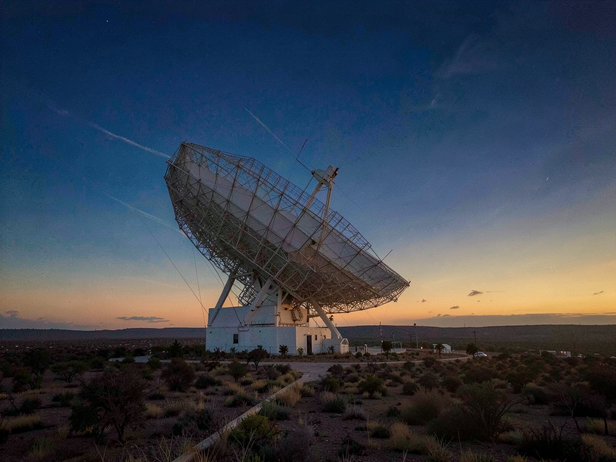
![Radio Telescope at Dusk]()
Radio Telescope at Dusk
Image credit : AI
I'm studying the cosmos with this radio telescope, a key element in understanding orbital velocity.
The Orbital Problem India Is Solving
Gaganyaan is scheduled to carry Indian astronauts to low Earth orbit, making India only the fourth nation to independently send humans to space after the Soviet Union, the United States, and China. The LVM3 rocket, formerly GSLV Mk III, that will launch the mission generates enough thrust to place the capsule into an orbit where it moves at the velocity that keeps it falling around the planet indefinitely. Sriharikota's geography, sitting close to the equator, gives ISRO a natural advantage: launches heading east pick up extra velocity from Earth's rotation, reducing the propellant needed to reach orbital speed.
Shubhanshu Shukla, the IAF Group Captain selected as a Gaganyaan astronaut, will experience that perpetual fall firsthand, an entirely different physical and engineering reality from anything a suborbital flight delivers. The altitude might look similar on a diagram. The velocity, the energy, and the complexity are not in the same category at all.