The Sun does not burn at a steady rate. Every eleven years, give or take a year, it passes through a complete cycle of magnetic activity, from a minimum so quiet that its disk can go weeks without a single dark patch, to a maximum where dozens of sunspots cluster in active regions capable of hurling billions of tonnes of plasma toward Earth. The count of those spots is the oldest continuous index in solar science, and it still tells researchers more about the Sun's interior than almost any other measurement.
What a Sunspot Actually Is
Sunspots are regions where the Sun's magnetic field punches through the photosphere with enough force to suppress the convective churning that normally keeps the surface at around 5,500 degrees Celsius. Inside the spot, that convection is blocked, so the area cools to roughly 3,500 degrees, still hotter than most stars, but dim enough against the surrounding photosphere to appear black. A large sunspot group can span an area wider than Jupiter.
They always come in pairs or clusters with opposite magnetic polarity, one end of a magnetic loop arching through the surface. When those loops become tangled and snap, reconnecting in a different configuration, they release the energy stored in the field as solar flares and coronal mass ejections. The spots themselves are not the danger. They are the map of where the danger is building.
![Sun's Surface Through Filter]()
Sun's Surface Through Filter
Image credit : AI
Observing the Sun's surface and its sunspot count through a solar filter. A glimpse into solar activity.
How the Cycle Is Counted
The systematic count began with Swiss astronomer Rudolf Wolf in the 1840s, who also reconstructed records back to Galileo's first telescopic observations in 1610. The number assigned to each cycle starts from that baseline. The cycle that peaked in 2014 was Solar Cycle 24. The current one, Solar Cycle 25, began in December 2019 and is tracking ahead of the predictions made at its start, its maximum, expected around 2025, is arriving stronger than the panel of forecasters anticipated.
The Royal Observatory of Belgium's Solar Influences Data Analysis Center now maintains the official international sunspot number, correcting Wolf's original formula to account for different telescope apertures and observer biases. The index is dimensionless, it is not a raw count of individual spots but a weighted sum that gives more weight to active regions than to isolated small spots. What matters is the pattern over months and years, not the number on any single day.
Why the Cycle Exists
The Sun rotates differentially: its equator completes a rotation in about 25 days, its poles in closer to 35. Over time, this differential rotation stretches and winds the Sun's magnetic field lines around the interior like rubber bands pulled tighter with each lap. After roughly eleven years, the field has wound to the point where it becomes unstable, breaks through the surface in many places simultaneously, and then reorganises, with the north and south magnetic poles flipping. The full magnetic cycle is therefore 22 years, two eleven-year activity cycles, before the poles return to their original orientation. The sunspot count tracks only the activity half of that longer rhythm.
The precise trigger for why the winding reaches instability at eleven years rather than eight or fifteen is not fully resolved. Dynamo models running in supercomputers can reproduce the cycle's approximate length, but the details of how convection, rotation, and the deep magnetic field interact remain an active area of research at institutions including NASA's Marshall Space Flight Center and the Indian Institute of Astrophysics in Bengaluru.
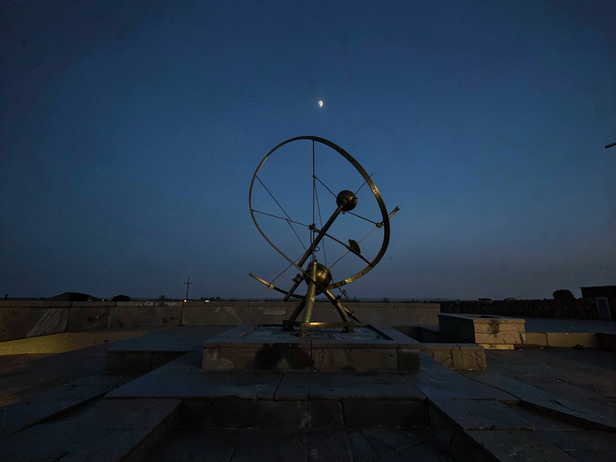
![Twilight Celestial Observatory]()
Twilight Celestial Observatory
Image credit : AI
I witness the celestial dance, a vintage brass instrument poised to track the solar cycle. The twilight sky holds a bright planet, a silent observer.
What Solar Maximum Does to Earth
At solar maximum, the Sun produces more extreme ultraviolet and X-ray radiation, which heats and expands Earth's upper atmosphere. That expansion increases drag on satellites in low Earth orbit, operators must fire thrusters more often to maintain altitude, and uncontrolled objects decay faster. The Indian Space Research Organisation accounts for this in mission planning for satellites in orbits below 600 kilometres.
Coronal mass ejections, clouds of magnetised plasma that can take one to three days to reach Earth, are far more frequent at maximum. When a large one strikes Earth's magnetosphere with the right orientation, it can induce currents in long conductors on the ground: power lines, pipelines, telegraph cables. The 1989 geomagnetic storm collapsed the Hydro-Québec grid in 90 seconds, leaving six million people without power for nine hours. A storm of comparable scale today would find a far more interconnected grid and a far larger satellite constellation in its path.
Radio blackouts caused by X-ray flares affect high-frequency communications on the sunlit side of Earth, a consideration for aviation over polar routes and for the Indian Navy's HF radio networks. The ISRO's Space Weather Monitoring Centre at the National Atmospheric Research Laboratory in Tirupati tracks these events in near real time.
Solar Minimum Is Not Quiet Either
At minimum, the Sun's disk clears, but a different phenomenon becomes more prominent: galactic cosmic rays. The Sun's extended magnetic field, the heliosphere, acts as a partial shield against these high-energy particles arriving from outside the solar system. At maximum, that field is tangled and energetic, deflecting more cosmic rays. At minimum, it is weaker and more ordered, and cosmic ray flux at Earth rises measurably. For astronauts beyond low Earth orbit, on a future Gaganyaan deep-space mission, for instance, the timing of the solar cycle is not a detail but a constraint on radiation exposure.
The Maunder Minimum, a period from roughly 1645 to 1715 when sunspot counts dropped to near zero for decades, coincided with the coldest phase of the Little Ice Age in Europe. Whether the Sun caused the cooling, contributed to it, or simply happened alongside other factors is still debated. What is clear is that the Sun's output is not a fixed constant, and the eleven-year cycle is the most accessible window into its variability. The sunspot number, a tally of dark patches on a star 150 million kilometres away, turns out to be one of the more consequential numbers in Earth science.