Sunset is not the moment the sky goes dark. The light that lingers after the sun disappears is doing something specific: it is bending around the curve of the Earth, scattering through the upper atmosphere, and illuminating the sky from below the horizon. How long that process takes depends on one number, the sun's angle below the horizon, and that number carves twilight into three distinct phases, each with a precise boundary and a different quality of light.
Civil Twilight: The Sun Is Gone but the World Is Not Dark
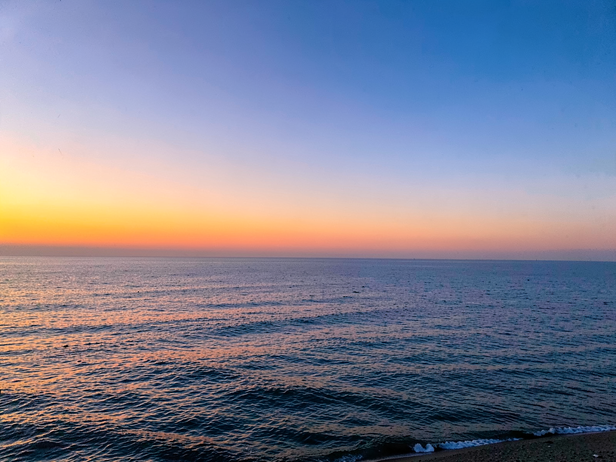
Civil twilight begins at sunset and ends when the sun reaches 6 degrees below the horizon. During this window, the sky is bright enough that the human eye needs no artificial light to navigate outdoors. Colours are still readable. Faces are recognisable. In India, this phase lasts roughly 20 to 30 minutes depending on latitude and season, shorter near the equator, longer farther north, and shortest of all at the solstices when the sun drops steeply rather than at a shallow angle. Airports, road traffic regulations, and aviation rules are built around civil twilight: it marks the legal boundary between day and night operations in most countries. The sky during civil twilight is not a single colour, it shifts from orange at the horizon through rose to a deep blue overhead, the gradient driven by the varying thickness of atmosphere the remaining sunlight must pass through at each angle.
![Coastal Horizon at Twilight]()
Coastal Horizon at Twilight
Image credit : AI
I witness the sky's transition through civil twilight, a breathtaking display of color above the calm sea.
Nautical Twilight: The Horizon Disappears
When the sun crosses 6 degrees below the horizon, civil twilight ends and nautical twilight begins. It runs until the sun reaches 12 degrees below. The name is exact: this is the window in which the sea horizon is still just visible but the sky is dark enough that navigational stars can be seen. Traditional celestial navigation required both, a readable horizon and visible stars, to take a sextant reading. Lose the horizon and you cannot measure the angle. Lose the stars and there is nothing to measure. Nautical twilight is the narrow overlap where both exist at once. On land, this phase feels distinctly different from civil twilight. Colours drain from the landscape. Shapes remain but detail is gone. The brightest planets, Venus, Jupiter, Mars, are clearly visible. The sky is no longer lit from the ground up; it is dark from the zenith down to a faint arc near the horizon.
Astronomical Twilight: The Last Interference
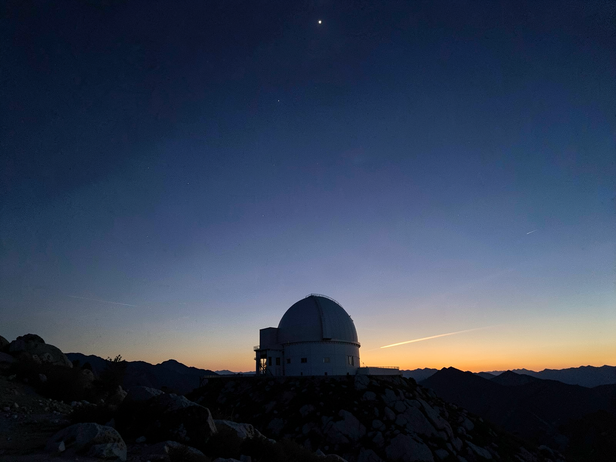
Astronomical twilight runs from 12 degrees to 18 degrees below the horizon. At 18 degrees, the sun's scattered light no longer reaches the upper atmosphere above the observer, and the sky reaches its true night state. For an astronomer, the end of astronomical twilight is the starting gun. Before that point, even a sky that looks dark to the naked eye carries enough diffuse solar light to wash out faint objects, distant galaxies, dim nebulae, the outer planets. Professional observatories schedule observations around this boundary. The sky brightness difference between 12 and 18 degrees is invisible to the eye but significant to a CCD sensor. At Vainu Bappu Observatory in Kavalur, Tamil Nadu, or at the Indian Astronomical Observatory at Hanle in Ladakh, at 4,500 metres, one of the world's highest optical telescopes, the end of astronomical twilight is the first entry in the night's log.
![Observatory Under Twilight Sky]()
Observatory Under Twilight Sky
Image credit : AI
I witness the final moments of astronomical twilight, a single star appearing above the observatory.
Why Latitude and Season Change Everything
The three boundaries are fixed by definition. What changes is how quickly the sun crosses them. Near the equator, the sun sets at a steep angle relative to the horizon, cutting through each 6-degree band fast. In Chennai or Thiruvananthapuram, the entire span from sunset to the end of astronomical twilight can compress to under 70 minutes. At higher latitudes, the sun's path at sunset becomes shallower, and the crossing slows. In Srinagar in June, twilight stretches noticeably longer than in Kochi in December. At latitudes above roughly 48 degrees north, well beyond India's northernmost point, the sun can remain less than 18 degrees below the horizon all night in summer, meaning astronomical twilight never fully ends. True darkness does not come. This is why dark-sky astronomy is more difficult in European summers and why Hanle's high-altitude, low-latitude position makes it one of the most productive sites in Asia for night observation.
The Geometry Behind the Glow
All three phases share one cause: Rayleigh scattering. Sunlight entering the atmosphere at a low angle travels through a far greater thickness of air than it does at noon. That path length scatters shorter wavelengths, blue and violet, across the sky while longer wavelengths, red and orange, pass through. As the sun descends, the scattering geometry shifts, the illuminated column of upper atmosphere shrinks, and the sky darkens from the top down. The belt of Venus, the pink arc visible just above the horizon opposite the setting sun, is the shadow of the Earth itself, rising as the sun drops, marking the exact boundary between the lit upper atmosphere and the dark lower atmosphere behind it. It is one of the cleaner pieces of evidence that twilight is geometry, not magic: a shadow cast by a planet on its own air.