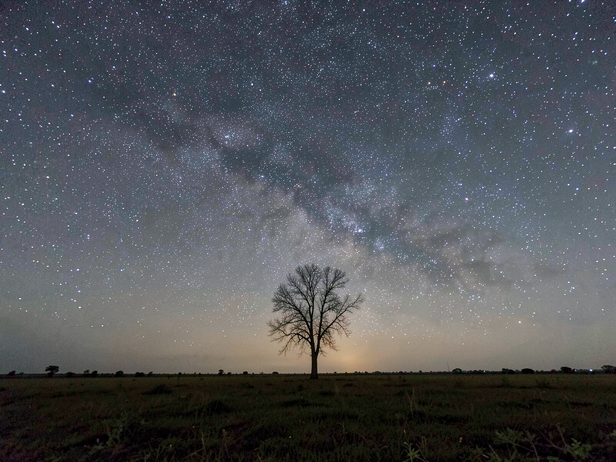
For roughly three to four weeks each October, a narrow atmospheric corridor opens above the Indo-Gangetic Plain that amateur astronomers in Jaipur, Lucknow, Dehradun, and Varanasi quietly wait for all year. The monsoon has retreated south and east. The cold-weather crop-burning has not yet begun. The air is dry, the particulate load is at its annual low, and the sky overhead, on a night away from city sodium lamps, is genuinely dark in a way it will not be again until the following October.
What the Monsoon Does to the Sky
The Indian summer monsoon keeps the atmosphere above the northern plains saturated with water vapour from June through September. Water vapour is not just cloud, even on a night with no visible clouds, a humid atmosphere scatters and absorbs starlight, reducing what astronomers call atmospheric transparency. The result is a sky that looks clear but is actually milky, where the Milky Way is a vague suggestion rather than a structure. When the monsoon withdraws, relative humidity across Rajasthan, Uttar Pradesh, and the Delhi NCR belt drops sharply, from above 80 percent to below 40 percent on many October nights. The sky does not just feel clearer. It is measurably clearer, and the difference shows immediately in how far down toward the horizon faint stars remain visible.
![North Indian Starry October Night]()
North Indian Starry October Night
Image credit : AI
I gaze at the Milky Way visible North India October, a breathtaking display of stars over the plains.
The Pollution Clock That Starts at Diwali
The fireworks burned on Diwali night release fine particulate matter, PM2.5, in quantities that push air quality indices across Delhi, Kanpur, and Patna into the hazardous range within hours. Satellite data from ISRO's RESOURCESAT and ground-station readings from the Central Pollution Control Board have consistently recorded this spike for over a decade. What is less discussed is that the particulate load does not return to pre-festival levels for weeks. Stubble burning in Punjab and Haryana, which typically peaks in October and November, adds a second aerosol source that compounds the firework haze. By early November, the same sky that was transparent in mid-October is opaque enough that even Jupiter, at its brightest, carries a visible brownish cast near the horizon. The pre-Diwali window is therefore bounded on both sides: the monsoon closes it from the left, the festival and the crop fires close it from the right.
What Is Actually Visible in That Window
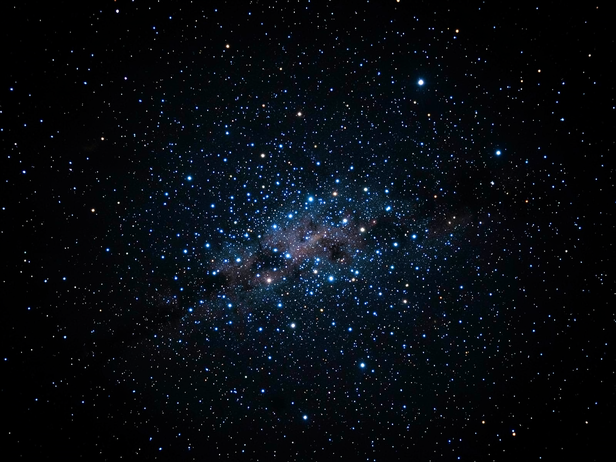
In mid-to-late October, the sky above North India carries a specific set of objects that reward the effort of getting away from city light. The Andromeda Galaxy, M31, the most distant object visible to the unaided eye at roughly 2.5 million light-years, rises to a useful height after 9 pm and is findable with no equipment from a dark site near Corbett, Ranthambore, or the Chambal ravines. Saturn, which has been well-placed since late northern-hemisphere summer, sits in the southern sky in the early evening hours. The Pleiades cluster in Taurus, known in Sanskrit astronomical tradition as the Krittika nakshatra, clears the eastern horizon by 8 pm and climbs through the night. The Great Square of Pegasus is nearly overhead. None of this requires a telescope. Binoculars with a 7x or 10x magnification will resolve the Andromeda Galaxy's core from its halo, split several of the Pleiades into individual stars, and show Saturn's disk as something noticeably non-circular even at low power.
![Pleiades Star Cluster Revealed]()
Pleiades Star Cluster Revealed
Image credit : AI
Observing the Pleiades, a celestial jewel in the pre-Diwali clear sky October.
The Indian Sky-Watching Tradition This Season Carries
The Krittika nakshatra, the Pleiades, holds a specific place in Vedic astronomical reckoning. In older Vedic texts, Krittika was listed first among the 27 nakshatras, suggesting it once marked the vernal equinox, a position it held thousands of years ago due to the slow wobble of Earth's axis called axial precession. By October it is a prominent autumn object, and its heliacal rising, the moment it first becomes visible before dawn after a period of invisibility, was used across the subcontinent to calibrate the agricultural calendar. The same stars that guided sowing schedules in the Gangetic plain are now visible in the evening sky, in the same season, over the same landscape. That continuity is not metaphor. It is the same light, arriving on the same geometry, observed from the same latitude.
How to Use the Window Before It Closes
The practical ceiling for this window is the night of Diwali itself, though the sky quality begins degrading a few days earlier as regional firework activity builds. A dark site does not require a long drive. The Aravalli ridge west of Delhi, the ghats above Rishikesh, or even the rooftops of smaller towns in eastern Rajasthan sit outside the worst urban light domes. The key variable is not distance from a city but distance from its light pollution boundary, which on a clear October night is visible as an orange glow on the horizon. Face away from it. Let your eyes adjust for twenty minutes without looking at a phone screen. The sky that appears is not the sky most North Indians have seen since childhood, it is considerably more.