The most common beginner mistake in amateur astronomy is not buying the wrong eyepiece or pointing at the wrong star. It is buying a telescope too early. A shaky, underpowered 60mm refractor sold at a mall kiosk will show you a blurry Moon and nothing else, and it will end the hobby in a weekend. A pair of 7x50 or 10x50 binoculars costing between ₹3,000 and ₹8,000 will show you hundreds of objects, teach you the sky, and stay useful long after you own a serious telescope.
What the Numbers on Binoculars Actually Mean
The two numbers on any binocular, 7x50, 10x50, 8x42, describe magnification and aperture. The first number is how many times closer the object appears. The second is the diameter of the front lenses in millimetres. For stargazing, aperture matters more than magnification, because aperture determines how much light enters the instrument. A 50mm objective gathers roughly 50 times more light than the naked eye's fully dark-adapted pupil at 7mm. That extra light is what turns a faint smudge into a resolvable cluster.
The exit pupil, divide the objective diameter by the magnification, tells you how wide the beam of light is that reaches your eye. A 7x50 gives a 7.1mm exit pupil, which matches a dark-adapted adult eye almost perfectly. This is why 7x50 was the standard naval binocular for a century. At 10x50 the exit pupil drops to 5mm, which is fine for most adults and gives sharper stars at the cost of a slightly dimmer field. Either format works. The 10x50 is the more common choice today because it is lighter and easier to find in India.
![Binocular Lens Moonlight Reflection]()
Binocular Lens Moonlight Reflection
Image credit : AI
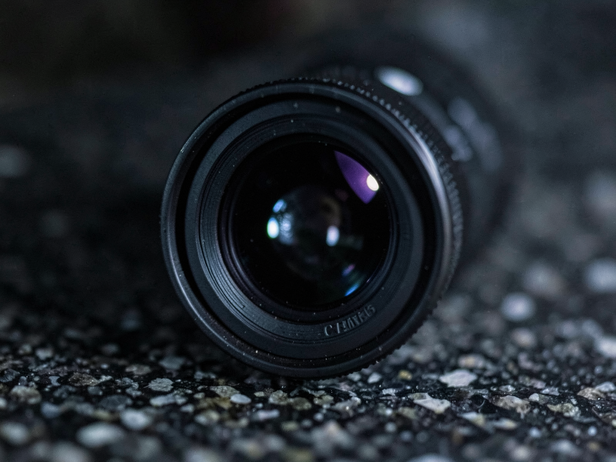
I focused on the intricate details of a binocular lens, revealing a subtle crescent reflection from the moonlight, perfect for stargazing binoculars India.
What You Can See From an Indian Dark Sky
India has genuine dark-sky access within a few hours of most cities. The Rann of Kutch, the Spiti Valley, Coorg, the Thar Desert outside Jaisalmer, and the high-altitude sites of Ladakh all offer Bortle Class 3 or better skies on a clear moonless night. From any of these locations with a 10x50, the list of visible objects is not short.
The Andromeda Galaxy, M31, appears as a large oval glow spanning several Moon-widths, its core noticeably brighter than its halo. The Orion Nebula resolves into a soft four-star trapezium surrounded by nebulosity. The Pleiades, which look like six or seven stars to the naked eye, become forty or fifty stars scattered across a rich field. The double cluster in Perseus, NGC 869 and NGC 884, fits in a single binocular field and is one of the finest sights in the northern sky at any aperture. Jupiter shows four pinpoints of light arranged in a line: the Galilean moons, the same four Galileo saw in 1610. Saturn is obviously not round, though the ring system does not fully separate at 10x until you have a very steady hold or a tripod.
The Milky Way itself changes completely through binoculars. What looks like a pale band resolves into lanes of stars, dark rifts, and embedded clusters. Scanning slowly along it from Scorpius through Sagittarius on a July or August night from a dark site is an experience that no single telescope eyepiece can replicate, because the field of view is too narrow. Binoculars give you sky, not a keyhole.
The Tripod Question
Hand-holding a 10x50 is possible and often fine for bright objects. Above 10x magnification, hand tremor becomes the limiting factor. A simple photo tripod with a binocular adapter, the L-shaped bracket that screws into the central hinge, costs between ₹800 and ₹2,000 and transforms the experience. Stars stop dancing. Faint objects that were invisible while hand-holding become visible because the eye can integrate light over a longer moment. If you are buying binoculars specifically for astronomy, budget for the adapter at the same time.
Image-stabilised binoculars exist, Canon makes a well-regarded 10x42 IS, but they cost ₹40,000 upward and run on batteries. For a beginner, a standard 10x50 on a cheap tripod delivers more value at a fraction of the price.
![Ladakh's Starry Night]()
Ladakh's Starry Night
Image credit : AI
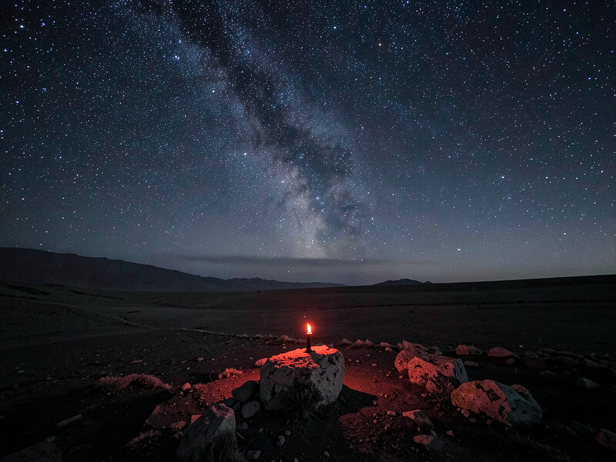
Witnessing the Milky Way's core during beginner stargazing in India. A truly breathtaking celestial display.
Which Binoculars to Actually Buy in India
The Indian market carries a wide range, from ₹500 junk to professional Nikon SE and Fujinon FMT-SX at ₹50,000 and above. The practical sweet spot for a first astronomy binocular sits between ₹3,000 and ₹8,000. In this range, look for fully multi-coated optics, not just coated, not multi-coated, but fully multi-coated, which means every air-to-glass surface has an anti-reflection coating. This single specification makes a larger difference to image brightness than almost any other factor at this price tier.
Brands available through Amazon India and specialist astronomy retailers like Tejraj and Company in Mumbai or Khagol Vishwa include Nikon Aculon (7x50 and 10x50), Olympus DPS I 10x50, and Celestron UpClose G2 10x50. The Nikon Aculon A211 10x50 sits around ₹5,500 to ₹6,500 and is the most consistently recommended entry-level astronomy binocular in Indian amateur astronomy forums, including those run by the Astronomical Society of India's outreach wing.
When to Move to a Telescope
The right time to buy a telescope is after you can identify the major constellations without help, find Messier objects by star-hopping, and have a specific target the binoculars cannot resolve. That moment is different for everyone, but it rarely arrives in the first three months. When it does, the binocular habit will have built the sky knowledge that makes a telescope useful rather than frustrating.
The standard recommendation from amateur astronomy clubs across India, the Bangalore Astronomical Society, the Amateur Astronomers Association Delhi, the Khagol Mandal in Mumbai, is a 6-inch or 8-inch Dobsonian reflector as a first telescope. A 6-inch Dobsonian from a local maker like Tejraj or an imported Orion XT6 costs between ₹12,000 and ₹22,000 and will outperform any department-store refractor at any price. But that conversation belongs after the binoculars have done their work.
The binoculars do not get retired when the telescope arrives. Every experienced amateur astronomer keeps a pair beside the eyepiece case. They are for finding fields, for scanning the Milky Way, for the twenty minutes before the telescope has cooled down to ambient temperature, and for every night when setting up a tube feels like too much effort. The sky is still there on those nights, and so are the binoculars.