On certain nights, a planet that usually blends into the background of stars suddenly demands attention. It rises in the east just as the Sun drops below the western horizon, climbs to its highest point at midnight, and does not set until dawn. If you have ever looked up and thought a star seemed wrong, too bright, too steady, too orange, you were probably looking at a planet near opposition.
The geometry: Earth laps a slower neighbour
The solar system is a set of concentric tracks, each planet moving at its own pace. Earth takes one year to complete a lap. Mars takes about 1.88 years. Jupiter takes nearly twelve. Because Earth is on the inside lane, it periodically catches up to and passes each outer planet, the way a faster runner laps a slower one on a circular track. The moment Earth draws a straight line between the Sun and the outer planet, Sun, Earth, planet, all in a row, is called opposition. At that instant, the planet is directly opposite the Sun in Earth's sky.
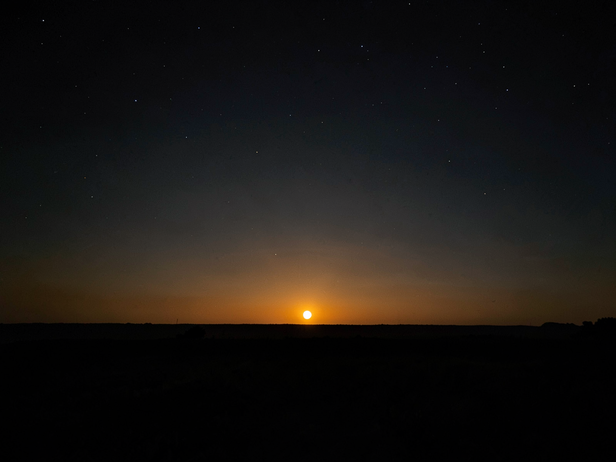
![Bright Planet at Dusk]()
Bright Planet at Dusk
Image credit : AI
I observed a bright planet low on the horizon during sunset, a stunning celestial event. This view highlights why planets are brightest at opposition.
Why all three things happen at once
Three coincidences stack on top of each other, and they are not coincidences at all, they follow from the same geometry. First, the planet is closest to Earth at opposition because the two are on the same side of the Sun, separated only by the difference in their orbital radii rather than the full width of the solar system. Second, the planet is brightest because brightness follows the inverse-square law: halve the distance, quadruple the reflected light. Third, the planet is visible all night because any object opposite the Sun rises when the Sun sets and sets when the Sun rises. The same alignment that brings Earth and planet together also ensures the planet is above the horizon for the entire dark half of the day.
Why oppositions are not all equal
Orbits are ellipses, not perfect circles. A planet's distance from the Sun varies across its orbit, and so does Earth's. When opposition coincides with a planet being near its own closest point to the Sun, its perihelion, the planet is also at its closest possible approach to Earth. These are called perihelic oppositions, and they produce the most dramatic nights. Mars swings between roughly 56 million kilometres and 101 million kilometres from Earth at different oppositions. The 2003 Mars opposition brought the planet to within 55.76 million kilometres, the closest it had been in nearly 60,000 years. A more typical opposition puts Mars around 80 to 90 million kilometres away, still spectacular, but noticeably dimmer and smaller through a telescope. Jupiter's orbit is far larger and more circular, so its oppositions are less variable, but it is so enormous that even at its farthest it remains one of the brightest objects in the sky.
![Rocket on Launch Pad]()
Rocket on Launch Pad
Image credit : AI
Dawn breaks over a rocket launch pad, a testament to human ambition reaching for the stars. This scene evokes the wonder of space exploration.
The Indian sky and ISRO's window
Opposition matters practically, not just aesthetically. Planetary missions are timed around it. The launch window for a Mars mission opens when Earth and Mars are approaching each other, so a spacecraft can ride the geometry rather than fight it. India's Mangalyaan, the Mars Orbiter Mission, launched from Sriharikota in November 2013, used exactly this kind of transfer window. The spacecraft did not fly straight to Mars; it spiralled out from Earth's orbit and coasted along a curved path, arriving at Mars in September 2014. The opposition geometry determined when that window opened. Miss the window and you wait roughly two years for Earth to lap Mars again. The same logic will govern any future mission to Jupiter or Saturn under the Gaganyaan-era ambitions ISRO has begun articulating.
What to look for and when
You do not need a telescope to appreciate opposition. The planet rises in the east around sunset and is highest in the sky around midnight, the best time to observe, when you are looking through the least atmosphere. Mars at a favourable opposition glows a deep amber-orange, steady rather than twinkling, because it is a disk rather than a point of light and atmospheric turbulence averages out across it. Jupiter shines a cold cream-white and is bright enough to cast a faint shadow on a dark night. Saturn's rings, even through modest binoculars, become visible near opposition. For any given year, national observatories and amateur astronomy clubs in India, including those affiliated with the Astronomical Society of India, publish opposition dates months in advance. The next time a planet looks absurdly bright on an ordinary weeknight, the Sun, Earth, and that planet are in a line. You are standing on the middle point.