At the moment a spacecraft hits the upper atmosphere on its way home, the air in front of it cannot move out of the way fast enough. It compresses, and compressed air heats, not from friction, as the textbooks used to say, but from the shockwave that forms just ahead of the vehicle. Temperatures at that shockwave can exceed 7,000 degrees Celsius. The surface of the Sun sits at roughly 5,500. The heat shield is the only thing standing between that plasma and everything behind it.
The Two Jobs a Heat Shield Has to Do
A heat shield has to block heat transfer into the vehicle, and it has to do it without adding so much mass that the spacecraft cannot reach orbit in the first place. These two requirements pull in opposite directions. The best insulating materials tend to be dense and heavy. The best lightweight materials tend to conduct heat. The engineering answer, developed through the early crewed programmes and refined ever since, was to stop trying to block all the heat and instead give some of it a controlled exit: burn the shield itself, and let the burning carry the energy away. This is ablation. The material chars, melts, or vaporises at the surface, and each gram of material that leaves the shield takes a large quantity of heat with it as latent energy. The vehicle behind stays cool because the heat is spending itself on the shield rather than passing through it.
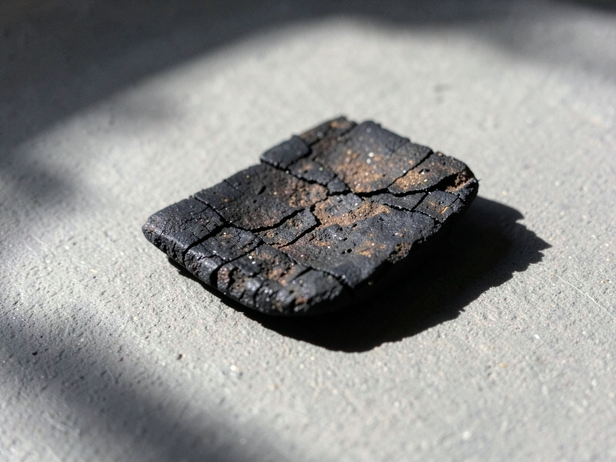
![Charred Ceramic Fragment]()
Charred Ceramic Fragment
Image credit : AI
This fragment shows the intense heat damage, reminiscent of spacecraft heat shield material after re-entry.
What the Material Actually Is
The most widely used ablative material in history is AVCOAT, a silica fibre matrix filled with an epoxy-novalac resin. NASA used it on Apollo and brought it back for Orion. When AVCOAT chars, the char layer itself becomes a secondary insulator while fresh material beneath it continues to ablate. The char does not fall away cleanly, it sits on the surface and slows the rate at which the next layer is exposed, buying time. PICA, Phenolic Impregnated Carbon Ablator, was developed at NASA Ames and used on Stardust and later on the Dragon capsule's heat shield. It is lighter than AVCOAT and handles higher heat flux, which matters for missions returning from beyond low Earth orbit. SpaceX developed PICA-X, a variant they can manufacture in-house. Reinforced Carbon-Carbon, the material used on the Space Shuttle's nose cap and wing leading edges, takes a different approach: it does not ablate at all. It is designed to withstand re-entry temperatures repeatedly without losing mass. The trade-off is that it is brittle, expensive to manufacture, and catastrophically unforgiving of surface damage, a fact that became impossible to ignore after Columbia in 2003.
Where India Fits Into This
ISRO has been developing its own ablative heat shield materials for the Gaganyaan crewed mission, which will carry Indian astronauts, including Group Captain Shubhanshu Shukla, selected for the programme, to low Earth orbit from Sriharikota. The crew module re-entry vehicle uses a carbon-phenolic ablative heat shield developed domestically, tested through a series of Crew Module Atmospheric Re-entry Experiment flights, the first of which flew in 2014. ISRO's materials scientists had to solve the same mass-versus-protection equation that every other agency has faced, with the additional constraint of developing the manufacturing capability without importing the critical components. Mangalyaan, India's Mars Orbiter Mission, did not need a re-entry shield, it was never designed to return, but the aerocapture problem it did not face is exactly what a future Mars sample return or crewed mission would demand, at velocities significantly higher than Earth re-entry.
![Dusk Radio Telescope Silhouette]()
Dusk Radio Telescope Silhouette
Image credit : AI
I observe the immense radio telescope at dusk, a silent sentinel against the vibrant sky. The atmospheric haze adds a subtle grain to the scene.
Why Burning Away Is the Right Answer
A reusable thermal protection system sounds more elegant than one that destroys itself on every flight. The Shuttle tiles were reusable, and they required thousands of hours of inspection and repair between each mission. An ablative shield is consumed, but it is also simple to inspect, you can see how much material is left, and the physics of ablation are well understood and predictable. For a crewed capsule making one or two flights, the ablative approach is more reliable precisely because there is less that can go wrong silently. The char layer forms, the gases carry the heat away, and the rate of recession can be modelled against the expected heat flux for the re-entry trajectory. The shield does not need to be perfect. It needs to be thick enough that it is still there when the plasma stops.