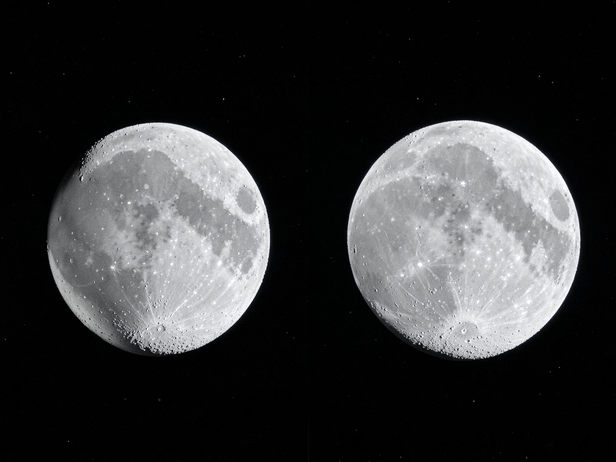
The Moon keeps the same face turned toward Earth at all times, yet astronomers have mapped nearly 59 percent of its surface from the ground alone. That extra 9 percent comes into view slowly, rocking in and out like a face turning just enough to show one ear and then the other. The mechanism is called libration, and it has three distinct causes, each running on a different clock.
Orbital Libration: The Moon's Elliptical Path
The Moon does not orbit Earth in a perfect circle. Its path is an ellipse, which means its orbital speed is not constant, it moves faster when it is closer to Earth (near perigee) and slower when it is farther away (near apogee). Its rotation rate, however, is constant. That mismatch between a variable orbital speed and a steady spin is called optical libration in longitude. When the Moon is racing through perigee, its rotation lags slightly behind its orbital position, and a sliver of the far side on one edge swings into view. Two weeks later, near apogee, the orbit slows down while the spin keeps pace, and the opposite limb tips toward us. The effect is small, about 7.9 degrees either way, but it is enough to expose a meaningful strip of terrain that would otherwise remain permanently hidden.
![Moon's Orbital Dance Revealed]()
Moon's Orbital Dance Revealed
Image credit : AI
Observing the Moon's wobble, I see more than half its surface over time due to libration in longitude and latitude.
Latitudinal Libration: A Tilted Axis
The Moon's rotational axis is not perfectly perpendicular to its orbital plane. It leans by about 6.7 degrees. Because of this tilt, the Moon's north pole tips toward Earth for part of its orbit and away from Earth for another part. When the north pole leans in, we see terrain beyond the lunar north pole that is normally just out of sight. Six months later, the south pole tips toward us and a corresponding strip of southern terrain appears. This is libration in latitude, and it runs on the same monthly cycle as the Moon's orbit. The two librations, in longitude and in latitude, are independent and add together, which is why the visible zone is not a neat strip on one side but a shifting oval that wanders around the Moon's limb throughout the month.
Diurnal Libration: The Effect of Where You Stand
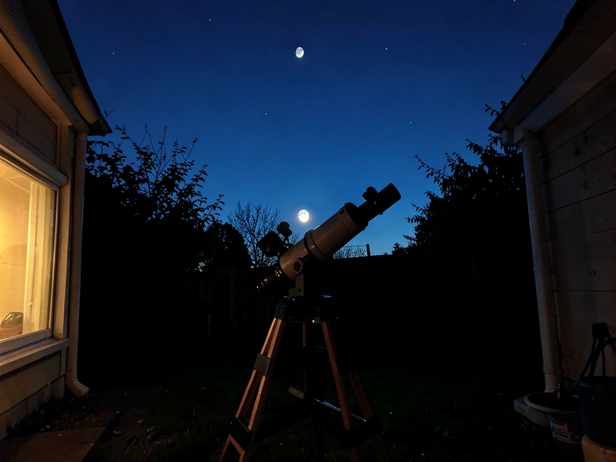
There is a third, smaller effect. As Earth rotates over the course of a single day, an observer on its surface is carried from one side of the planet to the other, a displacement of roughly 12,700 kilometres. That shift in vantage point changes the viewing angle to the Moon by about one degree. At moonrise, you are looking at the Moon from slightly to the east of where you will be at moonset. This daily parallax, called diurnal libration, peels back a thin additional strip of the lunar limb each night. It is the smallest of the three librations, but it is also the most immediate, visible in principle on any single clear night if you photograph the Moon at rising and setting and compare the two images precisely.
![Moon Gazing at Dusk]()
Moon Gazing at Dusk
Image credit : AI
Observing the Moon's subtle wobble, a phenomenon known as lunar libration, reveals more than half its surface over time.
What Libration Has Revealed
The regions that libration brings into view are called the lunar limb zones, and they are among the most scientifically interesting parts of the Moon precisely because they are so rarely well-lit and well-angled for observation. Mare Marginis, Mare Smythii, and Mare Orientale, one of the solar system's most perfectly preserved large impact basins, all sit in or near the libration zones. Mare Orientale was not properly mapped until spacecraft flew around the Moon; from Earth, even at maximum libration, it appears as a foreshortened ellipse near the western limb. Chandrayaan-1, India's first lunar mission launched from Sriharikota in 2008, carried instruments that mapped the entire lunar surface including these limb regions, confirming water ice signatures near the poles that ground-based observers could only partially glimpse through libration. The far side, the roughly 41 percent that libration never brings into view, remained completely unknown until the Soviet Luna 3 spacecraft photographed it in 1959.
Watching Libration Yourself
Libration is slow enough to be invisible night to night but obvious across a month if you track it deliberately. Photograph the Moon on the same night each week, aligning the images so the disc fills the frame equally. A distinctive crater near the limb, Grimaldi on the western edge or Pythagoras near the north, will drift visibly inward and outward over the sequence. Free planetarium software such as Stellarium shows the current libration state in real time, displayed as two angles: the libration in longitude and the libration in latitude. At maximum combined libration, the Moon's disc appears to have rotated by nearly ten degrees from its average orientation. That is enough of a shift to matter to anyone imaging the limb regions with even a modest telescope.