The nearest star outside our solar system is 4.24 light-years away. The Andromeda galaxy sits 2.537 million light-years out. A quasar catalogued as 3C 273 lives roughly 2.4 billion light-years from Earth. These numbers feel authoritative, the kind printed in textbooks without footnotes. But none of them was measured directly. Each one was inferred from the rung below it on a structure astronomers call the cosmic distance ladder, and every rung depends on the one beneath it being correct.
The First Rung: Parallax and the Width of Earth's Orbit
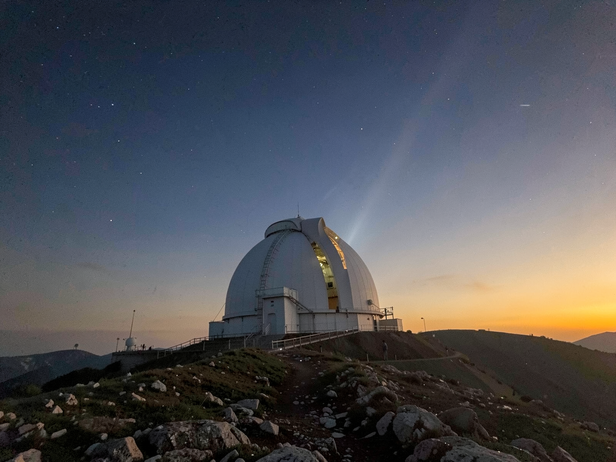
![Observatory Dome at Dusk]()
Observatory Dome at Dusk
Image credit : AI
Exploring the cosmos: This observatory aids in measuring galaxy distances, a key step in understanding the cosmic distance ladder.
The ladder starts with geometry so simple a school student can follow it. As Earth moves around the Sun, nearby stars appear to shift slightly against the background of more distant ones. That apparent wobble, parallax, lets astronomers calculate distance the same way a surveyor triangulates across a field, using the diameter of Earth's orbit as the baseline. The European Space Agency's Gaia mission has now measured parallax distances for over a billion stars with sub-milliarcsecond precision, anchoring the entire ladder at its base. Without this rung, nothing above it has a fixed number to attach to.
The Second Rung: Cepheid Variables and the Period-Luminosity Relation
Parallax works only to a few thousand light-years. Beyond that, the wobble becomes too small to detect. The ladder climbs using a different trick: stars that pulse. Cepheid variable stars brighten and dim on a strict schedule, and in 1908 Henrietta Swan Leavitt, working at Harvard College Observatory, noticed that the longer a Cepheid's pulsation period, the more intrinsically luminous it is. Measure how long a Cepheid takes to pulse, and you know its true brightness. Compare that to how bright it looks from Earth, and distance falls out of the arithmetic. Edwin Hubble used Cepheids in 1923 to prove that the Andromeda nebula lay far beyond the Milky Way, settling, in one observation, the question of whether other galaxies existed at all. ISRO's future deep-sky missions and the James Webb Space Telescope have both refined Cepheid measurements in nearby galaxies, tightening this rung considerably.
The Third Rung: Type Ia Supernovae and the Reach to Billions of Light-Years
![Dawn Rocket Launch Spectacle]()
Dawn Rocket Launch Spectacle
Image credit : AI
A colossal rocket awaits its ascent, a testament to humanity's reach for cosmic distance. The dawn sky paints a vibrant backdrop.
Cepheids are visible only to a few tens of millions of light-years. The universe is billions of light-years across. The ladder climbs again using a different kind of standard candle: Type Ia supernovae. These explosions occur when a white dwarf star accumulates mass from a companion until it crosses a critical threshold and detonates. Because the trigger mass is nearly identical in every case, the peak brightness of the explosion is nearly identical too. Spot a Type Ia supernova in a distant galaxy, measure how bright it appears, and you can calculate how far away it must be. This rung is how two independent teams in 1998, led by Saul Perlmutter and by Brian Schmidt and Adam Riess, discovered that the universe's expansion is accelerating, a finding that earned the 2011 Nobel Prize in Physics.
The Hubble Tension: When the Rungs Disagree
Here is where the ladder becomes genuinely unsettling. The rate at which the universe expands is described by a number called the Hubble constant. Measured by climbing the distance ladder from Cepheids through supernovae, it comes out at roughly 73 kilometres per second per megaparsec. Measured independently from the cosmic microwave background, the afterglow of the Big Bang, using physics entirely separate from the ladder, it comes out at roughly 67. The two methods are now precise enough that the gap between them cannot be explained by measurement error alone. Astronomers call this the Hubble tension, and it has not been resolved. Either one of the rungs carries a systematic error no one has found yet, or there is genuinely new physics, something in the early universe, or in the nature of dark energy, that the standard model of cosmology does not account for. The ladder that took a century to build is now precise enough to reveal its own crack.
Why the Crack Matters
The cosmic distance ladder is not a curiosity for specialists. Every statement about the age of the universe, the rate of its expansion, the distribution of dark matter, and the fate of everything in it rests on these rungs being correctly calibrated against each other. The Hubble tension means that at least one rung is off, or that the universe behaves differently than the model predicts. The Webb telescope is re-measuring Cepheids in galaxies where Hubble's older optics introduced scatter, and early results have not closed the gap. Upcoming missions, including the Nancy Grace Roman Space Telescope, are designed in part to stress-test the ladder further. The distance to a galaxy billions of light-years away is not just an impressive number. It is a claim about the structure of reality, and the ladder is the only tool we have to check it.