The moment a rocket leaves the pad, it is fighting the one thing it can never negotiate with: gravity. It needs an enormous push in the first few seconds, and it needs that push to be reliable down to the millisecond. Later, once it is moving fast and the air is thinning, the demands change entirely. That shift in what the rocket needs, raw brute force at liftoff, then precise and controllable thrust in the upper atmosphere and beyond, is exactly why most orbital launch vehicles carry two fundamentally different kinds of engine at the same time.
What a Solid Rocket Booster Actually Does
Solid propellant is fuel and oxidiser mixed together and cast into a rubbery block, called the grain, inside a metal casing. Once you light it, it burns. There is no throttle, no valve to close, no way to pause it. This sounds like a disadvantage, and in some situations it is. But at liftoff, it is precisely the point.
A solid booster can sit on the pad for years, fully loaded, without degrading significantly. It produces very high thrust almost instantly from ignition. The thrust-to-weight ratio of a solid motor is typically higher than a liquid engine of comparable size, which matters enormously in the first stage of flight when the vehicle is at its heaviest and needs to accelerate hard against Earth's gravity. The Space Shuttle's solid rocket boosters each produced roughly 12.5 million newtons of thrust at liftoff. ISRO's PSLV uses a solid first stage, the S139, named for its 139-tonne propellant load, for exactly this reason: get the vehicle moving fast before the liquid stages take over.
The grain geometry also lets engineers shape the thrust curve. A star-shaped cross-section burns differently over time than a cylindrical bore, so manufacturers can design a motor that delivers a specific thrust profile, high at ignition, tapering as the vehicle passes through maximum dynamic pressure, the point called Max-Q where aerodynamic stress peaks.
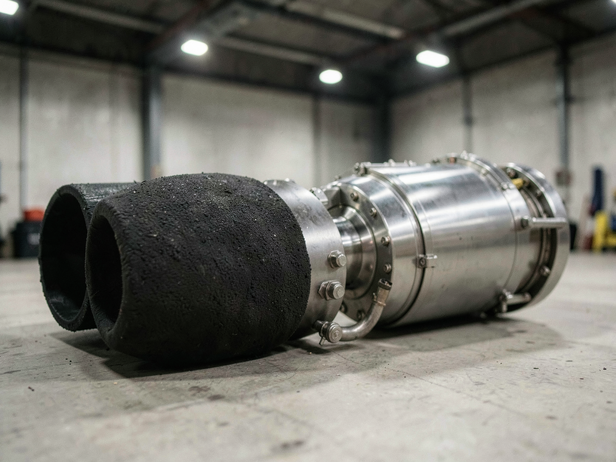
![Rocket Motor Assembly]()
Rocket Motor Assembly
Image credit : AI
I examine solid and liquid rocket engine stages, crucial components for space launch.
What a Liquid Engine Does That Solid Cannot
A liquid-propellant engine stores its fuel and oxidiser separately, pumps them into a combustion chamber, and burns them there. The flow rate is controllable. The engine can throttle down, throttle up, restart, and shut off cleanly. These properties are nearly useless at liftoff but become critical the moment the vehicle needs to steer precisely, coast, circularise an orbit, or place a satellite at an exact altitude.
Liquid engines also tend to have a higher specific impulse, the measure of how efficiently they convert propellant mass into thrust. The Vikas engine used in PSLV's second and fourth stages has a specific impulse around 293 seconds in vacuum. The cryogenic upper stage on GSLV Mk III, burning liquid hydrogen and liquid oxygen, reaches around 443 seconds. A solid motor of comparable size rarely exceeds 270 seconds. In the upper stages, where the vehicle is lighter and efficiency dominates over raw thrust, this gap in specific impulse translates directly into how much payload reaches orbit.
The tradeoff is complexity. Liquid engines require turbopumps, pressurised tanks, plumbing, and careful thermal management, especially cryogenic engines, where liquid hydrogen sits at minus 253 degrees Celsius and liquid oxygen at minus 183. Cryogenic propellants cannot be stored in the vehicle for long before launch; they boil off. A liquid-fuelled first stage would require fuelling just before launch and could not sit ready for months the way a solid motor can.
How ISRO Built PSLV Around This Logic
PSLV is the clearest illustration of the alternating-stage principle. Its four stages go solid, liquid, solid, liquid. The first stage is a large solid motor for high thrust at liftoff. The second is a liquid stage for sustained, controllable acceleration. The third is another solid motor, smaller, for a second burst of thrust in the upper atmosphere. The fourth is a twin-engine liquid stage that can be restarted in orbit, allowing precise injection of multiple payloads at different altitudes.
This is not an accident of history. ISRO's engineers chose the architecture deliberately, balancing the storability and high thrust of solids against the efficiency and controllability of liquids at each phase of the mission. PSLV has now completed more than 60 launches, placing Chandrayaan-1 on its way to the Moon and Mangalyaan on its way to Mars, both from this alternating architecture.
GSLV Mk III, the vehicle that carried Chandrayaan-3, takes a different configuration. Two large solid strap-on boosters flank a liquid core stage, and a cryogenic upper stage completes the vehicle. The solid strap-ons do the heavy lifting at liftoff. The liquid core ignites on the ground but is sized to work efficiently once the solids have dropped away. The cryogenic stage handles the final push to the target orbit with the highest possible efficiency.
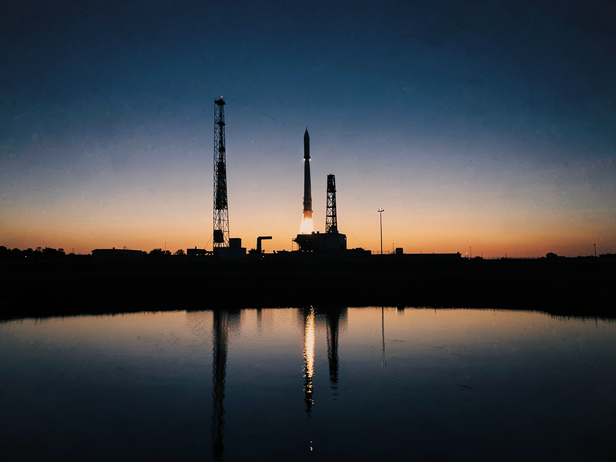
![Rocket Launch Pad at Dusk]()
Rocket Launch Pad at Dusk
Image credit : AI
I observe a rocket launch pad at dusk, the vehicle a silhouette against the sky. The retention pond reflects the scene, showcasing the scale of the launch tower arms.
The Physics Behind the Trade-off
The Tsiolkovsky rocket equation states that the velocity a rocket can achieve depends on its exhaust velocity and the ratio of its initial mass to its final mass. Higher specific impulse means higher exhaust velocity, which means more delta-v for the same amount of propellant. This is why liquid engines dominate upper stages: every kilogram of propellant saved at altitude translates directly into payload capacity.
But the equation also shows that the vehicle needs to shed mass as it burns propellant, which is why staging exists at all. A single-stage vehicle would need to carry enormous propellant reserves, most of which would be dead weight once partially burned. Dropping a spent stage, whether solid or liquid, keeps the mass ratio favourable throughout the flight.
Solid stages are dropped when their propellant is exhausted and they cannot be throttled or restarted anyway. Liquid stages can, in principle, be throttled down and recovered, SpaceX demonstrated this with the Falcon 9 first stage, but recovery adds mass and complexity that not every mission justifies. For most missions, both solid and liquid stages are expended, and the architecture is chosen purely on what each phase of the flight demands.
The combination persists across every major space agency's launcher family because the physics has not changed. Gravity is the same at liftoff as it was for the first orbital rockets. The atmosphere thins at the same rate. The efficiency advantage of cryogenic liquid engines in vacuum is the same number it was when engineers first calculated it. Solid boosters and liquid stages are not a legacy compromise. They are the answer the physics keeps returning.