Hold one finger in front of your face and close each eye in turn. The finger jumps against the background. That jump is parallax, and for three centuries it was the only geometrically honest way to measure how far away a star actually is.
The Geometry Behind the Jump
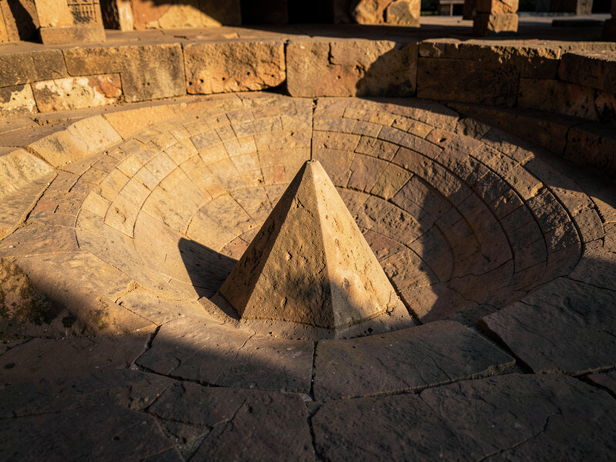
![Jantar Mantar Dawn Shadow]()
Jantar Mantar Dawn Shadow
Image credit : AI
Ancient astronomical instrument's shadow reveals celestial measurement principles, akin to how astronomers measure star distances using parallax.
As Earth orbits the Sun, it moves roughly 300 million kilometres from one side of its path to the other over six months. A nearby star, observed in January and then again in July, appears to shift slightly against the much more distant stars behind it. The angle of that shift, called the parallax angle, is half the total apparent movement. Knowing the baseline, Earth's orbital radius, about 150 million kilometres, and the angle, a straightforward trigonometric calculation gives the distance. No assumptions about the star's brightness, temperature, or age. Just geometry.
Why It Took So Long to Work
Astronomers suspected parallax would work long before they could measure it. Copernicus himself knew that if Earth orbited the Sun, nearby stars should show an annual shift. The problem was that the nearest star beyond the Sun, Proxima Centauri, has a parallax angle of just 0.77 arcseconds, less than one three-thousandth of a degree. For two centuries after Copernicus, no instrument was precise enough to detect it. The first successful stellar parallax measurement came in 1838, when Friedrich Bessel measured the star 61 Cygni and found it lay about 10.3 light-years away. Within months, Thomas Henderson and Friedrich Georg Wilhelm von Struve had measured Alpha Centauri and Vega. Three stars in one year, after centuries of trying.
The Parsec Is Just Parallax Made Into a Unit
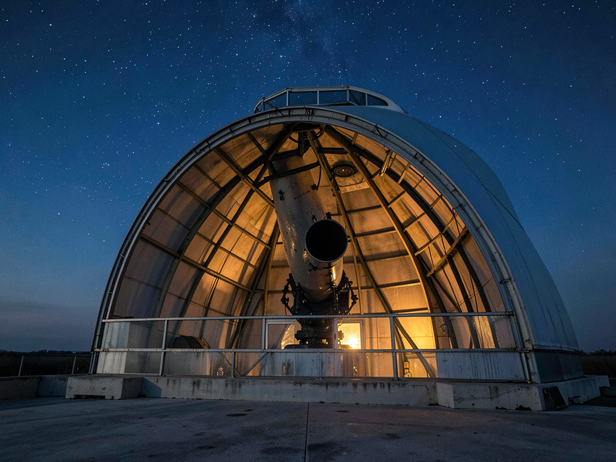
![Observatory Dome Under Pre-Dawn Sky]()
Observatory Dome Under Pre-Dawn Sky
Image credit : AI
Observatory dome reveals a telescope aimed at stars. Understanding stellar parallax explained is key to measuring cosmic distances.
The unit astronomers use most often for stellar distances, the parsec, is defined directly by parallax. One parsec is the distance at which a star would show a parallax angle of exactly one arcsecond. No star is actually that close, but the unit makes the arithmetic clean: a star with a parallax of 0.1 arcseconds is 10 parsecs away. One parsec equals about 3.26 light-years. The parsec is not an arbitrary convention; it is the parallax angle written as a ruler.
Hipparcos and Gaia: Parallax From Space
Ground-based parallax measurements were limited by atmospheric blurring to distances of a few hundred light-years at most. The European Space Agency's Hipparcos satellite, launched in 1989, measured parallax for about 118,000 stars with precision down to a milliarcsecond, extending reliable distances to a few thousand light-years. Its successor, Gaia, launched in 2013 and still operating, has mapped parallax for over a billion stars with precision approaching microarcseconds, one millionth of a degree. Gaia's data release in 2018 gave astronomers a three-dimensional map of a significant portion of the Milky Way, all of it anchored to the same geometric principle Bessel used in 1838. India's astronomical community, including researchers at the Inter-University Centre for Astronomy and Astrophysics in Pune, uses Gaia's catalogue as the baseline for stellar population studies across the galaxy.
The Rung It Holds on the Cosmic Distance Ladder
Parallax matters beyond the stars it can directly reach because it calibrates everything above it. The cosmic distance ladder, the sequence of methods astronomers use to measure distances across the universe, has parallax as its lowest and most secure rung. Cepheid variable stars, whose pulsation period relates to their luminosity, are calibrated against nearby Cepheids whose distances parallax has confirmed. Those calibrated Cepheids then anchor distances to galaxies far beyond any parallax measurement. Type Ia supernovae, used to measure the expansion of the universe and to establish that expansion is accelerating, are calibrated against galaxies whose distances Cepheids established. Every number at the edge of the observable universe traces back, through this chain, to the angular shift of a nearby star against the background sky. The geometry Bessel used to measure 61 Cygni is still holding the whole structure up.