At the spring equinox, just after sunrise, a shaft of light enters the Modhera Sun Temple in Gujarat, passes through a succession of carved doorways, and falls directly onto the sanctum where the Surya idol once stood. The builders who finished this temple in 1026 CE under the Solanki king Bhimdev I did not do this by accident. They were working with a detailed knowledge of the sun's apparent path across the sky, knowledge embedded in the structure so completely that the alignment still functions nearly a thousand years later.
The Geometry Behind the Alignment
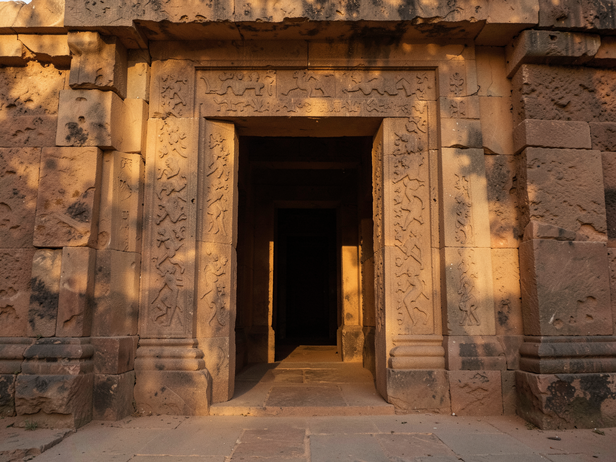
Modhera sits at approximately 23.58 degrees north latitude, just above the Tropic of Cancer. This position is not incidental. At the summer solstice, the sun passes almost directly overhead at the Tropic of Cancer, which lies at 23.5 degrees north. The temple's architects oriented the east-facing sanctum along the true east-west axis, the direction from which the sun rises on both equinoxes, when day and night are of equal length. On those two days each year, the equinoxes in March and September, the sun rises due east and its light travels in a straight line through the sabha mandapa, the gudha mandapa, and into the garbhagriha. The doorways are not merely decorative frames; they are calibrated apertures that funnel and direct the light precisely to the sanctum floor.
![Sunrise Temple Light Shaft]()
Sunrise Temple Light Shaft
Image credit : AI
Sunrise light aligns with ancient Modhera Sun Temple architecture, revealing a sacred interior.
What the Stepped Tank Adds
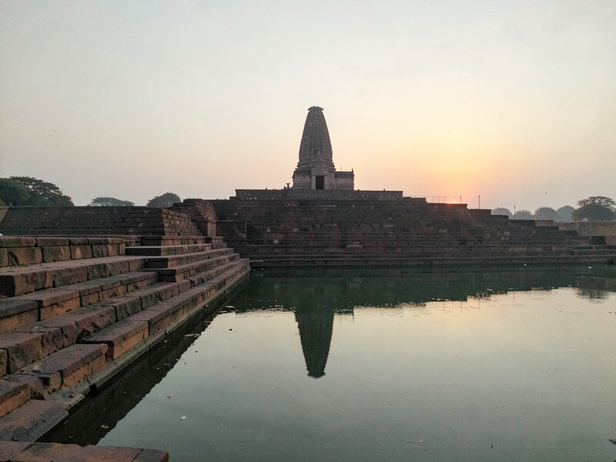
In front of the temple sits the Surya Kund, one of the finest surviving examples of a vav, a stepwell, in India. It is oriented on the same east-west axis as the temple. At the equinoxes, the rising sun is also reflected in the still water of the kund, so the worshipper standing at the tank's western edge sees the sun appear twice: once rising above the horizon and once rising from the water below. This doubling was almost certainly intentional. The kund's 108 smaller shrines, 108 being a number with deep astronomical and religious significance in Hindu tradition, appearing in the distance between the Earth and the Sun measured in solar diameters, are arranged in a grid that also respects the cardinal directions. The geometry of the tank and the geometry of the temple are a single system.
The Solstice Readings
The equinox alignment is the most dramatic, but the temple encodes the solstices as well. At the summer solstice, the sun rises at its northernmost point on the horizon. At the winter solstice, it rises at its southernmost. The Solanki builders placed subsidiary shrines and carved panels on the temple's exterior in positions that receive direct sunlight at these extreme points. The twelve Adityas, the solar deities corresponding to the twelve months, are carved on the outer walls in positions that receive the sun's light sequentially across the year. The temple reads the calendar on its own exterior.
![Ancient Gujarat Stepwell Dawn]()
Ancient Gujarat Stepwell Dawn
Image credit : AI
I capture the Surya Kund stepwell Gujarat at dawn, its ancient architecture reflecting a tranquil sky and temple silhouette.
What Survives and What Doesn't
The Surya idol is gone, removed during the raids of Mahmud of Ghazni in the early eleventh century, though the temple itself was completed after those raids under Bhimdev I. The sanctum is empty. But the alignment does not depend on the idol; it depends on the geometry of the structure, which stands intact. The Archaeological Survey of India has documented the equinox alignments, and they hold. Visitors who arrive at Modhera at dawn on the March or September equinox, roughly the 20th or 21st of each month, can observe the light shaft themselves. Gujarat Tourism now organises the Modhera Dance Festival around the winter solstice, which has brought attention back to the site's astronomical design. The dance festival is a modern addition; the solstice geometry it is staged against is original.
The Knowledge System Behind the Stone
The precision at Modhera was not unique to this temple. It belongs to a broader tradition of astronomical awareness in temple architecture across the subcontinent, documented in the Manasara and the Mayamata, ancient Sanskrit texts on architecture and town planning that specify cardinal orientation as a foundational requirement. The Vedanga Jyotisha, one of the oldest Indian astronomical texts, established methods for tracking the sun's annual movement that predate Modhera by well over a millennium. The builders were not improvising. They were applying a mature observational and mathematical tradition to a specific site, a specific latitude, and a specific patron's commission. The result is a structure that functions as a temple, a calendar, and a demonstration of what careful watching of the sky, over generations, makes possible.