Manali Kallat Vainu Bappu was thirty-one years old when he returned to India in 1953 with a Harvard doctorate and a problem he could not let go: the country had no serious optical observatory of its own. What it had were borrowed time on foreign telescopes, colonial-era instruments pointed at colonial-era questions, and a generation of astronomers who had learned to think big while working small. Bappu decided to fix that, and the place he chose to do it was a granite ridge in the Javadi Hills, about two hundred kilometres southwest of Chennai, where the skies were dark, the seeing was steady, and the land was cheap.
The Man Before the Observatory
Bappu had already made his name before a single stone was laid at Kavalur. Working with William Wilson Morgan at Yerkes Observatory in the early 1950s, he co-discovered what became known as the Wilson-Bappu effect: a precise relationship between the width of a particular calcium emission line in a star's spectrum and the star's absolute luminosity. Because luminosity tells you how bright a star actually is, as opposed to how bright it appears from Earth, the effect gave astronomers a new way to measure stellar distances across the galaxy. It is the kind of discovery that gets a person's name attached to a physical law, and it did. Bappu came home carrying that reputation like a letter of introduction to every funding body he would ever have to convince.
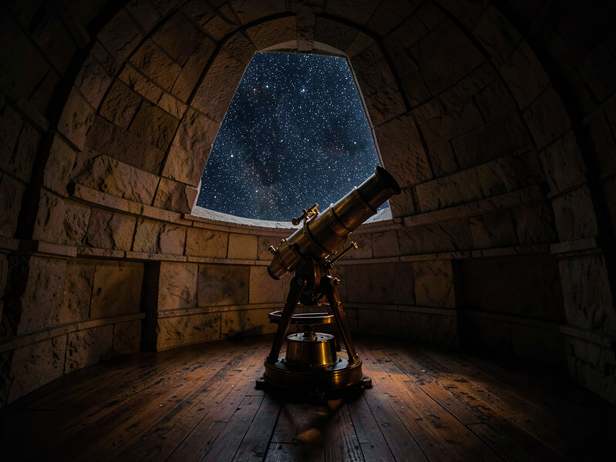
![Vintage Telescope Under Stars]()
Vintage Telescope Under Stars
Image credit : AI
I observe the cosmos through a vintage brass refractor telescope in a stone observatory, a scene reminiscent of the Vainu Bappu Observatory.
Building Kavalur on Almost Nothing
The Vainu Bappu Observatory at Kavalur did not appear quickly. The site was identified in the late 1960s. The access road had to be built first. Then the dome. Then the instruments, some fabricated locally because importing precision optics was expensive and the foreign exchange was not always available. The 102-centimetre reflector telescope came first, followed in 1986 by the 234-centimetre Vainu Bappu Telescope, at the time of its commissioning, the largest optical telescope in Asia. Bappu did not live to see it dedicated in his name; he died in 1982 in Munich, at a meeting of the International Astronomical Union, of which he had been president. He was fifty-eight. The telescope was named for him three years later, and the observatory was renamed in his honour shortly after that.
What Kavalur Actually Found
The science that came out of Kavalur in its active decades was not decorative. The observatory contributed to the discovery of rings around Uranus in 1977, one of the landmark planetary findings of that era, made through careful occultation timing as the planet passed in front of a distant star. Indian astronomers at Kavalur were part of the global network that caught that event. The facility also produced systematic work on stellar chromospheres, variable stars, binary systems, and comets, including observations of Halley's Comet during its 1986 return. For a site built on a shoestring in the Tamil Nadu hills, the output was disproportionate to the budget in the way that tends to happen when the people running an instrument are genuinely motivated by the questions rather than the equipment.
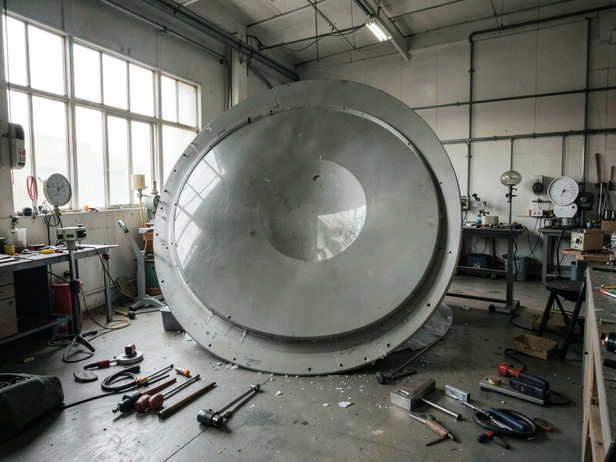
![Giant Telescope Mirror Blank]()
Giant Telescope Mirror Blank
Image credit : AI
I see the raw potential of a giant telescope mirror blank, a crucial component for astronomical discovery, perhaps destined for Kavalur Observatory India.
What Kavalur Meant for Indian Astronomy
The observatory's deeper significance was institutional. Before Kavalur, Indian optical astronomy was largely a guest enterprise, Indian scientists doing good work, but doing it on instruments owned and operated by other nations. Kavalur changed the ownership structure. It demonstrated that Indian engineers could design and build a large telescope mount, that Indian opticians could figure a primary mirror to the required tolerances, and that Indian observers could run a professional programme without supervision from abroad. That proof of concept mattered enormously when ISRO and the Department of Science and Technology began planning what came next: the Indian Astronomical Observatory at Hanle in Ladakh, at 4,500 metres one of the highest optical sites in the world, and eventually the ambitions that fed into the Thirty Metre Telescope consortium, which India joined as a founding partner. Kavalur was not the end of something. It was the demonstration that the end was worth aiming for.
The Observatory Today
The Vainu Bappu Observatory is operated by the Indian Institute of Astrophysics, headquartered in Bengaluru, the institution Bappu himself directed from 1960 until his death. The 234-centimetre telescope is no longer the largest in Asia, China and Japan have since built instruments that dwarf it, but it remains in scientific use, particularly for time-domain work: monitoring objects that change, catching transient events, following up on alerts from space-based observatories. A site that was chosen because the skies above it were dark in the 1960s now has to contend with light pollution creeping in from growing towns in the plains below, a problem Kavalur shares with optical observatories everywhere. The darkness Bappu found in those hills was always finite. What he built inside it has lasted longer than the dark.