Vyommitra will board a Gaganyaan capsule without a crew, strap into the seat a human will eventually occupy, and spend the duration of the flight doing the one thing a sensor array cannot: responding to the spacecraft the way a body does.
Why a humanoid and not just sensors
A pressure transducer tells you the cabin pressure. It cannot tell you whether the oxygen mix at head height differs from the mix at chest height, whether a vibration sequence would disorient a seated person, or whether the seat harness loads the torso in a way that restricts breathing under acceleration. Vyommitra is shaped like a human torso and head precisely because the data that matters is positional and anthropometric. She occupies the volume a crew member occupies. Her sensors read what a crew member's body would read, not what the bulkhead reads.
ISRO built her in collaboration with the Vikram Sarabhai Space Centre. She can monitor cabin pressure, carbon dioxide concentration, and oxygen levels from the seated position. She can detect switches, operate panels, and send back acknowledgement signals, a functional check that the crew interface works as designed, not merely that it is powered. She speaks, in the sense that she can respond to voice commands and report her status, which means the communication loop between capsule and ground control gets a real test rather than a simulated one.
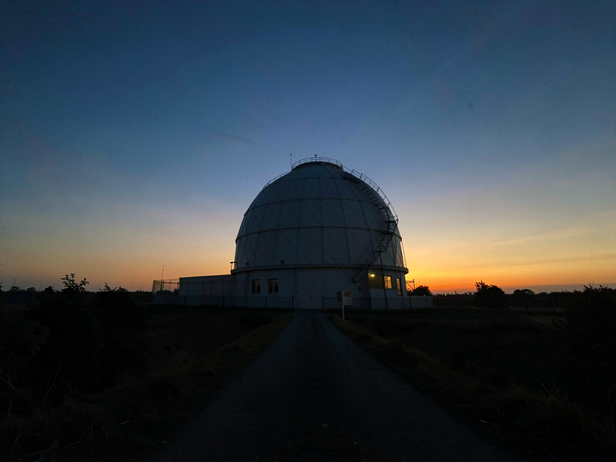
![Observatory at Dusk]()
Observatory at Dusk
Image credit : AI
I observe the cosmos at dusk, a silent sentinel on a narrow road. The ISRO Gaganyaan mission inspires my gaze towards the stars.
What the uncrewed flight is actually testing
The Gaganyaan programme has always been structured around eliminating failure modes before a human enters the loop. The uncrewed orbital mission, designated G1, is not a rehearsal in the theatrical sense. It is a qualification run. Every system that keeps an astronaut alive must demonstrate it works across the full flight envelope: launch loads, the coast phase in orbit, re-entry heating, parachute deployment sequence, and splashdown in the Bay of Bengal.
Vyommitra's role inside that envelope is to generate a continuous physiological-proxy dataset. If cabin pressure drops two minutes into orbit, the sensors on the wall catch it. Vyommitra catches what it would feel like at the position where a person sits. The distinction matters because spacecraft are not uniform environments. Air circulates unevenly. Vibration transmits differently through a seat than through a frame. A human analogue in the seat closes the gap between instrument data and crew experience.
She also operates the life-support panel during the flight. This is not symbolic. The crew interface, the switches, displays, and controls, must be validated under actual flight conditions, not just in a ground test rig. Having Vyommitra interact with the panel means ISRO gets confirmation that the ergonomics work when the capsule is in motion, under load, and in the thermal environment of real spaceflight.
What she cannot do
Vyommitra has no legs. She is designed for a seated, restrained environment and was never intended to move through the capsule. She cannot perform an emergency egress, cannot reposition herself if a system on the opposite side of the cabin needs attention, and cannot make a judgment call that falls outside her programmed response tree. She is a measurement instrument and a panel operator, not a substitute crew member in any operational sense.
This matters because it sets the boundary of what the uncrewed flight proves. G1 will validate the launch vehicle, the capsule's life-support systems, the re-entry trajectory, and the recovery sequence. It will not validate every scenario a crew might face, because Vyommitra cannot improvise. The crewed flights that follow, with Prashanth Balakrishnan Nair, Ajit Krishnan, Angad Pratap, and Shubhanshu Shukla among the astronaut corps, will carry the human judgment that no robot payload can replicate.
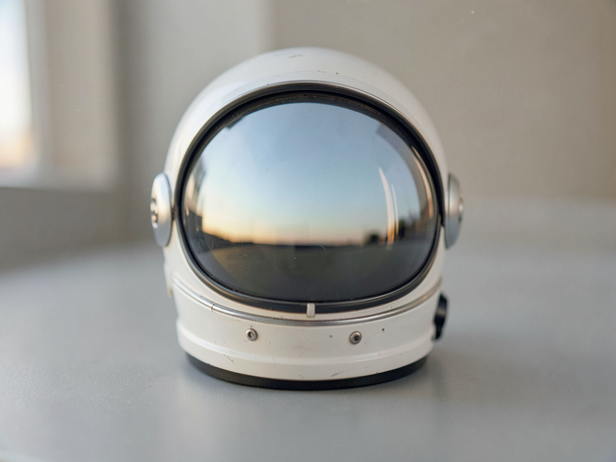
![Astronaut Helmet Reflection]()
Astronaut Helmet Reflection
Image credit : AI
My visor reflects the pale blue sky, a silent sentinel of the ISRO Gaganyaan mission.
The engineering context she sits inside
Gaganyaan's crew module is built to sustain three people for up to seven days in low Earth orbit, at an altitude between 400 and 450 kilometres. The service module carries the propulsion system for orbital manoeuvres and the de-orbit burn. Re-entry is designed to end with a parachute-assisted splashdown, with the Indian Navy conducting recovery operations in the Bay of Bengal, a capability India has not exercised for a crewed mission before.
The Crew Escape System, tested in a pad abort demonstration over Sriharikota in 2023, is the last line of protection if the launch vehicle fails. Vyommitra will fly with that system armed. If it triggers during G1, the data from her sensors during the abort sequence would itself be valuable, the loads, the pressures, the timeline of events as experienced from the crew seat.
Vyommitra is, in that sense, doing what every good test instrument does: she is making the invisible legible. The question Gaganyaan must answer before it carries a person is whether the spacecraft is safe. She is one of the tools ISRO is using to find out.