The festival does not drift. The Gregorian calendar does not drift. What shifts is the relationship between two entirely different ways of counting time, and once you see the machinery, the annual surprise disappears.
Two Calendars, Two Astronomical Clocks
The Gregorian calendar is a solar calendar. Its year is the time Earth takes to complete one orbit of the Sun, approximately 365.25 days. That quarter-day is why a leap day gets added every four years: without it, the calendar would slowly slide against the seasons.
The Nanakshahi calendar, which governs Sikh religious observances, uses a lunisolar system. Its months are defined by the Moon's phases. One lunar month runs from new moon to new moon, averaging 29.53 days. Twelve of those months add up to roughly 354 days, about eleven days shorter than a solar year. That eleven-day gap is the entire explanation for why Guru Nanak Jayanti appears to move.
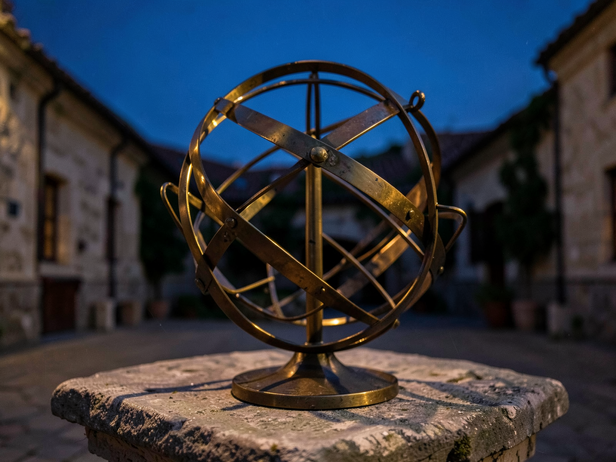
![Brass Armillary Sphere at Dusk]()
Brass Armillary Sphere at Dusk
Image credit : AI
I observe the celestial dance of an armillary sphere, its brass rings catching the last light, a beautiful reminder of how lunisolar calendar India explains festival dates.
The Eleven-Day Drift and the Leap Month
If a purely lunar calendar ran without correction, festivals would migrate backward through the solar year by about eleven days annually. In thirty-three years, a winter festival would have lapped the calendar and returned to winter having passed through every season in between. This is exactly how the Islamic Hijri calendar works, Eid moves through the entire Gregorian year over roughly thirty-three years, by design.
The lunisolar calendars used across South Asia, including the Bikrami calendar that underlies Nanakshahi, handle this differently. They insert an intercalary month, called Adhik Maas or a leap month, approximately every two to three years. The insertion follows a rule derived from the Metonic cycle: nineteen solar years contain almost exactly 235 lunar months. Spread those extra months across nineteen years and the lunar calendar stays broadly anchored to the seasons, never drifting more than a few weeks from its solar position before a correction pulls it back.
Guru Nanak Jayanti is observed on the full moon of the lunar month of Kartik. Because the full moon of Kartik does not fall on the same Gregorian date each year, and because the insertion of a leap month occasionally pushes the entire lunar sequence forward by a month, the festival can land anywhere from late October to late November on the Gregorian calendar.
What the Moon Is Actually Doing
The Moon's orbit is not a perfect circle. It is an ellipse, and the Moon moves faster when it is closer to Earth and slower when it is farther away. This means the time between consecutive full moons is not a fixed 29.53 days, it varies between roughly 29.27 and 29.83 days depending on where the Moon sits in its elliptical path. Calendar makers working with lunar months are therefore working with an average, and averages accumulate small errors that require periodic correction.
The full moon of Kartik is also defined by the Moon reaching opposition, the point at which it sits directly opposite the Sun as seen from Earth, while the Sun is transiting the Gregorian months of October or November. In years when a leap month has been inserted earlier in the lunisolar year, the month of Kartik arrives later in the Gregorian calendar. In years without an insertion, it arrives earlier. The shift between the two extremes can exceed three weeks.
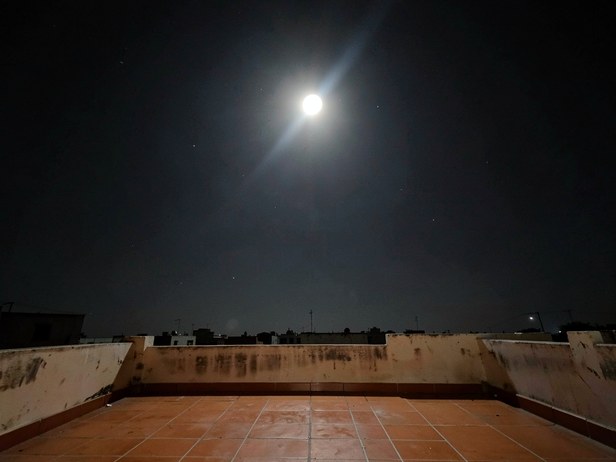
![Moonlit Indian Rooftop Night]()
Moonlit Indian Rooftop Night
Image credit : AI
The full moon shines brightly, a celestial guide. Understanding why Gurpurab shifts each year involves the lunisolar calendar.
Why This Is Not an Error
The movement is sometimes described as the calendar being imprecise or difficult to follow. The opposite is true. A calendar that keeps the full moon of Kartik anchored to the actual full moon of Kartik, rather than to a fixed Gregorian date, is tracking the sky correctly. The Gregorian calendar, for all its administrative convenience, has no relationship to the Moon's phases at all. A date like 23 November carries no lunar information.
The lunisolar system was built to keep religious observances tied to real astronomical events: the actual full moon, the actual position of the Sun in its annual cycle, the actual arrival of seasons. Guru Nanak Jayanti on the full moon of Kartik means the celebration happens under a full moon, every year, without exception. That is the precision the calendar was designed to deliver.
The Gregorian date changes. The Moon does not.