Uranus is the coldest planet in the solar system, colder even than Neptune despite being closer to the Sun. That single fact is a sign that something unusual is happening inside it, and it points directly to why planetary scientists stopped calling Uranus and Neptune small gas giants decades ago and gave them their own category entirely.
The Chemistry That Separates Them
Jupiter and Saturn are composed overwhelmingly of hydrogen and helium. Hydrogen is their dominant ingredient at every depth, from the outer atmosphere down to the metallic hydrogen layer near the core. The gas giant label is accurate in the sense that matters: these planets are made of the same stuff as the Sun, just not hot enough to fuse it.
Uranus and Neptune are not. Their bulk composition is dominated by water, methane, and ammonia, compounds that planetary scientists group under the term ices, though not because they are frozen in the familiar sense. At the pressures and temperatures inside these planets, water and ammonia do not behave like anything in a kitchen. They become dense, electrically conducting fluids. The word ice in this context is a historical term from planetary science, referring to the hydrogen-oxygen, hydrogen-nitrogen, and hydrogen-carbon compounds that condense in the outer solar system. It does not mean cold and solid.
Uranus is roughly 80 percent water, methane, and ammonia by mass. Neptune is similar. Hydrogen and helium are present in their outer atmospheres but are a minority ingredient, not the defining one. That compositional difference is why the ice giant classification exists.
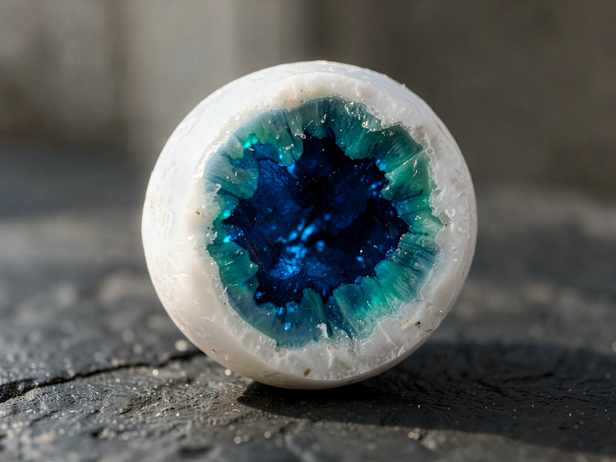
![Geode of Cosmic Ice]()
Geode of Cosmic Ice
Image credit : AI
Exploring the icy depths, reminiscent of Uranus and Neptune's interiors. A geode's heart glows with compressed fluid.
What the Interior Actually Looks Like
Neither Uranus nor Neptune has a surface. What they do have, working inward from the outer atmosphere, is a layered structure that planetary models suggest goes roughly like this: a hydrogen and helium atmosphere giving way to a water-rich mantle that becomes increasingly hot and dense with depth, surrounding a small rocky core.
The mantle is where the term ice giant earns its meaning. At pressures millions of times higher than Earth's surface pressure, water takes on a phase called superionic water, in which oxygen atoms lock into a crystalline lattice while hydrogen ions flow freely through it. This is not liquid, not solid, not gas in any ordinary sense. It conducts electricity. It may be the reason both planets have magnetic fields that are dramatically tilted and offset from their rotational axes, a property that distinguishes them sharply from Jupiter and Saturn, whose magnetic fields align much more closely with their poles.
Uranus's magnetic field is tilted 59 degrees from its rotation axis and offset from the planet's centre by a significant fraction of its radius. Neptune's is tilted 47 degrees and similarly off-centre. Earth's magnetic field wobbles a few degrees. The off-axis, multi-polar magnetic fields of the ice giants are a signature of the unusual conducting fluid layer inside them, not of a metallic hydrogen dynamo like Jupiter's.
The Heat Mystery at Uranus
Neptune radiates about 2.6 times more heat into space than it receives from the Sun. That excess heat is internal, left over from the planet's formation and from ongoing processes in its interior, the same pattern seen in Jupiter and Saturn. Uranus radiates almost no internal heat at all. Its heat output is close to what you would predict from sunlight alone.
This is one of the most unresolved questions in planetary science. One hypothesis is that a layered structure inside Uranus traps heat more effectively than Neptune's interior does, preventing it from escaping. Another is that a giant impact early in the solar system's history tilted Uranus onto its side, it orbits with its rotation axis nearly in the plane of the solar system, and that same impact disrupted the internal convection that would otherwise carry heat outward. No model has yet fully reproduced the observations.
What is clear is that Uranus and Neptune are not simply smaller, colder versions of Jupiter. Their internal heat budgets, their magnetic field geometries, and their bulk compositions place them in a physically distinct category.
![Observatory Under Pre-Dawn Sky]()
Observatory Under Pre-Dawn Sky
Image credit : AI
I watch the stars from the observatory, a radio telescope ready to explore the universe, perhaps even the ice giants.
Why the Distinction Matters for Planetary Science
Most planets detected outside the solar system fall into a size range between Earth and Neptune. Astronomers call them sub-Neptunes or super-Earths depending on where they sit in that range. Whether they are rocky planets with thick atmospheres, water worlds, or true ice giants like Neptune is one of the central questions in exoplanet research. Understanding what Uranus and Neptune are made of, and how their interiors behave, is the baseline for interpreting those distant worlds.
No spacecraft has visited either planet since Voyager 2 flew past Uranus in 1986 and Neptune in 1989. Those flybys gave us most of what we know about both planets directly. A dedicated orbiter mission to Uranus is the top priority in the 2023 to 2032 Planetary Science Decadal Survey from the US National Academies, which recommended a Uranus Orbiter and Probe as the next flagship mission after Mars Sample Return. If it launches in the early 2030s, it would arrive in the 2040s and begin answering questions that Voyager 2 could only raise in passing.
The four planets of the outer solar system are not a gradient from big to small. Jupiter and Saturn belong to one class. Uranus and Neptune belong to another. The ice inside them is not what the word usually means, the cold is not simple, and the magnetic fields point in directions that still require explanation. They are the solar system's least-visited planets and, in many ways, its least understood ones.