India currently operates one of the most active space science programmes on the planet, with ISRO running parallel missions to the Moon, the Sun, and eventually Mars again. The students who will staff those missions, and the observatories and university departments that feed them, are sitting in Class 12 classrooms right now with no clear picture of how to get from a physics textbook to a radio telescope. The path exists. It is just not signposted.
Start With the Right Undergraduate Degree
There is no undergraduate degree called astrophysics at most Indian universities. The entry point is a BSc or BS in Physics, or an integrated MSc in Physics. This is not a detour, it is the actual foundation. Astrophysics at the research level is applied physics and mathematics, and the undergraduate years are where that base is built.
The Indian Institutes of Science Education and Research, IISERs at Pune, Kolkata, Mohali, Bhopal, Thiruvananthapuram, Tirupati, and Berhampur, offer a five-year integrated BS-MS that is widely regarded as the strongest undergraduate science training in the country. IISc Bengaluru offers a four-year BS programme. IIT Bombay, IIT Kharagpur, and IIT Madras have physics departments with active astrophysics research groups at the postgraduate level, and their undergraduate programmes are a legitimate route in.
The entrance exams for these paths are IISER Aptitude Test (IAT), KVPY (now replaced by INSPIRE-SHE and the IISER entrance via board scores and JEE), and JEE Advanced for the IITs. KVPY scholarship holders historically received direct admission to IISERs; check the current admission cycle because the scheme's structure has been revised. The Chennai Mathematical Institute (CMI) and the Tata Institute of Fundamental Research (TIFR) Graduate School run their own entrance exams and are worth tracking separately.
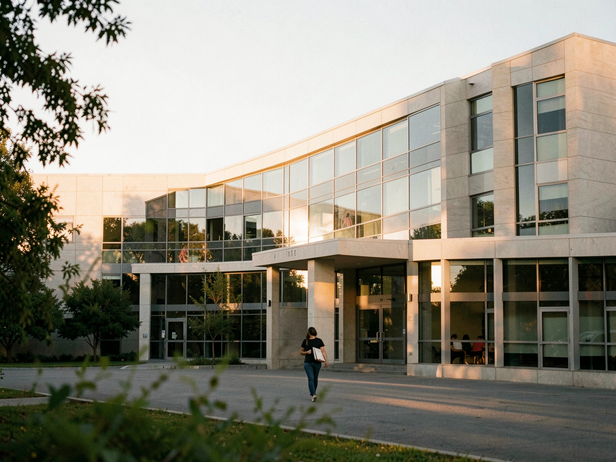
![Dawn at Modern Science Building]()
Dawn at Modern Science Building
Image credit : AI
I approach the science building at dawn, ready to pursue my astrophysics studies in India.
The Institutes That Actually Do Astrophysics Research
Once you have a physics degree, the field opens into specific institutions. Knowing their names and what they work on is not trivia, it shapes which postgraduate programmes to apply to and which research groups to contact.
The Inter-University Centre for Astronomy and Astrophysics (IUCAA) in Pune is the hub of university-level astrophysics in India. It runs graduate programmes, hosts visiting students through its IUCAA Associateship scheme, and its researchers work on gravitational waves, cosmology, and high-energy astrophysics. The Raman Research Institute (RRI) in Bengaluru works on radio astronomy and cosmology. The Indian Institute of Astrophysics (IIA) in Bengaluru operates optical telescopes including the Vainu Bappu Observatory in Kavalur and the Indian Astronomical Observatory at Hanle in Ladakh, one of the highest optical observatories in the world at roughly 4,500 metres. The National Centre for Radio Astrophysics (NCRA) in Pune runs the Giant Metrewave Radio Telescope (GMRT) near Khodad, a facility used by researchers from across the world. TIFR in Mumbai has a Department of Astronomy and Astrophysics that covers everything from X-ray binaries to the cosmic microwave background.
ISRO itself, with centres at Bengaluru, Thiruvananthapuram, Ahmedabad, and elsewhere, recruits scientists and engineers, but the route there typically runs through an engineering degree or a physics PhD rather than directly from a BSc.
The Exam That Opens the Postgraduate Door: JEST
The Joint Entrance Screening Test (JEST) is the central exam for MSc and PhD admissions across most of these institutes. It is held once a year, typically in February, and a single score is accepted by IUCAA, RRI, IIA, NCRA, TIFR, IMSc Chennai, and several others. The syllabus covers classical mechanics, electrodynamics, quantum mechanics, statistical mechanics, and mathematical physics, the full undergraduate physics curriculum, tested at depth.
GATE Physics is the other route, accepted by some universities and by CSIR-funded positions. The CSIR-UGC NET in Physical Sciences is the third major exam, relevant for those aiming at lectureships or fellowships at universities rather than the dedicated research institutes.
Preparing for JEST without a strong undergraduate foundation is genuinely difficult. The exam does not test memory, it tests whether you can apply the concepts under time pressure. Students who perform well consistently report working through Irodov, Griffiths, and past JEST papers over 18 to 24 months of focused preparation.
![Physics Study Scene]()
Physics Study Scene
Image credit : AI
I prepare for my astrophysics studies in India, focusing on the IUCAA JEST exam.
What a Realistic Timeline Looks Like
A student who clears Class 12 with strong physics and mathematics, secures admission to an IISER or IIT, completes the five-year integrated programme, clears JEST, and joins a PhD programme at IUCAA or NCRA will spend roughly ten to eleven years between Class 12 and the start of an independent research career. That is not a discouraging number, it is an honest one, and it matches the timelines in most countries with active astrophysics communities.
PhD fellowships at TIFR, IUCAA, and NCRA are funded. Students receive a monthly stipend, the Junior Research Fellowship rate set by CSIR, revised periodically, and are not expected to pay tuition. The financial picture for a PhD in astrophysics at a central institute is therefore considerably different from a self-funded postgraduate degree in many other fields.
Short-term entry points exist for students still in their undergraduate years. The IUCAA Vacation Students Programme takes students for six-week research stints. The Indian Academy of Sciences runs a Summer Research Fellowship Programme. ISRO's RESPOND programme funds university research projects. These are not shortcuts to a career, but they are how students figure out whether research is what they actually want before committing to a decade of it.
The Honest Constraints
Seats at the top institutes are few. IUCAA admits a small cohort of PhD students each year. NCRA's intake is similarly limited. Competition at the JEST level is real, and clearing the exam does not guarantee a position, institutes conduct interviews after the written test, and the final selection depends on research fit as much as score.
Geography matters more than it should. The major astrophysics institutes are concentrated in Pune, Bengaluru, and Mumbai. Students from smaller cities without access to strong undergraduate physics departments face a steeper preparation curve, not because the material is different, but because peer groups, faculty mentorship, and access to research problems during the undergraduate years vary significantly by institution.
The field is also genuinely narrow in terms of faculty positions. A PhD in astrophysics from TIFR opens doors in data science, quantitative finance, and technology in addition to academia, the analytical and computational skills transfer, but if the goal is a faculty position at an Indian research institute, the number of openings in any given year is small and the competition is international.
India's space science infrastructure is expanding. The Thirty Metre Telescope consortium includes India as a partner. Gaganyaan will eventually carry Indian astronauts to orbit. The Square Kilometre Array has Indian participation through NCRA. The students entering undergraduate physics programmes now will work on instruments and missions that do not yet have names. The path to that work is not glamorous in its early stages, it is years of mechanics and electrodynamics and problem sets, but it is a real path, and it is open.